The Ford Mustang Convertible V (facelift 2012): An Enduring American Icon
The Ford Mustang stands as a quintessential symbol of American automotive prowess and freedom, a legacy that continued with the fifth generation (S197) model. Specifically, the Ford Mustang Convertible V (facelift 2012) represented a significant update to this iconic pony car, offering a blend of classic styling, modern performance, and open-air driving excitement. Produced from 2012 to 2014, this iteration of the Mustang Convertible with the 3.7-liter V6 engine and automatic transmission carved out a crucial niche in the market, providing an accessible yet potent entry point into the Mustang experience without sacrificing much of the visual appeal or driving dynamics that define the brand.
Positioned within the highly competitive American pony car segment, the 2012 facelift brought refreshed aesthetics and technological refinements to the S197 platform, which had originally debuted for the 2005 model year. This particular variant, the V6-powered convertible, appealed to a broad demographic, from enthusiasts seeking an affordable performance machine to those simply desiring a stylish and comfortable cruiser for weekend getaways. It embodied Ford’s commitment to evolving the Mustang while staying true to its heritage, offering a compelling package of power, design, and a distinctly American driving character.
Engine and Performance: The Modern V6 in the Ford Mustang Convertible V (facelift 2012)
Under the hood of the Ford Mustang Convertible V (facelift 2012) lay a powerplant that dramatically redefined the entry-level Mustang’s performance credentials: the 3.7-liter (3731 cm3 or 227.68 cu. in.) Duratec 37 V6 engine. This naturally aspirated, all-aluminum V6 was a far cry from the less inspiring V6 engines of previous Mustang generations. Boasting an impressive 305 horsepower at 6500 rpm and 280.27 lb.-ft. (380 Nm) of torque at 4250 rpm, this engine delivered robust acceleration and a lively character that could genuinely excite. Its specific output of 81.7 horsepower per liter underscored its modern design and efficiency.
The Duratec 37 engine featured a sophisticated valvetrain with Dual Overhead Cams (DOHC) and Twin Independent Variable Cam Timing (Ti-VCT). This advanced technology allowed for precise control over valve overlap, optimizing both power delivery across the rev range and fuel efficiency. With a compression ratio of 10.5:1 and a multi-port manifold injection system, the V6 was designed for responsiveness and smooth operation, capable of revving cleanly up to a maximum engine speed of 7000 rpm.
Power was delivered to the rear wheels via a smooth and responsive 6-speed automatic transmission. This gearbox was well-matched to the V6’s powerband, providing seamless shifts and contributing to both spirited driving and comfortable cruising. The drivetrain architecture, with its front-longitudinal engine layout and rear-wheel drive, maintained the classic Mustang formula, offering balanced dynamics inherent to a sports car. The vehicle’s weight-to-power ratio of 5.4 kg/Hp (184.1 Hp/tonne) and a weight-to-torque ratio of 4.4 kg/Nm (229.3 Nm/tonne) highlighted its strong performance capabilities for its class.
Despite its significant power output, the 3.7 V6 also offered respectable fuel economy for a powerful convertible. It achieved an estimated 19 US mpg in urban driving, 30.2 US mpg on the highway, and a combined average of 23.1 US mpg. These figures represented a substantial improvement over previous V6 Mustangs, making it a more viable daily driver for many consumers.
Design and Features: Open-Air American Styling
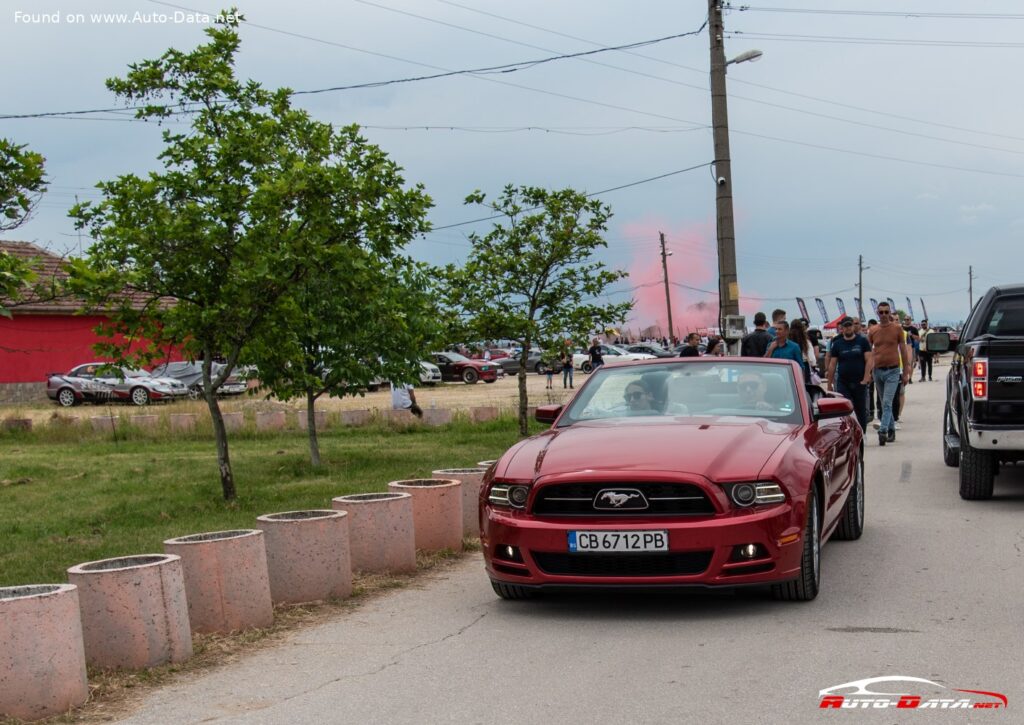
The Ford Mustang Convertible V (facelift 2012) retained the iconic long hood, short deck proportions that have defined the Mustang for decades, while incorporating a series of tasteful updates. As a two-door cabriolet with seating for four, it offered the allure of open-air motoring combined with practical seating for occasional rear passengers. The facelift introduced more aggressive styling cues, including a revised front fascia with a larger grille, updated headlights, and a more prominent power dome on the hood, giving it a more assertive stance.
At the rear, the updates included new LED taillights with sequential turn signals, a signature Mustang feature, and a revised lower valance. These design enhancements helped keep the S197 platform looking fresh and competitive against its contemporaries. The convertible’s power-operated soft top could be lowered or raised with ease, transforming the car from a sleek coupe-like profile to an exhilarating open-top cruiser.
The chassis and suspension were designed to balance ride comfort with sporty handling. The front featured an independent MacPherson strut setup with a transverse stabilizer, while the rear utilized a robust rigid axle suspension with coil springs and a transverse stabilizer. While some enthusiasts yearned for independent rear suspension, the solid axle was part of the Mustang’s heritage and, in this updated form, provided predictable handling characteristics. Braking duties were handled by ventilated discs all around: 316×30 mm (12.44×1.18 in.) at the front and 300×19 mm (11.81×0.75 in.) at the rear, complemented by an Anti-lock Braking System (ABS) for enhanced safety and control. Steering was managed by an electric power-assisted rack and pinion system, offering improved feel and efficiency over hydraulic setups.
The Mustang Convertible came with tire options including 215/65 R17 on 7J x 17 wheels or wider 235/50 R18 tires on 8J x 18 wheels, providing a good balance of grip and ride quality. With a length of 188.5 inches, a width of 73.9 inches (80.12 inches including mirrors), and a height of 55.79 inches, the Mustang Convertible commanded a significant road presence. Its wheelbase of 107.09 inches contributed to a stable ride, while a turning circle of 33.46 feet (10.2 meters) ensured reasonable maneuverability.
Inside, the cabin offered a classic dual-cowl dashboard design, evoking Mustangs of the past, but with updated materials and technology for the era. Standard features would have included air conditioning, power windows, and a decent audio system, with options for upgraded infotainment and comfort features. The trunk offered 9.61 cu. ft. (272 liters) of storage, which was respectable for a convertible, allowing for weekend luggage or groceries.
Technical Specifications
| Category | Specification | US Equivalent (Approx.) |
|---|---|---|
General Information |
||
| Brand | Ford | |
| Model | Mustang | |
| Generation | Mustang Convertible V (facelift 2012) | |
| Type (Engine) | 3.7 V6 (305 Hp) Automatic | |
| Start of production | 2012 year | |
| End of production | 2014 year | |
| Powertrain Architecture | Internal Combustion engine | |
| Body type | Cabriolet | |
| Seats | 4 | |
| Doors | 2 | |
Performance Specs |
||
| Fuel consumption (economy) – urban | 12.4 l/100 km | 19 US mpg |
| Fuel consumption (economy) – extra urban | 7.8 l/100 km | 30.2 US mpg |
| Fuel consumption (economy) – combined | 10.2 l/100 km | 23.1 US mpg |
| Fuel Type | Petrol (Gasoline) | |
| Weight-to-power ratio | 5.4 kg/Hp | 11.9 lbs/Hp |
| Weight-to-torque ratio | 4.4 kg/Nm | 9.7 lbs/Nm |
Engine Specs |
||
| Power | 305 Hp @ 6500 rpm | 305 Hp @ 6500 rpm |
| Power per litre | 81.7 Hp/l | |
| Torque | 380 Nm @ 4250 rpm | 280.27 lb.-ft. @ 4250 rpm |
| Maximum engine speed | 7000 rpm | |
| Engine layout | Front, Longitudinal | |
| Engine Model/Code | Duratec 37 | |
| Engine displacement | 3731 cm3 | 227.68 cu. in. (3.7 Liters) |
| Number of cylinders | 6 | |
| Engine configuration | V-engine | |
| Cylinder Bore | 95.5 mm | 3.76 in. |
| Piston Stroke | 86.7 mm | 3.41 in. |
| Compression ratio | 10.5:1 | |
| Number of valves per cylinder | 4 | |
| Fuel injection system | Multi-port manifold injection | |
| Engine aspiration | Naturally aspirated engine | |
| Valvetrain | DOHC, Ti-VCT | |
| Engine oil capacity | 5.7 l | 6.02 US qt |
| Coolant | 11.7 l | 12.36 US qt |
Space, Volume and Weights |
||
| Kerb Weight | 1657 kg | 3653.06 lbs. |
| Trunk (boot) space – minimum | 272 l | 9.61 cu. ft. |
| Fuel tank capacity | 61 l | 16.11 US gal |
| Permitted trailer load with brakes (12%) | 454 kg | 1000.9 lbs. |
Dimensions |
||
| Length | 4788 mm | 188.5 in. |
| Width | 1877 mm | 73.9 in. |
| Width including mirrors | 2035 mm | 80.12 in. |
| Height | 1417 mm | 55.79 in. |
| Wheelbase | 2720 mm | 107.09 in. |
| Front track | 1575 mm | 62.01 in. |
| Rear (Back) track | 1598 mm | 62.91 in. |
| Minimum turning circle (turning diameter) | 10.2 m | 33.46 ft. |
Drivetrain, Brakes and Suspension Specs |
||
| Drivetrain Architecture | The Internal combustion engine (ICE) drives the rear wheels of the vehicle. | |
| Drive wheel | Rear wheel drive | |
| Number of gears and type of gearbox | 6 gears, automatic transmission | |
| Front suspension | Independent type McPherson, Transverse stabilizer | |
| Rear suspension | Rigid axle suspension, Transverse stabilizer, Coil spring | |
| Front brakes | Ventilated discs, 316×30 mm | Ventilated discs, 12.44×1.18 in. |
| Rear brakes | Ventilated discs, 300×19 mm | Ventilated discs, 11.81×0.75 in. |
| Assisting systems | ABS (Anti-lock braking system) | |
| Steering type | Steering rack and pinion | |
| Power steering | Electric Steering | |
| Tires size | 215/65 R17; 235/50 R18 | |
| Wheel rims size | 7J x 17; 8J x 18 | |
Legacy and Market Impact
The Ford Mustang Convertible V (facelift 2012), particularly with the 3.7-liter V6 engine, played a pivotal role in solidifying the Mustang’s position in the modern automotive landscape. Prior to the 2011 model year, the V6 Mustang was often seen as a compromise, lacking the performance punch of its V8 GT sibling. However, with the introduction of the 305-horsepower Duratec 37, the V6 variant transformed into a genuinely potent and desirable option.
This V6 Mustang offered a compelling alternative to its primary competitors, such as the Chevrolet Camaro V6 and the Dodge Challenger V6. While the Camaro and Challenger also offered strong V6 options, the Mustang’s blend of classic styling, improved dynamics, and the appeal of open-top driving made it a perennial favorite. It successfully broadened the Mustang’s appeal, attracting buyers who desired the iconic styling and rear-wheel-drive dynamics without the higher purchase price, insurance costs, or fuel consumption associated with the V8 models.
The 2012 facelift, with its visual updates and continued mechanical improvements, ensured the S197 Mustang remained fresh and competitive until the introduction of the sixth-generation S550 model. The V6 convertible’s reputation was built on its ability to deliver an engaging driving experience, whether cruising down a coastal highway or tackling winding backroads. It provided a sense of freedom and excitement that few other cars in its price range could match, cementing its status as an aspirational yet attainable sports car.
Ultimately, the Ford Mustang Convertible V (facelift 2012) 3.7 V6 Automatic stands as a testament to Ford’s ability to innovate while respecting tradition. It delivered a significant upgrade in performance and efficiency for its segment, making the entry-level Mustang a truly respectable and enjoyable vehicle. Its legacy endures as a celebrated chapter in the Mustang’s storied history, representing a period when the V6 Mustang truly came into its own as a formidable and desirable American icon.