Introduction to the Ford Mustang Convertible V (facelift 2009) GT 4.6 V8 Automatic
The Ford Mustang, an enduring icon of American automotive culture, entered its fifth generation (S197) in 2005, ushering in a retro-futuristic design that paid homage to its legendary forebears. By 2009, Ford introduced a significant facelift to this generation, refining both its aesthetics and mechanicals. Among the most popular and evocative variants was the Ford Mustang Convertible V (facelift 2009) GT 4.6 V8 Automatic, a vehicle that perfectly encapsulated the spirit of open-air American performance. This refreshed model, produced from 2009 to 2010, continued the Mustang’s legacy as an accessible yet potent pony car, offering a compelling blend of classic styling, modern amenities, and a roaring V8 soundtrack.
Designed primarily for the North American market, this Mustang Convertible GT variant represented the pinnacle of mainstream performance for the S197 at the time. It combined the visceral thrill of a naturally aspirated V8 engine with the convenience of an automatic transmission and the undeniable appeal of a convertible body style. The 2009 facelift brought subtle yet impactful changes, ensuring the Mustang remained competitive and visually fresh, cementing its position as a beloved choice for enthusiasts and casual drivers alike seeking a slice of American motoring heritage.
Powertrain and Performance of the Ford Mustang Convertible V (facelift 2009) GT 4.6 V8 Automatic
At the heart of the Ford Mustang Convertible V (facelift 2009) GT 4.6 V8 Automatic was Ford’s venerable 4.6-liter “Modular” V8 engine. This powerplant, known for its robust construction and smooth power delivery, was a staple in many Ford vehicles. For the 2009 GT, it produced a healthy 315 horsepower at 6000 rpm and a substantial 325.26 lb.-ft. (441 Nm) of torque peaking at 4250 rpm. This naturally aspirated, SOHC (Single Overhead Camshaft) engine featured three valves per cylinder and a multi-port manifold injection system, allowing for efficient fuel delivery and a broad power band.
With an engine displacement of 4601 cm3 (280.77 cu. in.) and a compression ratio of 9.8:1, the V8 delivered a satisfying surge of power, characteristic of American muscle cars. The engine’s layout was front, longitudinal, driving the rear wheels, a classic configuration that provided balanced handling dynamics and a traditional performance feel. Mated to this robust V8 was a 5-speed automatic transmission, offering smooth and responsive shifts that catered to both spirited driving and comfortable cruising. While some purists might prefer a manual, the automatic option broadened the Mustang’s appeal, making its performance accessible to a wider audience.
Fuel economy figures for this V8 convertible were, as expected, aligned with its performance-oriented nature. It achieved an estimated 17 US mpg (13.8 l/100 km) in urban driving conditions and a more efficient 23.1 US mpg (10.2 l/100 km) on the highway. With a 16.11 US gallon (61 liter) fuel tank, the Mustang GT Convertible offered a reasonable cruising range, making it suitable for weekend getaways and scenic drives. The maximum engine speed of 6250 rpm allowed for exhilarating acceleration, complemented by the unmistakable rumble of its V8 exhaust note, a signature element of the Mustang experience.
Design Evolution and Key Features
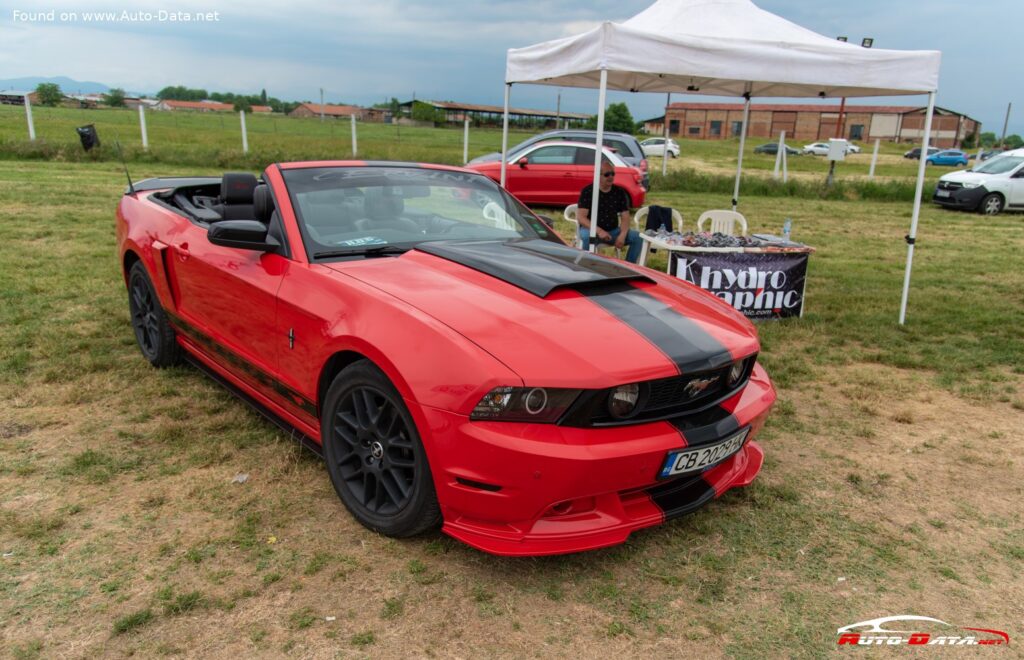
The 2009 facelift of the Ford Mustang V Convertible retained the core retro-futuristic styling that defined the S197 generation while introducing subtle yet impactful refinements. The body type remained a classic 2-door, 4-seat cabriolet, exuding timeless appeal. Externally, the facelift brought revised front and rear fascias, including new headlights, a more aggressive grille, and updated taillights, giving the car a more modern and assertive stance. The elongated hood, short deck, and muscular haunches were all present, faithfully echoing the original 1960s Mustang design language.
Inside, the Mustang GT Convertible offered a driver-focused cockpit. While the data does not detail interior specifics, the S197 facelift generally introduced improved materials and updated infotainment options for its era, enhancing comfort and usability. The convertible top, a key feature of this specific model, provided an open-air driving experience, transforming the car from a sleek coupe to a sun-drenched cruiser at the touch of a button, perfect for enjoying coastal roads or scenic routes.
In terms of chassis and safety, the 2009 model was equipped with a robust set of features. The front suspension utilized an independent McPherson type with a transverse stabilizer, providing precise steering and good road holding. The rear, in keeping with traditional Mustang engineering, featured a rigid axle suspension with coil springs and a transverse stabilizer, a setup known for its durability and ability to handle significant power. Stopping power was provided by ventilated disc brakes on both the front (316×30 mm) and rear (300×19 mm) axles, aided by an Anti-lock Braking System (ABS) for enhanced control during emergency braking. The hydraulic power steering, a rack and pinion system, offered direct feedback and a connected feel to the road. The car rode on 235/50 R18 tires with 8J x 18 wheels as standard, with an option for 245/45 R19 tires on 8.5J x 19 rims, further enhancing its visual appeal and grip.
Technical Specifications
| Category | Specification |
|---|---|
| General Information | |
| Brand | Ford |
| Model | Mustang |
| Generation | Mustang Convertible V (facelift 2009) |
| Type (Engine) | GT 4.6 V8 (315 Hp) Automatic |
| Start of Production | 2009 year |
| End of Production | 2010 year |
| Powertrain Architecture | Internal Combustion engine |
| Body type | Cabriolet |
| Seats | 4 |
| Doors | 2 |
| Performance Specs | |
| Fuel Consumption (Economy) – Urban | 13.8 l/100 km (17 US mpg) |
| Fuel Consumption (Economy) – Extra Urban | 10.2 l/100 km (23.1 US mpg) |
| Fuel Type | Gasoline |
| Power | 315 Hp @ 6000 rpm |
| Power per liter | 68.5 Hp/l |
| Torque | 441 Nm @ 4250 rpm (325.26 lb.-ft. @ 4250 rpm) |
| Maximum Engine Speed | 6250 rpm |
| Engine Specs | |
| Engine Layout | Front, Longitudinal |
| Engine Model/Code | Modular |
| Engine Displacement | 4601 cm3 (280.77 cu. in.) |
| Number of Cylinders | 8 |
| Engine Configuration | V-engine |
| Cylinder Bore | 90.2 mm (3.55 in.) |
| Piston Stroke | 90 mm (3.54 in.) |
| Compression Ratio | 9.8:1 |
| Number of Valves per Cylinder | 3 |
| Fuel Injection System | Multi-port manifold injection |
| Engine Aspiration | Naturally aspirated engine |
| Valvetrain | SOHC |
| Engine Oil Capacity | 5.7 l (6.02 US qt) |
| Coolant Capacity | 12.9 l (13.63 US qt) |
| Space, Volume and Weights | |
| Trunk (Boot) Space – Minimum | 272 l (9.61 cu. ft.) |
| Fuel Tank Capacity | 61 l (16.11 US gal) |
| Permitted Trailer Load with Brakes (12%) | 454 kg (1000.9 lbs.) |
| Dimensions | |
| Length | 4778 mm (188.11 in.) |
| Width | 1877 mm (73.9 in.) |
| Width Including Mirrors | 2035 mm (80.12 in.) |
| Height | 1425 mm (56.1 in.) |
| Wheelbase | 2720 mm (107.09 in.) |
| Front Track | 1582 mm (62.28 in.) |
| Rear (Back) Track | 1598 mm (62.91 in.) |
| Minimum Turning Circle (Turning Diameter) | 11.5 m (37.73 ft.) |
| Drivetrain, Brakes and Suspension Specs | |
| Drivetrain Architecture | Internal combustion engine (ICE) drives the rear wheels of the vehicle. |
| Drive Wheel | Rear wheel drive |
| Number of Gears and Type of Gearbox | 5 gears, automatic transmission |
| Front Suspension | Independent type McPherson, Transverse stabilizer |
| Rear Suspension | Rigid axle suspension, Transverse stabilizer, Coil spring |
| Front Brakes | Ventilated discs, 316×30 mm |
| Rear Brakes | Ventilated discs, 300×19 mm |
| Assisting Systems | ABS (Anti-lock braking system) |
| Steering Type | Steering rack and pinion |
| Power Steering | Hydraulic Steering |
| Tires Size | 235/50 R18; 245/45 R19 |
| Wheel Rims Size | 8J x 18; 8.5J x 19 |
Legacy and Market Impact of the Ford Mustang Convertible V (facelift 2009)
The Ford Mustang has always held a special place in the hearts of American enthusiasts, and the fifth-generation facelift, including the Ford Mustang Convertible V (facelift 2009) GT 4.6 V8 Automatic, continued to strengthen this bond. During its production run from 2009 to 2010, this model stood as a testament to Ford’s commitment to delivering an authentic pony car experience. It successfully balanced modern engineering with nostalgic design cues, appealing to both seasoned Mustang fans and a new generation of drivers seeking a powerful and stylish convertible.
In the North American market, the Mustang GT Convertible faced direct competition from its perennial rival, the Chevrolet Camaro, which had recently been reintroduced in 2010, and the Dodge Challenger, another retro-inspired muscle car. However, the Mustang, particularly in its GT V8 guise, carved out its niche by offering a compelling blend of performance, heritage, and value. Its relatively accessible price point, combined with the emotional appeal of its V8 engine and convertible top, made it a popular choice for those looking for a fun-to-drive, head-turning vehicle.
The 2009 facelift models are remembered for their slightly more aggressive styling and refined driving dynamics compared to the earlier S197 cars. The 4.6-liter V8, while not the most powerful engine in the Mustang’s storied history, delivered a satisfying and engaging driving experience, characteristic of the brand. Its hydraulic power steering and solid rear axle, while sometimes criticized for not being as technologically advanced as some European rivals, contributed to a raw, engaging feel that many Mustang purists cherished.
Ultimately, the Ford Mustang Convertible V (facelift 2009) GT 4.6 V8 Automatic solidified the S197 generation’s reputation as a successful modern interpretation of a classic. It upheld the Mustang’s legacy of delivering strong performance, iconic style, and open-air freedom, ensuring its continued relevance and desirability in the competitive American performance car segment. Even today, these models remain popular on the used car market, a testament to their enduring appeal and the timeless allure of the Mustang badge.