The Ford Mustang Convertible V (facelift 2009) GT 5.0 V8 (412 Hp): A Modern Classic Reborn
The Ford Mustang, an icon of American automotive culture, entered its fifth generation (S197) in 2005, ushering in a retro-futuristic design that paid homage to its legendary predecessors. The model undergoing a significant refresh for the 2010 model year, known as the Ford Mustang Convertible V (facelift 2009) GT 5.0 V8 (412 Hp), marked a pivotal moment in the pony car’s history with the triumphant return of the revered “5.0” V8 engine. This particular iteration, produced from 2010 to 2012, combined classic Mustang aesthetics with a thoroughly modern powertrain, cementing its status as a high-performance, open-top muscle car in the fiercely competitive American market. Positioned as the top-tier GT convertible, it offered an intoxicating blend of performance, style, and the unmistakable rumble of a naturally aspirated V8.
Engine and Performance: The Return of the Coyote 5.0
At the heart of the Ford Mustang Convertible V (facelift 2009) GT lies its most significant upgrade: the all-new “Coyote” 5.0-liter V8 engine. This powertrain architecture represented a substantial leap forward for the Mustang, replacing the previous 4.6-liter modular V8 with a thoroughly modern, high-revving unit. The 4,951 cubic centimeter (302.13 cu. in.) engine, code-named Coyote, featured an advanced DOHC (Double Overhead Camshaft) design with Ti-VCT (Twin Independent Variable Cam Timing), allowing for precise control over valve timing for optimal performance and efficiency across the rev range.
With a robust 412 horsepower delivered at 6,500 rpm and a peak torque of 390.17 lb.-ft. (529 Nm) available at 4,250 rpm, the Coyote V8 provided exhilarating acceleration and a broad powerband. Its impressive power-per-liter figure of 83.2 Hp/l underscored its engineering prowess, especially for a naturally aspirated unit. The engine’s high 11:1 compression ratio and multi-port manifold injection system further contributed to its responsiveness and potent output, with a maximum engine speed of 7,000 rpm.
Power was exclusively sent to the rear wheels via a crisp-shifting 6-speed manual transmission, offering an engaging and direct driving experience characteristic of traditional American muscle cars. This drivetrain architecture, combined with a curb weight of 3,719.2 lbs (1,687 kg), resulted in an impressive weight-to-power ratio of 4.1 kg/Hp (244.2 Hp/tonne), highlighting the car’s strong performance capabilities.
Fuel economy, while not the primary concern for a performance convertible, was respectable for its class. The combined fuel consumption was rated at 19.9 US mpg (11.8 l/100 km), with urban figures around 17 US mpg (13.8 l/100 km) and extra-urban cruising achieving approximately 26.1 US mpg (9 l/100 km). This blend of power and reasonable efficiency made the GT 5.0 a compelling package for enthusiasts.
Design and Features: Iconic Looks with Modern Touches
Exterior and Body Type
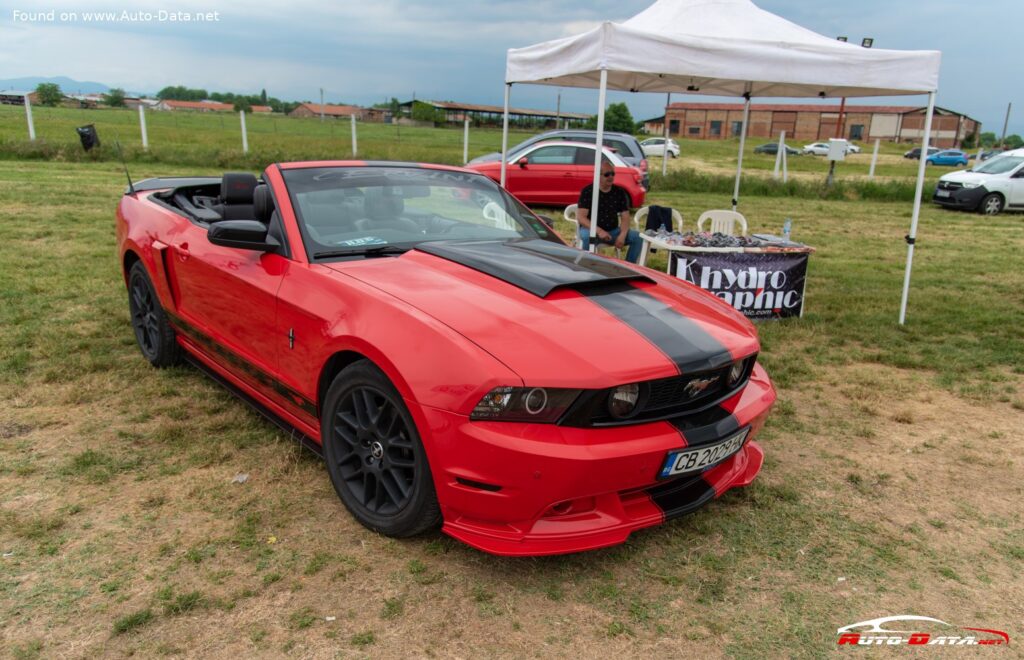
The 2010 facelift brought subtle yet effective styling updates to the S197 generation, making the Ford Mustang Convertible V (facelift 2009) appear more aggressive and contemporary while retaining its quintessential Mustang identity. The convertible body style, a timeless choice for the Mustang, offered a two-door configuration with seating for four occupants, blending the thrill of open-air motoring with practical usability. Key exterior changes included a revised front fascia with a larger grille and more prominent power dome hood, new headlights with integrated turn signals, and a restyled rear end featuring sequential LED taillights, a nod to classic Mustang design.
Dimensionally, the vehicle measured 188.11 inches (4778 mm) in length, 73.9 inches (1877 mm) in width (80.12 inches or 2035 mm including mirrors), and 55.79 inches (1417 mm) in height. Its wheelbase of 107.09 inches (2720 mm) contributed to a stable stance. The car rolled on stylish 18-inch wheels (8J x 18) with 235/50 R18 tires as standard, with an option for larger 19-inch wheels (8.5J x 19) and 245/45 R19 tires, enhancing both aesthetics and grip.
Chassis, Brakes, and Assisting Systems
The chassis of the Mustang GT 5.0 Convertible was engineered to handle its increased power output. The front suspension utilized an independent McPherson strut design with a transverse stabilizer bar, providing precise steering and handling. The rear, however, maintained a rigid axle suspension with coil springs and a transverse stabilizer, a characteristic design choice for the Mustang that offered durability and excellent straight-line performance, albeit with some compromises in more demanding cornering compared to fully independent setups.
Braking performance was handled by ventilated discs at both the front (336×36 mm) and rear (300×19 mm), providing ample stopping power for the spirited convertible. An Anti-lock Braking System (ABS) was standard, enhancing safety under hard braking. The electric power steering system, a modern addition, offered variable assist for easier maneuverability at low speeds and a firmer feel at higher velocities, contributing to a more refined driving experience.
Despite its performance focus, the car also offered practical elements, including a minimum trunk space of 9.61 cu. ft. (272 liters) and a fuel tank capacity of 16.11 US gallons (61 liters), providing a decent range for road trips. It even had a permitted trailer load with brakes of 1000.9 lbs (454 kg), though towing was unlikely to be a primary use case.
Technical Specifications
| Category | Specification |
|---|---|
| General Information | |
| Brand | Ford |
| Model | Mustang |
| Generation | Mustang Convertible V (facelift 2009) |
| Type (Engine) | GT 5.0 V8 (412 Hp) |
| Start of Production | 2010 year |
| End of Production | 2012 year |
| Powertrain Architecture | Internal Combustion engine |
| Body type | Cabriolet |
| Seats | 4 |
| Doors | 2 |
| Performance Specs | |
| Fuel consumption (economy) – urban | 13.8 l/100 km (17 US mpg) |
| Fuel consumption (economy) – extra urban | 9 l/100 km (26.1 US mpg) |
| Fuel consumption (economy) – combined | 11.8 l/100 km (19.9 US mpg) |
| Fuel Type | Petrol (Gasoline) |
| Weight-to-power ratio | 4.1 kg/Hp (244.2 Hp/tonne) |
| Weight-to-torque ratio | 3.2 kg/Nm (313.6 Nm/tonne) |
| Engine Specs | |
| Power | 412 Hp @ 6500 rpm |
| Power per liter | 83.2 Hp/l |
| Torque | 529 Nm @ 4250 rpm (390.17 lb.-ft. @ 4250 rpm) |
| Maximum engine speed | 7000 rpm |
| Engine layout | Front, Longitudinal |
| Engine Model/Code | Coyote |
| Engine displacement | 4951 cm3 (302.13 cu. in.) |
| Number of cylinders | 8 |
| Engine configuration | V-engine |
| Cylinder Bore | 92.2 mm (3.63 in.) |
| Piston Stroke | 92.7 mm (3.65 in.) |
| Compression ratio | 11:1 |
| Number of valves per cylinder | 4 |
| Fuel injection system | Multi-port manifold injection |
| Engine aspiration | Naturally aspirated engine |
| Valvetrain | DOHC, Ti-VCT |
| Engine oil capacity | 7.6 l (8.03 US qt) |
| Coolant | 12.3 l (13 US qt) |
| Space, Volume and Weights | |
| Kerb Weight | 1687 kg (3719.2 lbs) |
| Trunk (boot) space – minimum | 272 l (9.61 cu. ft.) |
| Fuel tank capacity | 61 l (16.11 US gal) |
| Permitted trailer load with brakes (12%) | 454 kg (1000.9 lbs) |
| Dimensions | |
| Length | 4778 mm (188.11 in.) |
| Width | 1877 mm (73.9 in.) |
| Width including mirrors | 2035 mm (80.12 in.) |
| Height | 1417 mm (55.79 in.) |
| Wheelbase | 2720 mm (107.09 in.) |
| Front track | 1575 mm (62.01 in.) |
| Rear (Back) track | 1598 mm (62.91 in.) |
| Minimum turning circle (turning diameter) | 11.2 m (36.75 ft.) |
| Drivetrain, Brakes and Suspension Specs | |
| Drivetrain Architecture | Internal combustion engine (ICE) drives the rear wheels of the vehicle. |
| Drive wheel | Rear wheel drive |
| Number of gears and type of gearbox | 6 gears, manual transmission |
| Front suspension | Independent type McPherson, Transverse stabilizer |
| Rear suspension | Rigid axle suspension, Transverse stabilizer, Coil spring |
| Front brakes | Ventilated discs, 336×36 mm |
| Rear brakes | Ventilated discs, 300×19 mm |
| Assisting systems | ABS (Anti-lock braking system) |
| Steering type | Steering rack and pinion |
| Power steering | Electric Steering |
| Tires size | 235/50 R18; 245/45 R19 |
| Wheel rims size | 8J x 18; 8.5J x 19 |
Legacy and Market Impact
The introduction of the Ford Mustang Convertible V (facelift 2009) GT with its new 5.0-liter Coyote V8 was nothing short of a renaissance for the Mustang brand. It addressed criticisms of the outgoing 4.6-liter engine’s power output, instantly elevating the Mustang GT back to a position of dominance in the muscle car segment. This engine became a cornerstone of Ford’s performance strategy and quickly gained a reputation for its robustness, tunability, and exhilarating sound.
In its primary market, the United States, the 2010-2012 Mustang GT Convertible faced fierce competition from its traditional rivals: the Chevrolet Camaro and the Dodge Challenger. The Camaro, having recently been resurrected with a V8 option, and the Challenger, with its retro-inspired styling and powerful HEMI engines, presented formidable challenges. However, the Mustang GT 5.0 distinguished itself with its lighter weight, more agile handling (for the era), and the undeniable heritage associated with the “5.0” badge. The convertible variant further broadened its appeal, offering a unique blend of performance and open-air cruising that resonated deeply with American car buyers.
The impact of this generation of Mustang, particularly the GT 5.0, was profound. It not only revitalized the model line but also set the stage for future performance advancements. Its combination of classic styling, a powerful and modern V8, and an accessible price point made it a runaway success. Today, these models are highly sought after by enthusiasts, representing a sweet spot in Mustang history where modern technology met traditional muscle car ethos. The Ford Mustang Convertible V (facelift 2009) GT 5.0 V8 remains a significant chapter in the Mustang’s storied legacy, celebrated for bringing back the roar of the 5.0 and reaffirming the Mustang’s place as a quintessential American performance car.