Ford Mustang Convertible V (facelift 2012) GT 5.0 V8 (420 Hp)
The Ford Mustang, an enduring icon of American automotive culture, entered its fifth generation (S197) in 2005, drawing heavily on the styling cues of the original 1960s Mustangs. The model under review, the Ford Mustang Convertible V (facelift 2012) GT 5.0 V8 (420 Hp), represents a significant refresh of this generation, introduced for the 2012 model year. This iteration brought a host of enhancements, most notably a more powerful and technologically advanced 5.0-liter Coyote V8 engine, firmly re-establishing the Mustang GT as a formidable contender in the American pony car segment. Combining classic muscle car aesthetics with modern performance and a quintessential open-top driving experience, this convertible variant offered enthusiasts a compelling blend of heritage and contemporary thrills. Positioned as a performance-oriented grand tourer, it appealed to a wide audience seeking a powerful, stylish, and engaging vehicle that proudly carried the Mustang legacy forward.
Engine and Performance: The Return of the 5.0
At the heart of the Ford Mustang Convertible V (facelift 2012) GT 5.0 V8 (420 Hp) lies one of Ford’s most celebrated modern engines: the 5.0-liter “Coyote” V8. This powerhouse engine, coded for its specific architecture, delivers a robust 420 horsepower at 6500 rpm and a substantial 390.17 lb.-ft. of torque at 4250 rpm. With an engine displacement of 4951 cubic centimeters (302.13 cubic inches), the Coyote V8 harkened back to the legendary “302” Mustangs of yesteryear, but with thoroughly modern engineering.
The engine’s sophisticated design features a dual overhead camshaft (DOHC) valvetrain with Twin Independent Variable Cam Timing (Ti-VCT) on all four valves per cylinder. This advanced system allows for precise control of valve lift and duration, optimizing performance across the entire RPM range, from low-end torque for city driving to high-end horsepower for spirited acceleration. Unlike many contemporary performance engines, the Coyote V8 in this Mustang GT remained naturally aspirated, providing a linear power delivery and a raw, unadulterated V8 soundtrack that purists cherished. Its impressive power-per-liter ratio of 84.8 Hp/l underscores its efficiency and engineering prowess.
Power is channeled to the rear wheels via a standard 6-speed manual transmission, offering direct engagement and control for the driver—a hallmark of true sports cars. This drivetrain architecture, combined with the engine’s output, results in a weight-to-power ratio of approximately 4 kg/Hp (247.9 Hp/tonne), indicating strong acceleration capabilities. While specific acceleration figures were not provided, the combination of 420 horsepower and a curb weight of 3734.63 lbs. ensured exhilarating performance. Fuel economy figures for this powerful convertible were rated at an estimated 15 US mpg in urban driving, 26.1 US mpg on the highway, and a combined 19 US mpg, reflecting a balance between performance and reasonable efficiency for a large V8.
Design and Features: Modern Muscle with Open-Air Appeal
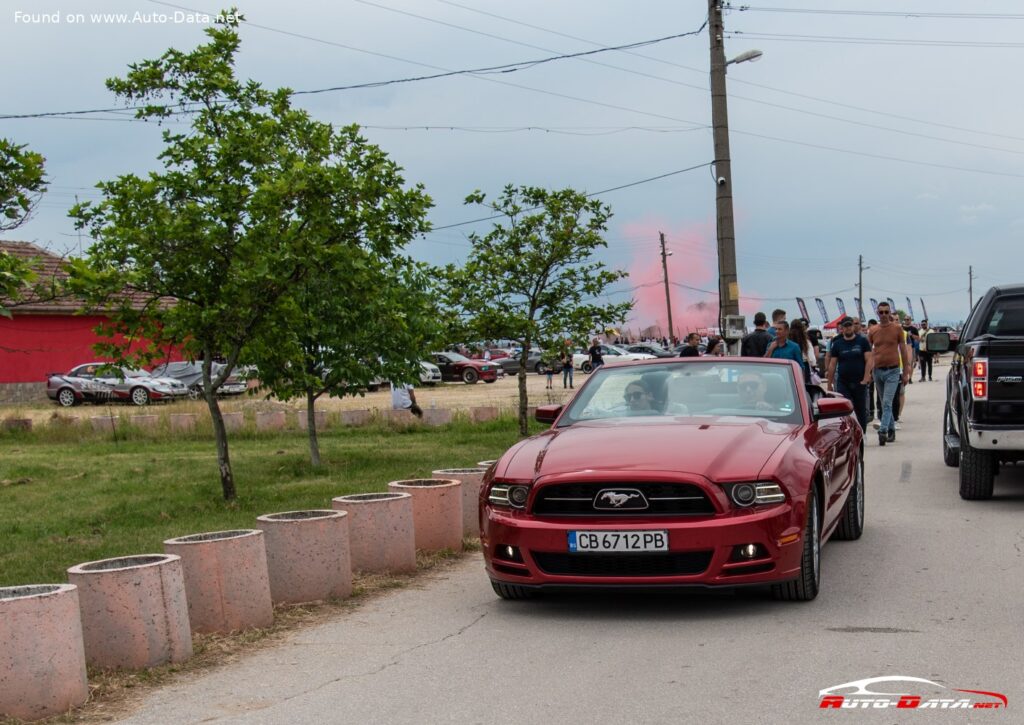
The 2012 facelift of the fifth-generation Mustang brought a more aggressive and refined aesthetic to the classic pony car shape. The Ford Mustang Convertible V (facelift 2012) GT 5.0 V8 (420 Hp) maintained its iconic long hood, short deck proportions, but received updated styling cues that enhanced its contemporary appeal. The front fascia featured a more prominent grille, revised headlights with available high-intensity discharge (HID) lamps, and a redesigned lower bumper that gave the car a more assertive stance. At the rear, sequential LED taillights, a signature Mustang feature, were retained and refined, complemented by a new rear diffuser and a choice of wheel designs, including 18-inch and optional 19-inch alloys.
As a two-door cabriolet with seating for four, the convertible offered the exhilarating experience of open-top driving. The soft-top roof, typically fabric, could be retracted to fully enjoy the V8’s symphony and the surrounding environment. Inside, the cabin received subtle but impactful upgrades, including improved material quality and an available 4.2-inch LCD screen integrated into the instrument cluster, which could display various performance metrics and “Track Apps” for enthusiasts. While still retaining a driver-focused layout, the interior blended retro-inspired elements with modern conveniences.
Dimensionally, the vehicle measured 188.5 inches in length, 73.9 inches in width (80.12 inches including mirrors), and 55.79 inches in height, with a wheelbase of 107.09 inches. These proportions contributed to its stable road presence. The suspension setup featured an independent MacPherson strut design with a transverse stabilizer bar at the front, while the rear employed a rigid axle suspension with coil springs and a transverse stabilizer. While the rigid rear axle was a traditional Mustang trait, offering robustness and excellent straight-line traction, it was a point of differentiation from more sophisticated independent rear suspension systems found in some competitors. Braking was handled by ventilated discs all around, with 336×36 mm discs at the front and 300×19 mm discs at the rear, aided by an Anti-lock Braking System (ABS) for enhanced safety. Electric power steering provided responsive and adjustable steering feel, further enhancing the driving experience.
Technical Specifications
| Category | Specification | Value |
|---|---|---|
| General Information | Brand | Ford |
| Model | Mustang | |
| Generation | Mustang Convertible V (facelift 2012) | |
| Type (Engine) | GT 5.0 V8 (420 Hp) | |
| Start of Production | 2012 year | |
| End of Production | 2014 year | |
| Powertrain Architecture | Internal Combustion engine | |
| Body type | Cabriolet | |
| Seats | 4 | |
| Doors | 2 | |
| Performance Specs | Fuel consumption (economy) – urban | 15.7 l/100 km (15 US mpg) |
| Fuel consumption (economy) – extra urban | 9 l/100 km (26.1 US mpg) | |
| Fuel consumption (economy) – combined | 12.4 l/100 km (19 US mpg) | |
| Fuel Type | Petrol (Gasoline) | |
| Weight-to-power ratio | 4 kg/Hp, 247.9 Hp/tonne | |
| Weight-to-torque ratio | 3.2 kg/Nm, 312.3 Nm/tonne | |
| Engine Specs | Power | 420 Hp @ 6500 rpm. |
| Power per liter | 84.8 Hp/l | |
| Torque | 529 Nm @ 4250 rpm (390.17 lb.-ft.) | |
| Maximum engine speed | 7000 rpm. | |
| Engine layout | Front, Longitudinal | |
| Engine Model/Code | Coyote | |
| Engine displacement | 4951 cm3 (302.13 cu. in.) | |
| Number of cylinders | 8 | |
| Engine configuration | V-engine | |
| Cylinder Bore | 92.2 mm (3.63 in.) | |
| Piston Stroke | 92.7 mm (3.65 in.) | |
| Compression ratio | 11:1 | |
| Number of valves per cylinder | 4 | |
| Fuel injection system | Multi-port manifold injection | |
| Engine aspiration | Naturally aspirated engine | |
| Valvetrain | DOHC, Ti-VCT | |
| Engine oil capacity | 7.6 l (8.03 US qt) | |
| Coolant capacity | 12.3 l (13 US qt) | |
| Space, Volume and Weights | Kerb Weight | 1694 kg (3734.63 lbs.) |
| Trunk (boot) space – minimum | 272 l (9.61 cu. ft.) | |
| Fuel tank capacity | 61 l (16.11 US gal) | |
| Permitted trailer load with brakes (12%) | 454 kg (1000.9 lbs.) | |
| Dimensions | Length | 4788 mm (188.5 in.) |
| Width | 1877 mm (73.9 in.) | |
| Width including mirrors | 2035 mm (80.12 in.) | |
| Height | 1417 mm (55.79 in.) | |
| Wheelbase | 2720 mm (107.09 in.) | |
| Front track | 1575 mm (62.01 in.) | |
| Rear (Back) track | 1590 mm (62.6 in.) | |
| Minimum turning circle (turning diameter) | 10.2 m (33.46 ft.) | |
| Drivetrain, Brakes and Suspension | Drivetrain Architecture | The Internal combustion engine (ICE) drives the rear wheels of the vehicle. |
| Drive wheel | Rear wheel drive | |
| Number of gears and type of gearbox | 6 gears, manual transmission | |
| Front suspension | Independent type McPherson, Transverse stabilizer | |
| Rear suspension | Rigid axle suspension, Transverse stabilizer, Coil spring | |
| Front brakes | Ventilated discs, 336×36 mm | |
| Rear brakes | Ventilated discs, 300×19 mm | |
| Assisting systems | ABS (Anti-lock braking system) | |
| Steering type | Steering rack and pinion | |
| Power steering | Electric Steering | |
| Tires size | 235/50 R18; 245/45 R19 | |
| Wheel rims size | 8J x 18; 8.5J x 19 |
Legacy and Market Impact of the Ford Mustang Convertible V (facelift 2012)
The Ford Mustang Convertible V (facelift 2012) GT 5.0 V8 (420 Hp) played a crucial role in maintaining the Mustang’s competitive edge and enduring popularity in the American automotive market. By 2012, the pony car segment was experiencing a resurgence, fueled by fierce competition between the “Detroit Three.” The Mustang GT faced strong rivals in the Chevrolet Camaro SS and the Dodge Challenger R/T and SRT models. With the powerful Coyote engine, Ford not only matched but often surpassed the performance offerings of its competitors in various metrics, solidifying its position as a performance benchmark.
The return of the “5.0” badge was more than just a marketing ploy; it was a powerful nod to Mustang history and a clear statement of intent. It resonated deeply with enthusiasts who remembered the legendary 5.0-liter Mustangs of the Fox Body era, while simultaneously showcasing a thoroughly modern and capable powertrain. This blend of nostalgic appeal and cutting-edge performance was a key factor in its market success. The convertible variant, in particular, offered a unique proposition, combining the visceral thrill of a powerful V8 with the sensory experience of open-air motoring, making it an ideal choice for cruising and spirited weekend drives alike.
The S197 generation, especially in its facelifted form from 2010-2014, is widely regarded as one of the most successful and beloved iterations of the Mustang. It successfully blended classic Mustang design language with modern safety standards and technology, appealing to a broad demographic, from younger buyers drawn to its aggressive looks and performance to older enthusiasts seeking a connection to the Mustang’s golden age. Its impact extended beyond sales figures, influencing aftermarket development and establishing a strong community of modifiers and racers.
While its solid rear axle was sometimes criticized compared to the independent setups of some European rivals, and eventually its successor, the S550 Mustang, it contributed to the car’s robust character and made it a favorite for drag racing. The accessible power, distinctive V8 rumble, and customizable nature ensured its place as a quintessential American muscle car. The 2012 Mustang GT Convertible, with its potent 5.0-liter engine and timeless styling, stands as a significant chapter in the Mustang’s illustrious history, embodying the spirit of American performance and freedom on the open road. It continued the Mustang’s legacy as an affordable yet exhilarating performance car, cementing its reputation for generations to come.