The Ford Mustang Convertible VI 2.3 EcoBoost (309 Hp): A Global Icon with a Modern Twist
The Ford Mustang, an undisputed icon of American automotive culture, entered a new era with its sixth generation, internally codenamed S550. Launched for the 2015 model year, this iteration marked a significant departure from its predecessors, transforming the beloved pony car into a truly global vehicle. Among its diverse powertrain offerings, the Ford Mustang Convertible VI 2.3 EcoBoost (309 Hp) emerged as a particularly compelling option, blending traditional Mustang appeal with modern engineering efficiency. Produced between 2015 and 2017 in this specific configuration, this convertible variant presented a sophisticated package, combining the thrill of open-air driving with the performance and fuel economy of Ford’s advanced EcoBoost technology. It represented a strategic move by Ford to broaden the Mustang’s appeal beyond North America, introducing it to markets where smaller displacement, turbocharged engines were highly valued.
This generation of the Mustang was revolutionary for several reasons. It was the first to feature an independent rear suspension across the lineup, significantly enhancing ride comfort and handling dynamics, a long-requested upgrade by enthusiasts and critics alike. Furthermore, the S550 Mustang was designed from the outset as a global product, available in both left-hand and right-hand drive configurations, and sold in over 100 countries. The introduction of the 2.3-liter EcoBoost engine alongside the traditional V6 and V8 options underscored Ford’s commitment to offering a versatile and technologically advanced sports car that could meet diverse market demands and regulatory requirements. The convertible body style added another layer of allure, allowing drivers to experience the Mustang’s performance and distinctive exhaust note with the wind in their hair.
Engine and Performance: The Heart of the Ford Mustang Convertible VI 2.3 EcoBoost
At the core of the Ford Mustang Convertible VI 2.3 EcoBoost lies a potent 2.3-liter (2264 cm3 or 138.16 cu. in.) inline-four engine, a marvel of modern powertrain engineering. This powerplant, part of Ford’s acclaimed EcoBoost family, utilizes a sophisticated combination of direct fuel injection, a twin-scroll turbocharger, and an intercooler to deliver impressive performance figures. Despite its relatively small displacement for a Mustang, this engine produces a robust 309 horsepower at 5500 rpm, showcasing its high specific output of 136.5 horsepower per liter. More critically for daily driving and spirited acceleration, the engine generates a substantial 300.19 lb.-ft. of torque, available across a broad rev range from 2500 to 4500 rpm. This wide torque band ensures responsive acceleration and excellent drivability, whether cruising on the highway or navigating city streets.
Power is channeled to the rear wheels, adhering to the classic Mustang formula, through a precise 6-speed manual transmission. This setup provides an engaging driving experience, allowing enthusiasts to fully exploit the engine’s capabilities. The engine’s layout is front and longitudinal, contributing to a balanced weight distribution and the Mustang’s characteristic long hood profile. With a compression ratio of 9.5:1 and a DOHC (Dual Overhead Camshaft) valvetrain with four valves per cylinder, the EcoBoost engine is designed for both power and efficiency.
One of the key advantages of the 2.3 EcoBoost engine in the Mustang Convertible is its commendable fuel economy, especially when compared to its larger V8 sibling. Running on gasoline, the official figures for this variant were:
- Urban: 22 US mpg (10.7 l/100 km)
- Extra Urban: 30.9 US mpg (7.6 l/100 km)
- Combined: 26.1 US mpg (9 l/100 km)
These figures made the EcoBoost Convertible an attractive proposition for those seeking the Mustang experience with a more economical running cost, particularly in international markets where fuel prices are higher and displacement taxes are common. The engine oil capacity is 5.4 liters (5.71 US quarts), and the cooling system holds 8.96 liters (9.47 US quarts).
Design and Features: The S550 Convertible Aesthetic
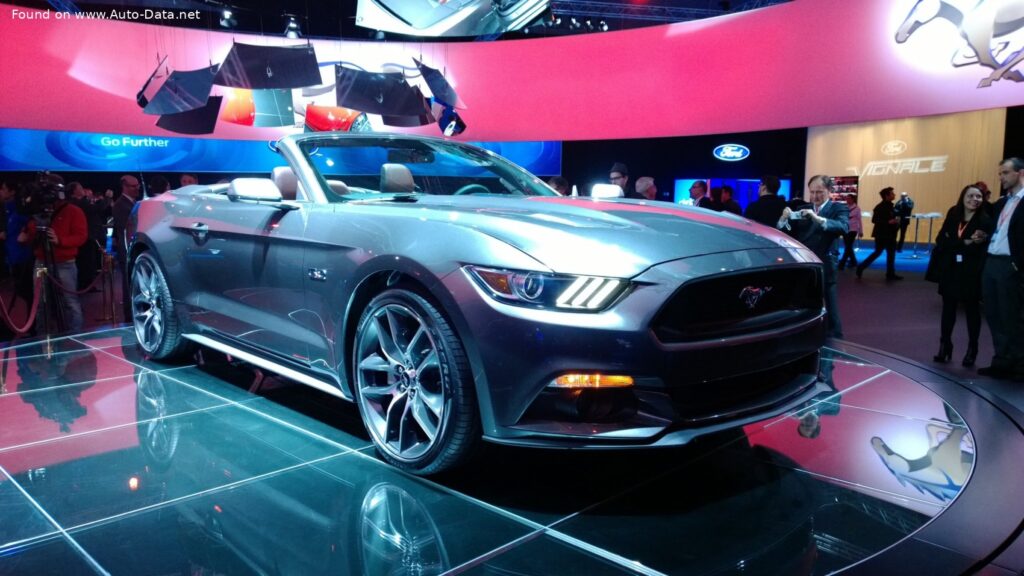
The sixth-generation Mustang Convertible, including the 2.3 EcoBoost variant, beautifully blended modern design language with undeniable heritage cues. Its cabriolet body type, featuring two doors and accommodating four occupants, maintained the classic proportions that define the Mustang. The S550’s exterior design was sleek and muscular, characterized by a wider stance and a lower roofline compared to previous generations. The aggressive front fascia, signature tri-bar taillights, and prominent rear haunches all paid homage to Mustang’s storied past while projecting a contemporary and athletic image. The soft-top convertible roof mechanism was designed for ease of use, allowing drivers to quickly transition between an enclosed cabin and open-air exhilaration.
In terms of dimensions, the Mustang Convertible VI measured 188.31 inches (4783 mm) in length, 75.39 inches (1915 mm) in width (81.89 inches or 2080 mm with mirrors folded), and 54.88 inches (1394 mm) in height. Its wheelbase of 107.09 inches (2720 mm) contributed to both stable high-speed cruising and a comfortable ride. The front track measured 62.28 inches (1582 mm) and the rear track was 64.88 inches (1648 mm). A drag coefficient (Cd) of 0.35 indicated a focus on aerodynamic efficiency. The minimum turning circle was 36.48 feet (11.12 meters), making it reasonably maneuverable for its size.
Underneath its stylish exterior, the Mustang Convertible VI boasted a sophisticated chassis. It featured ventilated disc brakes on both the front and rear axles, providing ample stopping power and fade resistance. An Anti-lock Braking System (ABS) was standard, enhancing safety and control during emergency braking. The steering system utilized an electric power-assisted rack and pinion setup, offering precise feedback and variable assist to suit different driving conditions. The car rode on 17-inch wheel rims, shod with 235/55 R17 tires, providing a balance of grip, comfort, and durability.
Technical Specifications
| Category | Specification | Value |
|---|---|---|
General Information |
||
| Brand | Ford | |
| Model | Mustang | |
| Generation | Mustang Convertible VI | |
| Type (Engine) | 2.3 EcoBoost (309 Hp) | |
| Start of Production | 2015 year | |
| End of Production | 2017 year | |
| Powertrain Architecture | Internal Combustion engine | |
| Body Type | Cabriolet (Convertible) | |
| Seats | 4 | |
| Doors | 2 | |
Performance Specs |
||
| Fuel Consumption (Urban) | 10.7 l/100 km (22 US mpg) | |
| Fuel Consumption (Extra Urban) | 7.6 l/100 km (30.9 US mpg) | |
| Fuel Consumption (Combined) | 9 l/100 km (26.1 US mpg) | |
| Fuel Type | Petrol (Gasoline) | |
Engine Specs |
||
| Power | 309 Hp @ 5500 rpm | |
| Power per Liter | 136.5 Hp/l | |
| Torque | 407 Nm (300.19 lb.-ft.) @ 2500-4500 rpm | |
| Engine Layout | Front, Longitudinal | |
| Engine Model/Code | EcoBoost | |
| Engine Displacement | 2264 cm3 (138.16 cu. in.) | |
| Number of Cylinders | 4 | |
| Engine Configuration | Inline | |
| Cylinder Bore | 87.55 mm (3.45 in.) | |
| Piston Stroke | 94 mm (3.7 in.) | |
| Compression Ratio | 9.5:1 | |
| Number of Valves per Cylinder | 4 | |
| Fuel Injection System | Direct injection | |
| Engine Aspiration | Turbocharger, Intercooler | |
| Valvetrain | DOHC | |
| Engine Oil Capacity | 5.4 l (5.71 US qt) | |
| Engine Oil Specification | Not specified in data | |
| Coolant Capacity | 8.96 l (9.47 US qt) | |
Space, Volume and Weights |
||
| Fuel Tank Capacity | 58 l (15.32 US gal) | |
Dimensions |
||
| Length | 4783 mm (188.31 in.) | |
| Width | 1915 mm (75.39 in.) | |
| Width with Mirrors Folded | 2080 mm (81.89 in.) | |
| Height | 1394 mm (54.88 in.) | |
| Wheelbase | 2720 mm (107.09 in.) | |
| Front Track | 1582 mm (62.28 in.) | |
| Rear (Back) Track | 1648 mm (64.88 in.) | |
| Drag Coefficient (Cd) | 0.35 | |
| Minimum Turning Circle (Turning Diameter) | 11.12 m (36.48 ft.) | |
Drivetrain, Brakes and Suspension Specs |
||
| Drivetrain Architecture | The Internal combustion engine (ICE) drives the rear wheels of the vehicle. | |
| Drive Wheel | Rear wheel drive | |
| Number of Gears and Type of Gearbox | 6 gears, manual transmission | |
| Front Brakes | Ventilated discs | |
| Rear Brakes | Ventilated discs | |
| Assisting Systems | ABS (Anti-lock braking system) | |
| Steering Type | Steering rack and pinion | |
| Power Steering | Electric Steering | |
| Tires Size | 235/55 R17 | |
| Wheel Rims Size | 17 inches | |
Legacy and Market Impact of the Ford Mustang Convertible VI 2.3 EcoBoost
The sixth-generation Ford Mustang, and particularly its 2.3 EcoBoost variant, carved out a unique and significant legacy in the automotive world. For decades, the Mustang was primarily an American phenomenon, but the S550 generation, with its global design and diverse powertrain options, transformed it into a truly international sports car. The Ford Mustang Convertible VI 2.3 EcoBoost (309 Hp) played a pivotal role in this expansion, offering a compelling alternative to the thirsty V8s that previously defined the brand. This decision was met with some initial skepticism from purists, but the EcoBoost quickly proved its worth, delivering impressive performance that rivaled older V8 models while offering significantly better fuel economy and reduced emissions, crucial for acceptance in European and Asian markets.
In its primary markets, the EcoBoost Mustang Convertible competed with a wide array of vehicles. In the U.S., it found itself in a segment alongside the Chevrolet Camaro and Dodge Challenger, but its open-top configuration also placed it against more premium European convertibles from brands like Audi and BMW, especially considering its refined handling and modern interior. Globally, its blend of performance and relative efficiency made it a strong contender against smaller, more expensive European sports coupes and convertibles that couldn’t match its raw power or iconic presence for the price.
The introduction of the independent rear suspension was a game-changer for the Mustang, elevating its handling capabilities to match its international rivals. This, combined with the electric power steering and advanced braking systems, made the S550 a far more refined and enjoyable car to drive, especially on twisty roads. The EcoBoost engine itself became a testament to Ford’s engineering prowess, demonstrating that a four-cylinder engine could indeed power a Mustang without compromising its spirit. It broadened the Mustang’s demographic, attracting buyers who desired the iconic styling and performance heritage but also valued modern efficiency and technology.
Ultimately, the 2015-2017 Ford Mustang Convertible VI 2.3 EcoBoost (309 Hp) cemented its place as a crucial chapter in the Mustang’s ongoing story. It proved that the legendary pony car could adapt and evolve without losing its soul, successfully bridging the gap between traditional American muscle and contemporary global sports car demands. Its blend of open-air freedom, engaging performance, and surprising efficiency ensured its reputation as a modern classic, offering a unique blend of heritage and forward-thinking engineering.