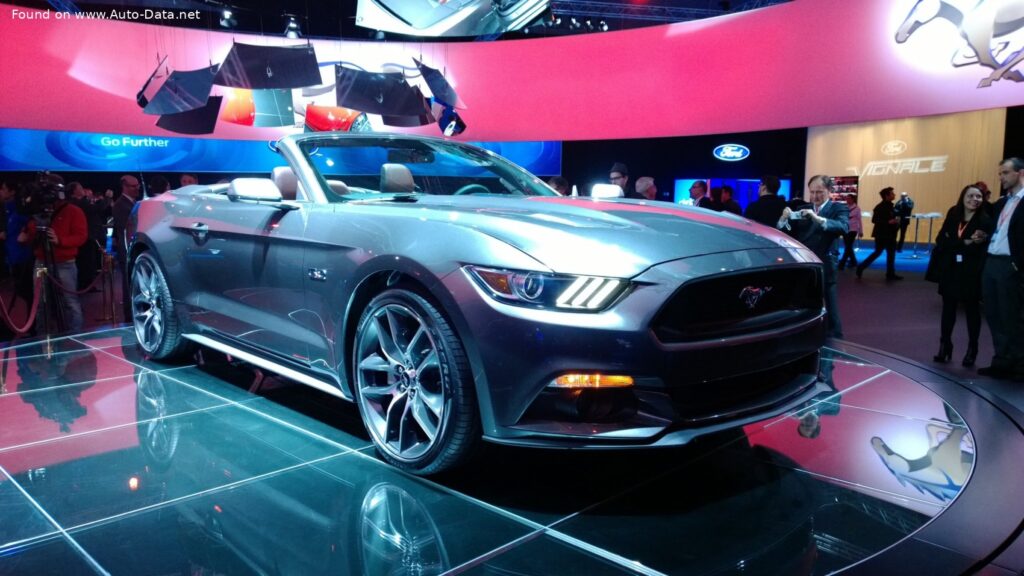
As an international automotive expert, I present a detailed analysis of the Ford Mustang Convertible VI 2.3 EcoBoost (317 Hp), a significant iteration in the Mustang’s storied history.
Introduction to the Ford Mustang Convertible VI 2.3 EcoBoost (317 Hp)
The sixth generation of the iconic Ford Mustang, internally known as the S550, marked a pivotal moment for the venerable American pony car. Launched for the 2015 model year, this generation was not only a complete redesign but also the first Mustang to be engineered as a true global vehicle, officially sold in right-hand-drive markets and across continents. Among its various powertrain options, the Ford Mustang Convertible VI 2.3 EcoBoost (317 Hp) emerged as a compelling choice, offering a modern, turbocharged four-cylinder engine that balanced performance with improved fuel efficiency, a stark departure from the traditional V8-only perception of the Mustang. This particular variant, produced from 2015 to 2017, represented Ford’s commitment to innovation, blending classic American muscle aesthetics with contemporary engineering and a convertible body style that emphasized open-air driving pleasure.
The S550 generation was celebrated for its independent rear suspension (IRS), a long-awaited upgrade that replaced the live axle setup of previous generations, significantly enhancing ride quality, handling dynamics, and overall refinement. The 2.3-liter EcoBoost engine, while initially met with some skepticism from purists, quickly proved its mettle, delivering robust power and torque figures that rivaled naturally aspirated V8s of earlier eras. The convertible variant further added to its appeal, allowing drivers to enjoy the exhilarating performance and distinctive styling with the added sensory experience of open-top motoring. This model effectively broadened the Mustang’s market reach, appealing to a new demographic of buyers who desired performance, style, and efficiency in one package.
Engine & Performance: The Heart of the Ford Mustang Convertible VI 2.3 EcoBoost (317 Hp)
At the core of the Ford Mustang Convertible VI 2.3 EcoBoost (317 Hp) lies a sophisticated 2.3-liter (2264 cm3 or 138.16 cu. in.) inline-four engine, a testament to modern powertrain engineering. This powerplant, part of Ford’s renowned EcoBoost family, utilizes direct fuel injection, a twin-scroll turbocharger, and an intercooler to achieve impressive output for its displacement. With a DOHC (Double Overhead Camshaft) valvetrain and four valves per cylinder, the engine is designed for optimal breathing and efficiency.
This particular iteration of the 2.3 EcoBoost engine delivers a robust 317 horsepower at 5500 rpm, translating to a remarkable 140 horsepower per liter. Equally impressive is its torque output, peaking at 318.63 lb.-ft. (432 Nm) at a relatively low 3000 rpm. This broad torque band ensures strong acceleration and responsiveness across a wide range of engine speeds, making it enjoyable for both spirited driving and daily commutes. Power is transmitted to the rear wheels via a precise 6-speed manual transmission, offering an engaging driving experience that connects the driver directly to the car’s performance capabilities. The rear-wheel-drive architecture, a hallmark of the Mustang, ensures classic sports car dynamics.
Despite its performance credentials, the 2.3 EcoBoost engine also shines in terms of efficiency. The combined fuel economy for the convertible is rated at 28.7 US mpg (8.2 l/100 km), a significant improvement over its V8 siblings and a strong selling point for a performance-oriented convertible. CO2 emissions are kept in check at 184 g/km, reflecting Ford’s efforts to meet global environmental standards. With a kerb weight of 3780.93 lbs (1715 kg), the car achieves a weight-to-power ratio of 5.4 kg/Hp, or 184.8 Hp/tonne, indicating a lively power-to-weight balance that contributes to its agile feel.
Design & Features of the Mustang Convertible VI
The design of the sixth-generation Mustang Convertible is a masterful blend of heritage and modernity. It retains the iconic long hood, short deck proportions, and aggressive stance that define the Mustang, while incorporating contemporary styling cues such as a sleeker profile, a wider body, and a lower roofline. The convertible body type, featuring two doors and seating for four, enhances the car’s appeal as a stylish cruiser, perfect for sunny drives. The soft top retracts to open up the cabin, providing an immersive driving experience, while its well-insulated design ensures comfort when raised.
Underneath its striking exterior, the Mustang Convertible VI benefits from significant engineering advancements. The introduction of an independent multi-link spring suspension with a stabilizer bar at the rear, coupled with an independent McPherson type front suspension, dramatically improved the car’s handling and ride comfort compared to previous generations. This setup allowed for greater control over individual wheel movements, leading to a more refined and predictable driving dynamic, especially when navigating corners or uneven road surfaces. Braking performance is handled by ventilated discs at both the front and rear, ensuring strong stopping power and fade resistance, complemented by an Anti-lock Braking System (ABS) for enhanced safety.
The car rides on 19-inch wheels, fitted with 255/40 R19 tires, providing a substantial contact patch for grip and stability. The steering system utilizes a precise rack and pinion setup, offering direct feedback and a responsive feel. With a length of 188.35 inches (4784 mm), a width of 75.43 inches (1916 mm), and a height of 54.88 inches (1394 mm), the Mustang Convertible VI possesses a commanding road presence. Its wheelbase of 107.09 inches (2720 mm) contributes to both interior space and handling stability. Despite its compact sports car dimensions, it offers a respectable trunk space of 11.72 cu. ft. (332 liters), making it practical for weekend getaways.
Technical Specifications
| Category | Specification | Value |
|---|---|---|
| General Information | ||
| Brand | Ford | |
| Model | Mustang | |
| Generation | Mustang Convertible VI | |
| Type (Engine) | 2.3 EcoBoost (317 Hp) | |
| Start of Production | 2015 year | |
| End of Production | 2017 year | |
| Powertrain Architecture | Internal Combustion engine | |
| Body type | Cabriolet | |
| Seats | 4 | |
| Doors | 2 | |
| Performance Specs | ||
| Fuel consumption (economy) – combined | 8.2 l/100 km (28.7 US mpg, 34.4 UK mpg) | |
| CO2 emissions | 184 g/km | |
| Fuel Type | Petrol (Gasoline) | |
| Weight-to-power ratio | 5.4 kg/Hp (184.8 Hp/tonne) | |
| Weight-to-torque ratio | 4 kg/Nm (251.9 Nm/tonne) | |
| Engine Specs | ||
| Power | 317 Hp @ 5500 rpm | |
| Power per liter | 140 Hp/l | |
| Torque | 432 Nm @ 3000 rpm (318.63 lb.-ft. @ 3000 rpm) | |
| Engine layout | Front, Longitudinal | |
| Engine Model/Code | EcoBoost | |
| Engine displacement | 2264 cm3 (138.16 cu. in.) | |
| Number of cylinders | 4 | |
| Engine configuration | Inline | |
| Cylinder Bore | 87.55 mm (3.45 in.) | |
| Piston Stroke | 94 mm (3.7 in.) | |
| Compression ratio | 9.5:1 | |
| Number of valves per cylinder | 4 | |
| Fuel injection system | Direct injection | |
| Engine aspiration | Turbocharger, Intercooler | |
| Valvetrain | DOHC | |
| Engine oil capacity | 5.4 l (5.71 US qt) | |
| Engine oil specification | Not specified | |
| Coolant | 8.96 l (9.47 US qt) | |
| Space, Volume and Weights | ||
| Kerb Weight | 1715 kg (3780.93 lbs) | |
| Trunk (boot) space – minimum | 332 l (11.72 cu. ft.) | |
| Fuel tank capacity | 59 l (15.59 US gal) | |
| Dimensions | ||
| Length | 4784 mm (188.35 in.) | |
| Width | 1916 mm (75.43 in.) | |
| Width with mirrors folded | 1956 mm (77.01 in.) | |
| Width including mirrors | 2080 mm (81.89 in.) | |
| Height | 1394 mm (54.88 in.) | |
| Wheelbase | 2720 mm (107.09 in.) | |
| Front track | 1582 mm (62.28 in.) | |
| Rear (Back) track | 1655 mm (65.16 in.) | |
| Minimum turning circle (turning diameter) | 12.2 m (40.03 ft.) | |
| Drivetrain, Brakes and Suspension Specs | ||
| Drivetrain Architecture | The Internal combustion engine (ICE) drives the rear wheels of the vehicle. | |
| Drive wheel | Rear wheel drive | |
| Number of gears and type of gearbox | 6 gears, manual transmission | |
| Front suspension | Independent type McPherson | |
| Rear suspension | Independent multi-link spring suspension with stabilizer | |
| Front brakes | Ventilated discs | |
| Rear brakes | Ventilated discs | |
| Assisting systems | ABS (Anti-lock braking system) | |
| Steering type | Steering rack and pinion | |
| Tires size | 255/40 R19 | |
| Wheel rims size | 19 | |
Legacy & Market Impact
The Ford Mustang Convertible VI 2.3 EcoBoost (317 Hp) holds a unique place in the Mustang’s storied legacy. It was a crucial component of Ford’s strategy to transform the Mustang from a regional icon into a global powerhouse. By offering a potent, yet fuel-efficient, turbocharged four-cylinder engine alongside the traditional V8s, Ford successfully broadened the Mustang’s appeal to international markets where fuel costs and emissions regulations made the V8 less practical. This adaptability allowed the Mustang to compete effectively in segments previously dominated by European and Asian sports coupes and roadsters.
In its primary markets, particularly North America and Europe, the EcoBoost Mustang Convertible carved out a niche for itself. It offered a compelling alternative to more expensive European convertibles like the Audi TT Roadster, BMW 2 Series Convertible, and even certain variants of the Mercedes-Benz C-Class Convertible, providing similar levels of performance and a distinctive American style at a more accessible price point. Within the domestic market, while still facing competition from V8-powered Chevrolet Camaros and Dodge Challengers, the EcoBoost Mustang distinguished itself with its superior fuel economy and a more refined, technologically advanced driving experience, especially with the new independent rear suspension.
The reputation of the S550 generation, and particularly the EcoBoost model, is one of a modern, sophisticated sports car that respects its heritage. It demonstrated that a Mustang could be more than just raw power; it could be a well-rounded performance vehicle capable of excelling in various driving conditions, from track days to long highway cruises. The 2.3 EcoBoost engine proved that a four-cylinder could deliver genuine Mustang-level performance, challenging long-held perceptions and introducing the brand to a new generation of enthusiasts. Its production run from 2015 to 2017 highlights its significance as an early and impactful offering in the global Mustang lineup, setting the stage for future iterations that continue to blend tradition with innovation.