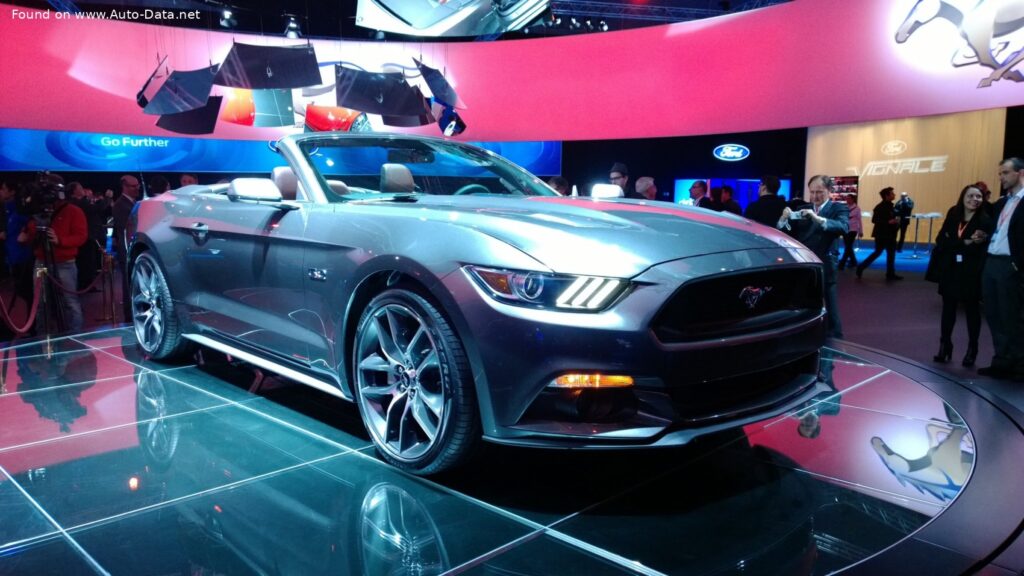
Ford Mustang Convertible VI 3.7 V6 (304 Hp)
The Ford Mustang, an icon of American automotive culture, entered its sixth generation (internal code S550) for the 2015 model year, marking a significant evolution for the storied pony car. This generation was particularly notable as it was the first Mustang designed from the ground up to be a global vehicle, intended for sale in markets beyond North America. Among its initial powertrain offerings, the Ford Mustang Convertible VI 3.7 V6 (304 Hp) served as a compelling entry point into the Mustang lineup, providing a blend of performance, style, and accessibility. Produced from 2015 to 2017, this particular variant showcased the new platform’s capabilities in a classic two-door, four-seat cabriolet configuration, embracing both its heritage and a fresh, modern appeal.
The S550 generation of the Mustang represented a pivotal moment, introducing an independent rear suspension across all models, a long-awaited upgrade that vastly improved handling and ride comfort compared to previous generations’ live axle setup. The 3.7-liter V6 engine, while eventually phased out, played a crucial role during its tenure, offering a robust power output that positioned it well against competitors and provided a spirited driving experience for those not opting for the more powerful EcoBoost four-cylinder or the range-topping V8 GT models. This article delves into the technical specifications, design philosophy, and market impact of the Ford Mustang Convertible VI 3.7 V6, examining its contribution to the Mustang’s enduring legacy.
Engine and Performance of the Ford Mustang Convertible VI 3.7 V6
At the heart of the Ford Mustang Convertible VI 3.7 V6 lies Ford’s Duratec 37 engine, a naturally aspirated, 3.7-liter (3726 cm3 or 227.37 cu. in.) V6 powerplant. This engine was a familiar and proven unit within Ford’s portfolio, known for its reliability and smooth power delivery. In this application, it produced a respectable 304 horsepower at 6500 rpm, translating to an impressive 81.6 horsepower per liter. Peak torque reached 269.95 lb.-ft. (366 Nm) at 4000 rpm, providing ample thrust for daily driving and spirited acceleration.
The engine’s configuration is a V-engine with six cylinders, featuring a DOHC (Dual Overhead Camshaft) valvetrain with four valves per cylinder, optimizing airflow for both power and efficiency. Fuel delivery was handled by a multi-port manifold injection system, a robust and well-understood technology. With a compression ratio of 10.5:1, the engine was designed to run on regular unleaded gasoline, making it a more economical choice compared to premium-fuel-dependent performance engines. The front, longitudinal engine layout contributed to the Mustang’s classic rear-wheel-drive architecture, ensuring a traditional sports car feel.
Power was channeled to the rear wheels via a standard six-speed manual transmission, offering an engaging driving experience that enthusiasts crave. This combination allowed drivers to fully exploit the V6’s power band, making the most of its high-revving nature. While acceleration figures were not provided in the raw data, contemporary reviews placed its 0-60 mph time in the mid-5-second range, a highly competitive figure for a V6-powered convertible of its era. Fuel economy for the 3.7 V6 Convertible was rated at an estimated 17 US mpg in the city, 28 US mpg on the highway, and a combined 21 US mpg, offering a reasonable balance between performance and everyday usability for a vehicle of its class.
Drivetrain, Brakes, and Suspension
The S550 generation marked a monumental shift for the Mustang with the adoption of an independent rear suspension (IRS) system across the entire lineup. This crucial upgrade significantly enhanced the car’s handling dynamics, providing improved ride comfort, better traction over uneven surfaces, and greater cornering stability compared to the solid rear axle of previous generations. The front suspension maintained a MacPherson strut design, working in harmony with the IRS to deliver a more refined and capable chassis.
Braking performance was handled by ventilated disc brakes on both the front and rear axles, providing strong, consistent stopping power. An Anti-lock Braking System (ABS) was standard, enhancing safety and control during emergency braking maneuvers. The steering system featured an electric power-assisted rack and pinion setup, offering customizable steering feel modes and precise control. The standard tire size was 235/55 R17 on 17-inch wheel rims, providing a comfortable ride and adequate grip.
Design and Features
The sixth-generation Mustang, including the Convertible VI, embraced a more contemporary and athletic design language while retaining unmistakable Mustang cues. With a length of 188.31 inches (4783 mm), a width of 75.39 inches (1915 mm), and a height of 54.88 inches (1394 mm), the S550 Convertible possessed a substantial and muscular presence. Its wheelbase measured 107.09 inches (2720 mm), contributing to its stable stance. The drag coefficient (Cd) of 0.35 indicated a focus on aerodynamic efficiency, crucial for both performance and fuel economy.
As a cabriolet, the Ford Mustang Convertible VI 3.7 V6 offered the exhilaration of open-air driving, a quintessential Mustang experience. The two-door, four-seat configuration provided seating for four, though the rear seats were typically more suited for occasional use or smaller passengers, common for this segment. The convertible top was designed for ease of operation, often featuring power actuation for convenient opening and closing. The interior, while not explicitly detailed in the provided data, in the S550 generation was a significant step up in material quality and design, incorporating modern technology and comfort features.
Key features of the S550 Mustang generally included Ford’s SYNC infotainment system, a rearview camera, and a suite of airbags. The electric power steering offered different modes (Normal, Sport, Comfort) allowing drivers to tailor the steering feel to their preference. While the 3.7 V6 was positioned as the entry-level engine, it still benefited from the platform’s overall advancements in safety, chassis rigidity, and technological integration, ensuring a modern driving experience.
Technical Specifications: Ford Mustang Convertible VI 3.7 V6 (304 Hp)
| Category | Specification |
|---|---|
| General Information | |
| Brand | Ford |
| Model | Mustang |
| Generation | Mustang Convertible VI |
| Type (Engine) | 3.7 V6 (304 Hp) |
| Start of Production | 2015 year |
| End of Production | 2017 year |
| Powertrain Architecture | Internal Combustion engine |
| Body type | Cabriolet |
| Seats | 4 |
| Doors | 2 |
| Performance Specs | |
| Fuel consumption (economy) – urban | 13.8 l/100 km (17 US mpg) |
| Fuel consumption (economy) – extra urban | 8.4 l/100 km (28 US mpg) |
| Fuel consumption (economy) – combined | 11.2 l/100 km (21 US mpg) |
| Fuel Type | Petrol (Gasoline) |
| Engine Specs | |
| Power | 304 Hp @ 6500 rpm |
| Power per liter | 81.6 Hp/l |
| Torque | 366 Nm (269.95 lb.-ft.) @ 4000 rpm |
| Engine layout | Front, Longitudinal |
| Engine Model/Code | Duratec 37 |
| Engine displacement | 3726 cm3 (227.37 cu. in.) |
| Number of cylinders | 6 |
| Engine configuration | V-engine |
| Cylinder Bore | 95.5 mm (3.76 in.) |
| Piston Stroke | 86.7 mm (3.41 in.) |
| Compression ratio | 10.5:1 |
| Number of valves per cylinder | 4 |
| Fuel injection system | Multi-port manifold injection |
| Engine aspiration | Naturally aspirated engine |
| Valvetrain | DOHC |
| Engine oil capacity | 5.7 l (6.02 US qt) |
| Coolant | 11.7 l (12.36 US qt) |
| Space, Volume and Weights | |
| Fuel tank capacity | 60 l (15.85 US gal) |
| Dimensions | |
| Length | 4783 mm (188.31 in.) |
| Width | 1915 mm (75.39 in.) |
| Width with mirrors folded | 2080 mm (81.89 in.) |
| Height | 1394 mm (54.88 in.) |
| Wheelbase | 2720 mm (107.09 in.) |
| Front track | 1582 mm (62.28 in.) |
| Rear (Back) track | 1648 mm (64.88 in.) |
| Drag coefficient (Cd) | 0.35 |
| Minimum turning circle (turning diameter) | 11.12 m (36.48 ft.) |
| Drivetrain, Brakes and Suspension Specs | |
| Drivetrain Architecture | The Internal combustion engine (ICE) drives the rear wheels of the vehicle. |
| Drive wheel | Rear wheel drive |
| Number of gears and type of gearbox | 6 gears, manual transmission |
| Front brakes | Ventilated discs |
| Rear brakes | Ventilated discs |
| Assisting systems | ABS (Anti-lock braking system) |
| Steering type | Steering rack and pinion |
| Power steering | Electric Steering |
| Tires size | 235/55 R17 |
| Wheel rims size | 17 |
Legacy and Market Impact
The Ford Mustang, an enduring symbol of American automotive prowess, continued its storied legacy with the introduction of the sixth generation. The Ford Mustang Convertible VI 3.7 V6 played a significant role in making this iconic car accessible to a broader audience. Positioned as the entry-level model, it provided a more affordable path to Mustang ownership, offering a stylish, fun-to-drive convertible experience without the higher price tag or insurance premiums associated with the V8-powered GT models.
In the highly competitive “pony car” segment, the Mustang faced fierce rivals primarily from its domestic counterparts: the Chevrolet Camaro and the Dodge Challenger. The Camaro, particularly in its V6 configurations, offered comparable performance and styling, while the Challenger leaned into a more retro, muscle-car aesthetic with its larger dimensions. The Mustang V6, especially in convertible form, aimed to strike a balance between daily usability, engaging performance, and classic American style, appealing to buyers looking for a blend of all three.
The S550 generation’s global aspirations were a game-changer for the Mustang. For the first time, it was engineered for right-hand drive markets and met international safety and emissions standards, allowing Ford to sell it in over 100 countries. While the 3.7 V6 was primarily a North American offering, its availability underscored Ford’s commitment to providing diverse powertrain options for different market preferences. However, as Ford shifted its focus towards more fuel-efficient and technologically advanced engines, the naturally aspirated 3.7L V6 was eventually phased out after the 2017 model year, replaced by the more potent and efficient 2.3-liter EcoBoost four-cylinder as the base engine. This move reflected evolving consumer preferences and stricter emissions regulations.
Despite its relatively short production run within the S550 generation, the Ford Mustang Convertible VI 3.7 V6 remains an important chapter in the Mustang’s history. It represented the last iteration of a naturally aspirated V6 as a primary entry-level engine in the Mustang lineup, offering a traditional, robust, and characterful powertrain for those who preferred a multi-cylinder engine over a turbocharged four-cylinder but didn’t require the outright power of a V8. Its combination of classic convertible style, modern chassis dynamics, and a strong V6 engine ensured its place as a desirable and significant model for Mustang enthusiasts and casual drivers alike, cementing its legacy as a true American classic for a new era.