The Ford Mustang Convertible VI: A Modern American Icon
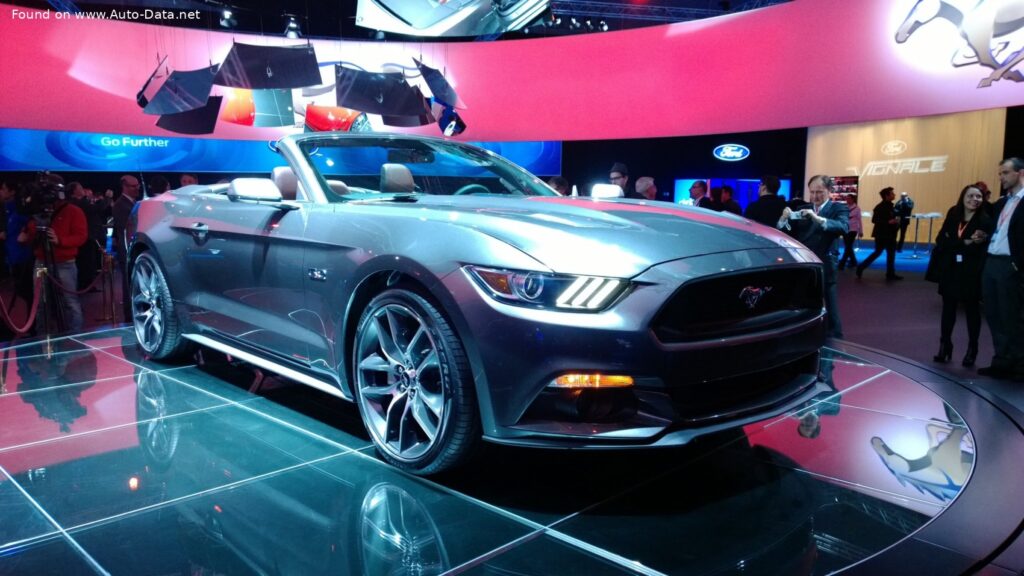
The Ford Mustang, a name synonymous with American automotive culture, entered its sixth generation (internal code S550) in 2015, marking a significant evolution in its storied history. This iteration was particularly notable for its global aspirations, being the first Mustang designed to be sold worldwide, and for its embrace of modern engineering, most notably the adoption of an independent rear suspension across the entire lineup. The variant under review, the Ford Mustang Convertible VI 3.7 V6 (304 Hp) Automatic, served as a compelling entry point into the Mustang ownership experience from its production start in 2015 through to 2017. It combined classic pony car aesthetics with contemporary performance and the undeniable appeal of open-air motoring, catering to enthusiasts seeking a blend of style, power, and everyday usability.
Positioned in the competitive American sports car segment, the S550 generation Mustang Convertible V6 offered a more refined driving experience than its predecessors while retaining the raw emotional connection that defines the Mustang brand. It represented a sophisticated blend of heritage and innovation, making it a pivotal model in the Mustang’s six-decade legacy.
Engine and Performance: The Duratec 37 V6 Powertrain
At the heart of the Ford Mustang Convertible VI 3.7 V6 (304 Hp) Automatic lies Ford’s venerable Duratec 37 engine, a 3.7-liter (3726 cm3 or 227.37 cu. in.) naturally aspirated V6. This robust powerplant, configured in a V-engine layout with six cylinders and four valves per cylinder, was engineered to deliver a spirited performance experience. It produced a healthy 304 horsepower at 6500 rpm, translating to an impressive 81.6 horsepower per liter, showcasing its efficiency and high-revving nature. Torque output stood at a substantial 269.95 lb.-ft. (366 Nm) at a more accessible 4000 rpm, providing strong acceleration and responsiveness in various driving conditions.
The engine’s design featured a DOHC (Dual Overhead Camshaft) valvetrain and a multi-port manifold injection fuel system, optimizing combustion and fuel delivery for both power and efficiency. Power was routed to the rear wheels via a smooth and responsive 6-speed automatic transmission, a popular choice for those prioritizing comfort and ease of driving in a convertible. This powertrain architecture, with its front, longitudinal engine layout and rear-wheel drive, maintained the classic Mustang dynamic, offering a balanced and engaging driving feel.
In terms of fuel economy, the 3.7 V6 offered a respectable balance for a performance-oriented convertible. The combined fuel consumption was rated at 22 US mpg (10.7 l/100 km), with urban figures at 19 US mpg (12.4 l/100 km) and extra-urban cruising achieving 28 US mpg (8.4 l/100 km). This made the V6 a more economical choice compared to its V8-powered siblings, without significantly compromising on the thrill of driving a Mustang. The 15.85 US gallon (60 l) fuel tank provided a decent range for road trips.
Design and Features: Open-Air American Muscle
The Ford Mustang Convertible VI inherited the S550 generation’s striking design language, which was a masterful evolution of the Mustang’s iconic styling cues. As a cabriolet with two doors and seating for four, it perfectly encapsulated the spirit of a performance-oriented cruiser. The car’s dimensions—188.31 inches in length, 75.39 inches in width (81.89 inches with mirrors folded), and 54.88 inches in height—contributed to its muscular stance and road presence. A wheelbase of 107.09 inches provided a stable platform, while the front and rear tracks of 62.28 inches and 64.88 inches, respectively, hinted at its capable handling.
A notable engineering achievement for this generation was the drag coefficient (Cd) of 0.35, indicating a relatively aerodynamic shape for a car of its type, contributing to both fuel efficiency and high-speed stability. The S550 Mustang’s exterior styling was characterized by its aggressive front fascia, sculpted body lines, and the signature triple-bar taillights, all contributing to a modern yet unmistakably Mustang aesthetic. The convertible top, engineered for ease of operation, allowed occupants to quickly transition between a coupe-like cabin and an open-air driving experience.
Inside, the Mustang Convertible VI offered a driver-centric cockpit with a blend of retro-inspired elements and contemporary technology. While specific interior features varied by trim, the S550 generation typically included modern infotainment systems, comfortable seating for four (though the rear seats were best suited for occasional use or smaller passengers), and quality materials. Safety was addressed with standard features such as ABS (Anti-lock Braking System) for its ventilated disc brakes on both the front and rear axles. The electric power steering system, a rack and pinion setup, offered precise control and could often be customized with different assist settings, enhancing the driving experience. The vehicle rode on 235/55 R17 tires mounted on 17-inch wheel rims, providing a good balance of grip and ride comfort.
Technical Specifications
| Category | Specification | Value |
|---|---|---|
| General Information | ||
| Brand | Ford | Mustang |
| Model | Generation | Mustang Convertible VI |
| Type (Engine) | 3.7 V6 (304 Hp) Automatic | |
| Start of Production | 2015 year | |
| End of Production | 2017 year | |
| Powertrain Architecture | Internal Combustion engine | |
| Body Type | Cabriolet | |
| Seats | 4 | |
| Doors | 2 | |
| Engine Specifications | ||
| Engine Model/Code | Duratec 37 | |
| Engine Layout | Front, Longitudinal | |
| Engine Displacement | 3726 cm3 (227.37 cu. in.) | |
| Number of Cylinders | 6 | |
| Engine Configuration | V-engine | |
| Cylinder Bore | 95.5 mm (3.76 in.) | |
| Piston Stroke | 86.7 mm (3.41 in.) | |
| Compression Ratio | 10.5:1 | |
| Number of Valves per Cylinder | 4 | |
| Fuel Injection System | Multi-port manifold injection | |
| Engine Aspiration | Naturally aspirated engine | |
| Valvetrain | DOHC | |
| Performance Specs | ||
| Power | 304 Hp @ 6500 rpm. | |
| Power per Liter | 81.6 Hp/l | |
| Torque | 366 Nm @ 4000 rpm. (269.95 lb.-ft. @ 4000 rpm.) | |
| Fuel Economy & Capacities | ||
| Fuel Type | Petrol (Gasoline) | |
| Fuel Consumption (Urban) | 12.4 l/100 km (19 US mpg) | |
| Fuel Consumption (Extra Urban) | 8.4 l/100 km (28 US mpg) | |
| Fuel Consumption (Combined) | 10.7 l/100 km (22 US mpg) | |
| Engine Oil Capacity | 5.7 l (6.02 US qt) | |
| Engine Oil Specification | Not specified | |
| Coolant Capacity | 11.7 l (12.36 US qt) | |
| Fuel Tank Capacity | 60 l (15.85 US gal) | |
| Dimensions & Aerodynamics | ||
| Length | 4783 mm (188.31 in.) | |
| Width | 1915 mm (75.39 in.) | |
| Width with Mirrors Folded | 2080 mm (81.89 in.) | |
| Height | 1394 mm (54.88 in.) | |
| Wheelbase | 2720 mm (107.09 in.) | |
| Front Track | 1582 mm (62.28 in.) | |
| Rear (Back) Track | 1648 mm (64.88 in.) | |
| Drag Coefficient (Cd) | 0.35 | |
| Minimum Turning Circle | 11.12 m (36.48 ft.) | |
| Drivetrain, Brakes, and Suspension | ||
| Drivetrain Architecture | Internal combustion engine drives the rear wheels. | |
| Drive Wheel | Rear wheel drive | |
| Number of Gears and Type of Gearbox | 6 gears, automatic transmission | |
| Front Brakes | Ventilated discs | |
| Rear Brakes | Ventilated discs | |
| Assisting Systems | ABS (Anti-lock braking system) | |
| Steering Type | Steering rack and pinion | |
| Power Steering | Electric Steering | |
| Tires Size | 235/55 R17 | |
| Wheel Rims Size | 17 inches | |
Legacy and Market Impact
The sixth-generation Ford Mustang, particularly the Ford Mustang Convertible VI 3.7 V6 (304 Hp) Automatic, holds a significant place in the model’s history. Its introduction marked a paradigm shift for the Mustang, moving from a primarily domestic icon to a truly global sports car. The decision to adopt an independent rear suspension (IRS) across the entire lineup, a first for mainstream production Mustangs, was a monumental engineering change that dramatically improved ride comfort, handling dynamics, and overall refinement. While some purists initially lamented the departure from the live axle, the IRS proved instrumental in making the S550 a more competitive and appealing vehicle on the international stage, as well as on varied American roads.
The 3.7-liter V6 engine, a carryover from the previous generation, continued its role as the accessible entry point into Mustang ownership. It provided a compelling balance of performance, affordability, and improved fuel economy compared to the more potent V8 options. For many buyers, the V6 convertible offered the quintessential Mustang experience—classic styling, open-air freedom, and satisfying power—without the higher acquisition cost, insurance premiums, or running costs associated with the GT models.
In the American market, the Mustang Convertible V6 competed primarily against the Chevrolet Camaro V6 and the Dodge Challenger SXT. Each offered its unique interpretation of the muscle/pony car formula, but the Mustang consistently stood out for its blend of heritage-inspired design and modern driving dynamics. The S550 generation’s more sophisticated chassis and refined interior helped it appeal to a broader demographic, including those who might have previously overlooked American performance cars. Its success paved the way for the Mustang to become one of the best-selling sports coupes globally.
The legacy of the 2015-2017 Mustang V6 convertible is one of transition and accessibility. It allowed a wider audience to experience the thrill of a modern Mustang, offering a robust engine, an engaging automatic transmission, and the timeless appeal of a convertible. While eventually superseded by the more efficient and powerful 2.3-liter EcoBoost four-cylinder as the base engine, the 3.7 V6 played a crucial role in bridging the gap between the traditional Mustang and its contemporary, globally-minded successor, solidifying its place as a cherished chapter in the Mustang saga.