Introduction: The Ford Mustang IV 3.8 V6 (147 Hp)
The Ford Mustang, an iconic symbol of American automotive culture, entered its fourth generation, known internally as the SN95, for the 1994 model year. This iteration marked a significant evolution from the long-running Fox Body platform, which had underpinned the Mustang since 1979. The SN95 generation brought a fresh, more contemporary design while retaining the classic pony car proportions and rear-wheel-drive architecture that defined the Mustang legend. Among the initial powertrain offerings, the Ford Mustang IV 3.8 V6 (147 Hp) served as the accessible entry point into the Mustang lineup, providing a balance of performance, affordability, and improved efficiency for its time. Produced from 1993 to 1997, this variant played a crucial role in broadening the Mustang’s appeal, making the dream of owning America’s beloved pony car attainable for a wider audience.
The SN95 Mustang, launched in December 1993, was based on a heavily modified version of the Fox platform, often referred to as the Fox-4 platform. This redesign aimed to address criticisms of the aging Fox Body’s interior quality and styling, while also enhancing structural rigidity and handling characteristics. The 3.8-liter V6 engine, a staple in Ford’s powertrain offerings, was tasked with delivering adequate performance for the base model, serving as a more economical and fuel-efficient alternative to the potent 5.0-liter V8 found in the GT models. Despite its more modest output compared to its V8 sibling, the V6 variant was a popular choice, contributing significantly to the Mustang’s sales figures during this period and solidifying its position in the fiercely competitive American sports coupe market.
Engine and Performance: Powering the Ford Mustang IV 3.8 V6 (147 Hp)
The 3.8L Essex V6
At the heart of the base model Ford Mustang IV was the venerable 3.8-liter (3797 cm3 or 231.71 cu. in.) Essex V6 engine, a naturally aspirated unit designed for reliable and economical operation. This V-engine configuration, with six cylinders, featured a front, longitudinal layout, driving the rear wheels—a classic Mustang setup. The engine was rated at a respectable 147 horsepower (Hp) delivered at 4000 rpm, and it produced a robust 292 Nm (215.37 lb.-ft.) of torque at a low 2500 rpm. This torque characteristic was particularly beneficial for everyday driving, providing eager acceleration from a standstill and strong passing power without needing to rev the engine excessively.
The 3.8L Essex V6 utilized a multi-port manifold injection system for precise fuel delivery, contributing to its efficiency and smooth operation. With a compression ratio of 9:1 and two valves per cylinder, the engine was designed for durability and ease of maintenance. The power output translated to a weight-to-power ratio of 9.5 kg/Hp (105.8 Hp/tonne) and a weight-to-torque ratio of 4.8 kg/Nm (210.1 Nm/tonne), indicating a car that, while not a drag strip champion in this configuration, offered a lively and engaging driving experience for its class. The standard transmission for the Ford Mustang IV 3.8 V6 (147 Hp) was a 5-speed manual, allowing drivers to fully exploit the engine’s power band and providing a direct, connected feel to the road. An automatic transmission was also available as an option, catering to those who preferred a more relaxed driving experience.
Design and Features: The SN95 Era Mustang
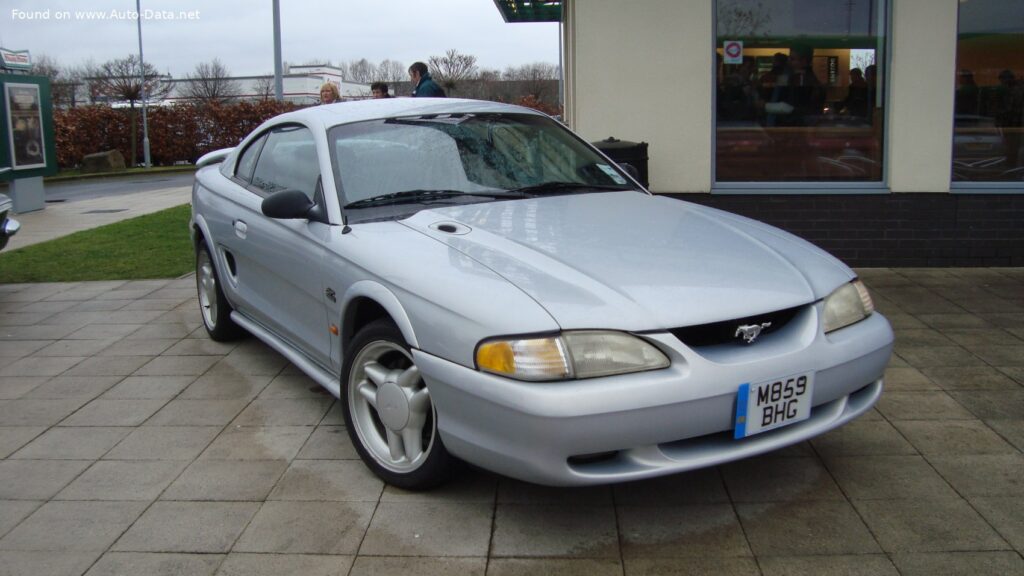
The SN95 generation represented a significant aesthetic departure for the Mustang, moving away from the straight lines and boxy profile of the Fox Body. The design team, led by Patrick Schiavone, crafted a more aerodynamic and curvaceous body, drawing inspiration from earlier Mustangs and giving it a distinct identity. The Ford Mustang IV 3.8 V6 (147 Hp) was offered exclusively as a 2-door coupe, accommodating four occupants. Its dimensions—181.5 inches (4610 mm) in length, 71.77 inches (1823 mm) in width, and 52.83 inches (1342 mm) in height—gave it a substantial road presence, while the 101.26-inch (2572 mm) wheelbase contributed to a stable ride and improved interior packaging compared to its predecessor.
Interior and Exterior Aesthetics
The exterior styling featured prominent haunches, a distinctive C-pillar design, and a three-bar taillight motif that paid homage to classic Mustangs. The front fascia was aggressive yet refined, characterized by a rounded nose and integrated headlamps. Inside, the SN95 brought a much-needed modernization to the Mustang’s cabin. The dashboard was redesigned with a dual-cockpit layout, incorporating improved ergonomics and higher-quality materials, addressing a common criticism of earlier generations. Standard features for the base V6 model were somewhat modest but included essentials like power windows, mirrors, and a decent audio system, with various options available to enhance comfort and convenience.
Chassis and Safety
Underneath its new skin, the SN95 Mustang retained a conventional but improved chassis. It featured a wishbone front suspension, providing better handling and ride quality, paired with a coil spring rear suspension that, while still a solid axle design, offered enhancements over the outgoing model. Braking performance was handled by disc brakes at both the front and rear, a significant upgrade for the base model, providing confident stopping power. An Anti-lock Braking System (ABS) was available as an assisting system, enhancing safety under hard braking conditions. Steering was managed by a rack and pinion system with hydraulic power steering, offering precise control and good feedback to the driver. The car rode on 205/65 R15 tires, a common size for the era, providing a balance of grip and ride comfort. With a curb weight of 3064.43 lbs (1390 kg), the Ford Mustang IV 3.8 V6 (147 Hp) felt solid and planted on the road, embodying the spirit of a true American muscle car, even in its entry-level form.
Technical Specifications
| Category | Specification | Value |
|---|---|---|
| Brand | Ford | |
| Model | Mustang | |
| Generation | Mustang IV (SN95) | |
| Type (Engine) | 3.8 V6 (147 Hp) | |
| Start of Production | 1993 year | |
| End of Production | 1997 year | |
| Powertrain Architecture | Internal Combustion engine | |
| Body type | Coupe | |
| Seats | 4 | |
| Doors | 2 | |
| Performance Specs | ||
| Fuel Type | Petrol (Gasoline) | |
| Weight-to-power ratio | 9.5 kg/Hp, 105.8 Hp/tonne | |
| Weight-to-torque ratio | 4.8 kg/Nm, 210.1 Nm/tonne | |
| Engine Specs | ||
| Power | 147 Hp @ 4000 rpm | |
| Power per liter | 38.7 Hp/l | |
| Torque | 292 Nm @ 2500 rpm (215.37 lb.-ft. @ 2500 rpm) | |
| Engine layout | Front, Longitudinal | |
| Engine Model/Code | Essex / 994 | |
| Engine displacement | 3797 cm3 (231.71 cu. in.) | |
| Number of cylinders | 6 | |
| Engine configuration | V-engine | |
| Cylinder Bore | 96.8 mm (3.81 in.) | |
| Piston Stroke | 86 mm (3.39 in.) | |
| Compression ratio | 9:1 | |
| Number of valves per cylinder | 2 | |
| Fuel injection system | Multi-port manifold injection | |
| Engine aspiration | Naturally aspirated engine | |
| Engine oil capacity | 4.7 l (4.97 US qt | 4.14 UK qt) | |
| Coolant | 11.2 l (11.83 US qt | 9.85 UK qt) | |
| Space, Volume and Weights | ||
| Kerb Weight | 1390 kg (3064.43 lbs) | |
| Fuel tank capacity | 58 l (15.32 US gal | 12.76 UK gal) | |
| Dimensions | ||
| Length | 4610 mm (181.5 in.) | |
| Width | 1823 mm (71.77 in.) | |
| Height | 1342 mm (52.83 in.) | |
| Wheelbase | 2572 mm (101.26 in.) | |
| Front track | 1539 mm (60.59 in.) | |
| Rear (Back) track | 1501 mm (59.09 in.) | |
| Drivetrain, Brakes and Suspension Specs | ||
| Drivetrain Architecture | The Internal combustion engine (ICE) drives the rear wheels of the vehicle. | |
| Drive wheel | Rear wheel drive | |
| Number of gears and type of gearbox | 5 gears, manual transmission | |
| Front suspension | Wishbone | |
| Rear suspension | Coil spring | |
| Front brakes | Disc | |
| Rear brakes | Disc | |
| Assisting systems | ABS (Anti-lock braking system) | |
| Steering type | Steering rack and pinion | |
| Power steering | Hydraulic Steering | |
| Tires size | 205/65 R15 | |
Legacy and Market Impact
The Ford Mustang IV, particularly its Ford Mustang IV 3.8 V6 (147 Hp) variant, cemented the Mustang’s place in the American automotive landscape throughout the 1990s. The SN95 generation was a critical success for Ford, revitalizing the Mustang’s image and attracting a new generation of buyers while retaining the loyalty of long-time enthusiasts. The V6 model played a pivotal role in this success by offering an affordable entry point into the pony car segment, making the Mustang dream accessible to a broader demographic who might not have been able to afford or justify the higher cost and insurance premiums of the V8 GT models.
In its primary market, the United States, the Mustang faced stiff competition from its traditional rivals: the Chevrolet Camaro and Pontiac Firebird, both of which also offered V6 and V8 options. The SN95 Mustang, with its fresh styling and improved interior, often outsold its F-Body competitors during this period, demonstrating its strong market appeal. The 3.8L V6, while not as powerful as the V8, was praised for its robust torque delivery, making it a capable daily driver and a fun car for cruising. Its fuel efficiency, though not stellar by modern standards, was a significant advantage over the thirstier V8s, making it a more practical choice for many consumers.
The legacy of the SN95 V6 Mustang is one of accessibility and enduring popularity. It introduced many drivers to the world of rear-wheel-drive performance and the unique thrill of owning a Mustang. Today, these V6 SN95 Mustangs are sought after as affordable project cars, reliable daily drivers, or canvases for customization. They represent a significant chapter in the Mustang’s storied history, bridging the gap between the utilitarian Fox Body and the more powerful New Edge and retro-inspired S197 generations. The Ford Mustang IV 3.8 V6 (147 Hp) proved that the Mustang’s appeal wasn’t solely dependent on raw V8 power, but also on its distinctive style, engaging driving dynamics, and the aspirational value of the Mustang nameplate itself. It remains a testament to Ford’s ability to adapt and evolve an icon for changing times, ensuring its continued relevance for generations to come.