Ford Mustang IV 4.6 V8 32V Cobra (320 Hp): A New Edge of American Muscle
The Ford Mustang, an icon of American automotive culture, entered its fourth generation, known internally as the SN95, for the 1994 model year. The specific variant under review, the Ford Mustang IV 4.6 V8 32V Cobra (320 Hp), represents the pinnacle of performance for the Mustang lineup during its “New Edge” facelift period, spanning from 1999 to 2002. This iteration of the Cobra, crafted by Ford’s Special Vehicle Team (SVT), was more than just a trim level; it was a carefully engineered performance machine designed to challenge perceptions of what a Mustang could be. Positioned in the highly competitive pony car segment, the 1999-2002 Cobra aimed to deliver a sophisticated blend of raw power, improved handling, and distinctive styling, solidifying its role as a modern classic for enthusiasts.
During its production run, the SN95 generation brought significant advancements to the Mustang platform, moving away from the Fox-body architecture that underpinned its predecessor. While standard GT models received the 2-valve 4.6-liter V8, the Cobra distinguished itself with a more advanced, high-revving 32-valve DOHC engine, alongside a crucial independent rear suspension (IRS) system, a first for a production Mustang. These technical upgrades underscored its ambition to compete with the best performance coupes of its era, offering a compelling package of speed, agility, and the unmistakable roar of an American V8.
Engine & Performance of the Ford Mustang IV 4.6 V8 32V Cobra
At the heart of the 1999-2002 Ford Mustang IV 4.6 V8 32V Cobra lay its formidable powertrain: a naturally aspirated 4.6-liter (4601 cm3 or 280.77 cu. in.) “Modular” V8 engine. Unlike the more common 2-valve SOHC versions found in GT models, the Cobra’s engine boasted a sophisticated DOHC (Dual Overhead Camshaft) 32-valve configuration. This advanced valvetrain, featuring four valves per cylinder, allowed for superior airflow, enabling the engine to breathe more efficiently and produce significantly more power at higher RPMs.
This meticulously engineered V8 delivered an impressive 320 horsepower at 6000 rpm, translating to a specific output of 69.6 horsepower per liter. Torque was equally robust, peaking at 317.15 lb.-ft. (430 Nm) at 4750 rpm, providing strong, immediate acceleration across the rev range. The engine’s layout was traditional American muscle: a front-mounted, longitudinal V-engine with an 8-cylinder configuration. With a compression ratio of 9.9:1 and a multi-port manifold injection system, the engine was designed for optimal combustion and responsiveness. Its bore and stroke dimensions were nearly square at 3.55 inches (90.2 mm) and 3.54 inches (90 mm) respectively, contributing to its balanced power delivery.
Power was channeled to the rear wheels via a precise 5-speed manual transmission, offering direct driver engagement and control. This drivetrain architecture, combined with the potent engine, allowed the Ford Mustang IV 4.6 V8 32V Cobra to achieve remarkable performance figures for its time. It could accelerate from 0 to 60 mph in a swift 5.2 seconds, and complete the 0-100 km/h sprint in 5.5 seconds. The Cobra’s top speed was electronically limited to 149.13 mph (240 km/h), a testament to its high-performance capabilities. The power-to-weight ratio stood at a competitive 4.8 kg/Hp (209.8 Hp/tonne), while the torque-to-weight ratio was 3.5 kg/Nm (282 Nm/tonne), highlighting the car’s strong acceleration potential relative to its 3362.05 lbs (1525 kg) curb weight.
Despite its performance focus, the Cobra offered a degree of everyday usability, albeit with fuel consumption typical of a high-performance V8. Urban fuel economy was rated at approximately 13.1 US mpg (18 l/100 km), while extra-urban driving saw this improve to about 23.5 US mpg (10 l/100 km), thanks to its efficient highway cruising capabilities. The 15.59 US gallon (59-liter) fuel tank provided a reasonable cruising range.
Design & Features: The “New Edge” Cobra
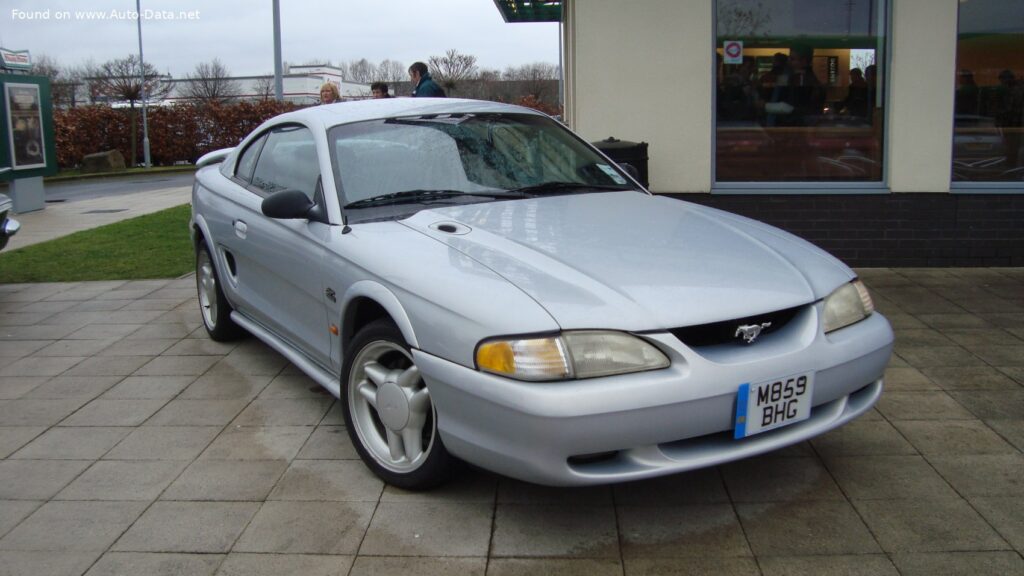
The 1999-2002 Ford Mustang IV Cobra embraced the “New Edge” design language that characterized the refreshed SN95 generation. This aesthetic was a significant departure from the softer, more rounded lines of the earlier 1994-1998 models, introducing sharper creases, angular headlights, and more aggressive bodywork. As a coupe with two doors and seating for four, the Cobra maintained the classic Mustang silhouette but infused it with a contemporary, assertive stance.
Visually, the Cobra distinguished itself with unique front and rear fascias, a prominent hood scoop, and specific badging that proudly proclaimed its SVT heritage. Its dimensions – a length of 183.5 inches (4661 mm), a width of 73.11 inches (1857 mm), and a height of 53.5 inches (1359 mm) – gave it a muscular, planted look. The 101.3-inch (2573 mm) wheelbase contributed to its stable handling characteristics, complemented by identical front and rear track widths of 59.88 inches (1521 mm).
Inside, the Cobra’s cabin was driver-centric, featuring supportive sport seats designed to hold occupants firmly during spirited driving. The instrumentation was clear and concise, providing essential information at a glance. While not overtly luxurious, the interior prioritized functionality and a connection to the driving experience, consistent with its muscle car ethos. The trunk offered 10.95 cu. ft. (310 liters) of space, sufficient for weekend getaways or daily errands.
Beyond aesthetics, the 1999 Cobra was groundbreaking for its introduction of an independent rear suspension (IRS) system. This was a critical engineering upgrade from the solid rear axle found on standard Mustangs, significantly improving ride quality, reducing unsprung weight, and enhancing cornering capabilities, especially over uneven surfaces. The front suspension utilized a wishbone design, working in concert with the IRS to provide a more refined and capable chassis. Stopping power was assured by disc brakes at both the front and rear, augmented by an Anti-lock Braking System (ABS), a crucial safety feature for controlling such a powerful vehicle. Steering was handled by a hydraulic rack and pinion system, offering direct feedback to the driver. The car rode on performance-oriented 245/45 R17 tires, providing ample grip for its performance potential.
Technical Specifications
| Category | Specification |
|---|---|
| Brand | Ford |
| Model | Mustang |
| Generation | Mustang IV |
| Type (Engine) | 4.6 V8 32V Cobra (320 Hp) |
| Start of Production | 1999 |
| End of Production | 2002 |
| Powertrain Architecture | Internal Combustion Engine |
| Body Type | Coupe |
| Seats | 4 |
| Doors | 2 |
| Performance Specs | |
| Fuel Consumption (Urban) | 13.1 US mpg (18 l/100 km) |
| Fuel Consumption (Extra Urban) | 23.5 US mpg (10 l/100 km) |
| Fuel Type | Petrol (Gasoline) |
| Acceleration 0-60 mph | 5.2 sec |
| Acceleration 0-100 km/h | 5.5 sec |
| Maximum Speed | 149.13 mph (240 km/h) |
| Weight-to-Power Ratio | 4.8 kg/Hp (209.8 Hp/tonne) |
| Weight-to-Torque Ratio | 3.5 kg/Nm (282 Nm/tonne) |
| Engine Specs | |
| Power | 320 Hp @ 6000 rpm |
| Power per Liter | 69.6 Hp/l |
| Torque | 317.15 lb.-ft. (430 Nm) @ 4750 rpm |
| Engine Layout | Front, Longitudinal |
| Engine Displacement | 4.6 l (4601 cm3 / 280.77 cu. in.) |
| Number of Cylinders | 8 |
| Engine Configuration | V-engine |
| Cylinder Bore | 3.55 in. (90.2 mm) |
| Piston Stroke | 3.54 in. (90 mm) |
| Compression Ratio | 9.9:1 |
| Number of Valves per Cylinder | 4 |
| Fuel Injection System | Multi-port manifold injection |
| Engine Aspiration | Naturally Aspirated |
| Valvetrain | DOHC |
| Engine Oil Capacity | 6.02 US qt (5.7 l) |
| Space, Volume and Weights | |
| Kerb Weight | 3362.05 lbs (1525 kg) |
| Trunk (Boot) Space – Minimum | 10.95 cu. ft. (310 l) |
| Fuel Tank Capacity | 15.59 US gal (59 l) |
| Dimensions | |
| Length | 183.5 in. (4661 mm) |
| Width | 73.11 in. (1857 mm) |
| Height | 53.5 in. (1359 mm) |
| Wheelbase | 101.3 in. (2573 mm) |
| Front Track | 59.88 in. (1521 mm) |
| Rear Track | 59.88 in. (1521 mm) |
| Drivetrain, Brakes and Suspension Specs | |
| Drivetrain Architecture | Internal combustion engine drives the rear wheels |
| Drive Wheel | Rear-wheel drive |
| Number of Gears and Type of Gearbox | 5 gears, Manual Transmission |
| Front Suspension | Wishbone |
| Rear Suspension | Independent Rear Suspension (Coil spring) |
| Front Brakes | Disc |
| Rear Brakes | Disc |
| Assisting Systems | ABS (Anti-lock Braking System) |
| Steering Type | Steering rack and pinion |
| Power Steering | Hydraulic Steering |
| Tires Size | 245/45 R17 |
Legacy & Market Impact of the Ford Mustang IV 4.6 V8 32V Cobra
The Ford Mustang IV 4.6 V8 32V Cobra (320 Hp) carved out a significant niche in the annals of American performance cars. As a product of Ford’s Special Vehicle Team (SVT), it was designed not just to be fast, but to showcase the engineering prowess and performance potential of the Mustang platform. Its introduction of the DOHC 32-valve 4.6-liter “Modular” V8 was a pivotal moment for the Mustang, signaling a shift towards more technologically advanced engines, moving beyond the traditional pushrod V8s that had long defined American muscle.
The most impactful feature, however, was undoubtedly the independent rear suspension (IRS). For decades, the Mustang had been criticized for its antiquated solid rear axle, which, while robust for drag racing, compromised ride comfort and handling dynamics, particularly on rough roads or during aggressive cornering. The 1999 Cobra’s IRS was a game-changer, dramatically enhancing the car’s composure, grip, and overall sophistication. This single engineering decision elevated the Cobra’s status, allowing it to compete more effectively with sports coupes that boasted more advanced chassis designs. It truly differentiated the Cobra from its stablemates and its direct competitors.
In its primary market, the United States, the Cobra faced fierce competition from its domestic rivals: the Chevrolet Camaro Z28 and SS, and the Pontiac Firebird Trans Am. These cars, often equipped with powerful LS1 V8 engines, offered similar performance figures. However, the Cobra’s unique combination of a high-revving DOHC engine, the revolutionary IRS, and its distinctive “New Edge” styling allowed it to maintain a strong identity and a dedicated following. It appealed to enthusiasts who sought a more refined and technologically advanced Mustang without sacrificing the raw power and iconic presence.
The 1999-2002 Cobra models are highly regarded by collectors and enthusiasts today. They represent a significant evolutionary step for the Mustang, bridging the gap between traditional muscle car brute force and modern performance engineering. The limited production numbers and the unique technical specifications, especially the DOHC engine and IRS, make these Cobras desirable. They are celebrated for their balanced performance, distinctive sound, and their role in pushing the Mustang brand forward in terms of handling and engine technology. The legacy of this generation of Cobra is not just in its speed, but in its influence on future performance Mustangs, demonstrating that the pony car could evolve while staying true to its roots. It remains a testament to Ford SVT’s commitment to building truly special performance vehicles.