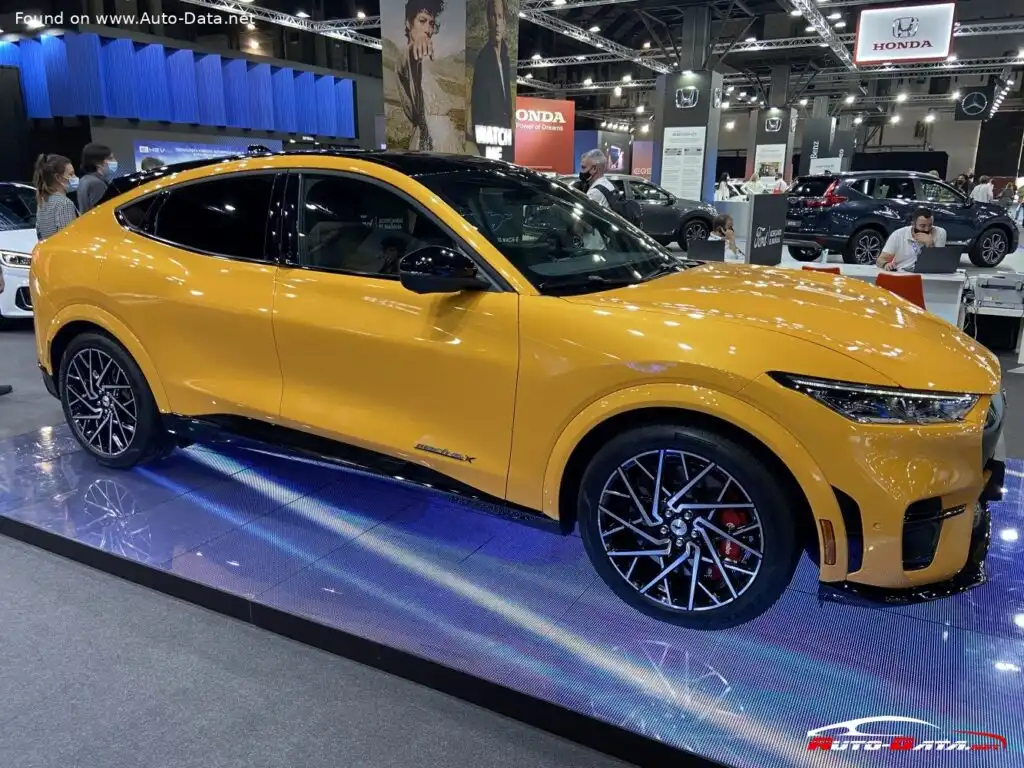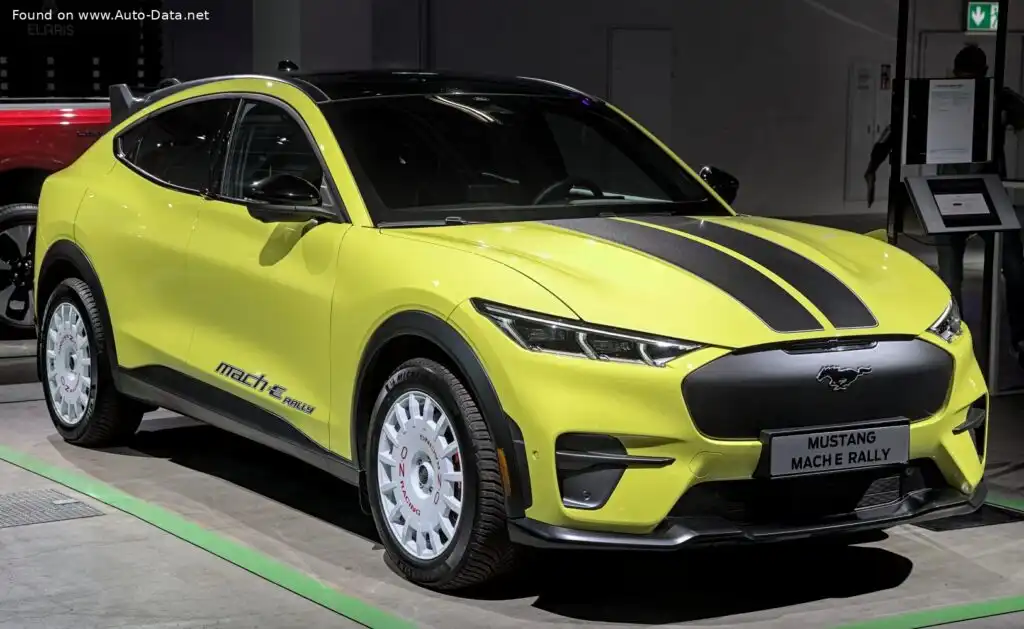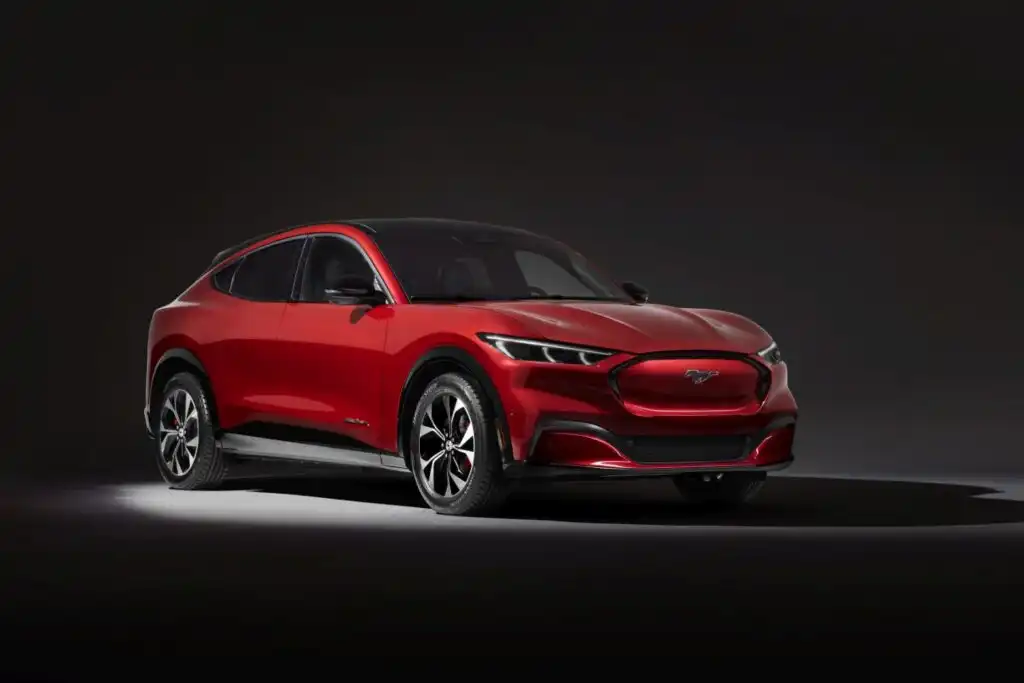
The Ford Mustang Mach-E Standard Range, introduced in November 2023 and produced through August 2024, represents Ford’s initial foray into the all-electric crossover market leveraging the iconic Mustang nameplate. Positioned as the entry-level variant of the Mach-E lineup, it aimed to provide a balance of affordability, range, and performance within the broader Mustang Mach-E generation. This model utilizes a dual-motor, all-wheel-drive configuration paired with a 76 kWh (usable 72.6 kWh) Lithium Iron Phosphate (LiFePO4) battery pack, delivering 315 horsepower and 580 Nm (427.79 lb.-ft.) of torque. It competes directly with other emerging electric SUVs like the Tesla Model Y, Hyundai IONIQ 5, and Kia EV6, offering a unique blend of American muscle car heritage and modern electric vehicle technology.
Technical Specifications
| Brand | Ford |
| Model | Mustang Mach-E |
| Generation | Mustang Mach-E |
| Type (Engine) | Standard Range 76 kWh (315 Hp) AWD |
| Start of production | November, 2023 |
| End of production | August, 2024 |
| Powertrain Architecture | BEV (Electric Vehicle) |
| Body type | Coupe, SUV |
| Seats | 5 |
| Doors | 5 |
| Fuel Type | Electricity |
| Acceleration 0 – 100 km/h | 6.2 sec |
| Acceleration 0 – 62 mph | 6.2 sec |
| Acceleration 0 – 60 mph | 5.9 sec |
| Maximum speed | 180 km/h (111.85 mph) |
| Weight-to-power ratio | 6.9 kg/Hp, 145 Hp/tonne |
| Weight-to-torque ratio | 3.7 kg/Nm, 267 Nm/tonne |
| Gross battery capacity | 76 kWh |
| Net (usable) battery capacity | 72.6 kWh |
| Battery technology | Lithium iron phosphate (LiFePO4) |
| Battery location | Below the floor |
| All-electric range (WLTP) | 428 km (265.95 mi) |
| All-electric range (EPA) | 364 km (226.18 mi) |
| Average Energy consumption (WLTP) | 19.6 kWh/100 km (31.54 kWh/100 mi, 107 MPGe, 5.1 km/kWh, 3.2 mi/kWh) |
| Electric motor 1 location | Rear axle, Transverse |
| Electric motor 1 type | Synchronous |
| Electric motor 2 location | Front axle, Transverse |
| Electric motor 2 type | Synchronous |
| System power | 315 Hp |
| System torque | 580 Nm (427.79 lb.-ft.) |
| Kerb Weight | 2172-2201 kg (4788.44 – 4852.37 lbs.) |
| Max. weight | 2690 kg (5930.43 lbs.) |
| Max load | 489-518 kg (1078.06 – 1141.99 lbs.) |
| Trunk (boot) space – minimum | 402 l (14.2 cu. ft.) |
| Trunk (boot) space – maximum | 1420 l (50.15 cu. ft.) |
| Max. roof load | 75 kg (165.35 lbs.) |
| Permitted trailer load with brakes (12%) | 750 kg (1653.47 lbs.) |
| Permitted trailer load without brakes | 750 kg (1653.47 lbs.) |
| Permitted towbar download | 30 kg (66.14 lbs.) |
| Length | 4713 mm (185.55 in.) |
| Width | 1881 mm (74.06 in.) |
| Width including mirrors | 2097 mm (82.56 in.) |
| Height | 1624 mm (63.94 in.) |
| Wheelbase | 2984 mm (117.48 in.) |
| Front track | 1613 mm (63.5 in.) |
| Rear (Back) track | 1610 mm (63.39 in.) |
| Ride height (ground clearance) | 147 mm (5.79 in.) |
| Minimum turning circle (turning diameter) | 11.6 m (38.06 ft.) |
| Front suspension | Independent, type McPherson with coil spring and anti-roll bar |
| Rear suspension | Independent multi-link spring suspension with stabilizer |
| Front brakes | Ventilated discs, 362 mm |
| Rear brakes | Disc, 316 mm |
| Steering type | Steering rack and pinion |
| Power steering | Electric Steering |
| Tires size | 225/55 R19 |
| Wheel rims size | 7J x 19 |
| Number of gears and type of gearbox | 1 gears, automatic transmission |
Powertrain & Engine Architecture
The Mustang Mach-E Standard Range utilizes a dual-motor, all-wheel-drive (AWD) powertrain. Both the front and rear axles are driven by permanently excited synchronous motors. Unlike traditional internal combustion engines, these motors deliver instant torque, contributing to the Mach-E’s brisk acceleration. The 76 kWh (72.6 kWh usable) battery pack, employing Lithium Iron Phosphate (LiFePO4) chemistry, is positioned low in the vehicle’s floor, contributing to a lower center of gravity and improved handling. LiFePO4 batteries are known for their thermal stability and longer lifespan compared to Nickel Manganese Cobalt (NMC) batteries, though they typically offer slightly lower energy density. The powertrain operates at a high voltage, requiring sophisticated battery management systems to ensure safety and optimize performance. The single-speed automatic transmission is integral to each motor, providing seamless power delivery. There is no traditional multi-gear transmission as found in internal combustion vehicles.
Driving Characteristics
The 315 horsepower and 580 Nm (427.79 lb.-ft.) of torque delivered by the dual-motor setup provide the Mach-E Standard Range with a 0-60 mph acceleration time of around 5.9 seconds. While not as quick as the higher-performance variants (like the GT), it offers ample power for everyday driving and highway merging. The instant torque characteristic of electric motors provides a responsive and engaging driving experience. The single-speed transmission ensures smooth and linear acceleration. Compared to the extended-range versions, the Standard Range model feels slightly less energetic, particularly at higher speeds, due to the battery’s lower energy density. The AWD system provides excellent traction in various weather conditions, enhancing stability and control.
Equipment & Trim Levels
The Standard Range trim typically included features such as a 15.5-inch touchscreen infotainment system with Ford’s SYNC 4A software, a digital instrument cluster, automatic climate control, and a suite of advanced driver-assistance systems (ADAS) including Ford Co-Pilot360. Standard interior upholstery was cloth, with options for synthetic leather upgrades. Available options included a panoramic sunroof, premium audio system, and various interior trim packages. The exterior styling remained consistent across the Mach-E range, with the Standard Range models often featuring standard wheels and exterior trim elements.
Chassis & Braking
The Mustang Mach-E utilizes an independent suspension system at all four corners. The front suspension employs a McPherson strut design with a coil spring and anti-roll bar, while the rear features a multi-link setup with a stabilizer bar. This configuration provides a comfortable ride and responsive handling. Braking duties are handled by ventilated discs at the front (362mm) and solid discs at the rear (316mm). The regenerative braking system captures energy during deceleration, increasing efficiency and extending range. The electronic stability control (ESC) and anti-lock braking system (ABS) work in conjunction to enhance safety and control.
Market Reception & Comparison
The Mustang Mach-E Standard Range was generally well-received by critics, praised for its stylish design, comfortable ride, and user-friendly technology. However, some reviewers noted that the range was slightly less competitive than some rivals, particularly the Tesla Model Y Long Range. Fuel economy, measured in MPGe, was competitive within the electric SUV segment. Compared to the higher-trim Mach-E models, the Standard Range offered a more affordable entry point but sacrificed some performance and range. Reliability reports have been generally positive, with owners reporting few major issues.
Legacy
The Mustang Mach-E Standard Range played a crucial role in establishing Ford as a serious contender in the electric vehicle market. Its success paved the way for further EV development and expansion of the Mach-E lineup. The LiFePO4 battery technology used in the Standard Range model demonstrated Ford’s commitment to exploring alternative battery chemistries. On the used car market, the Mach-E Standard Range remains a popular choice, offering a compelling combination of value, practicality, and electric driving experience. The longevity of the LiFePO4 battery pack is expected to contribute to the long-term reliability and resale value of these vehicles.