Ford Mustang V (facelift 2009) 3.7 V6 (305 Hp)
The Ford Mustang, an iconic symbol of American automotive prowess, entered its fifth generation (S197) in 2005, drawing heavily on the styling cues of the original 1960s Mustangs. The model received a significant refresh in 2009, bringing updated aesthetics and, critically, a revamped powertrain lineup for the 2010 model year. Among the most impactful changes was the introduction of the Ford Mustang V (facelift 2009) 3.7 V6 (305 Hp), a variant that redefined the entry-level Mustang. Produced from 2010 to 2012, this iteration of the Mustang V6 moved beyond its previous role as a mere budget-friendly option, offering a potent combination of modern performance, improved efficiency, and the undeniable appeal of the Mustang’s retro-futuristic design. This specific model, with its advanced Duratec 37 V6 engine, marked a pivotal moment for the Mustang, elevating the base model’s capabilities to a level previously reserved for its V8-powered siblings.
Engine and Performance: The Heart of the Ford Mustang V (facelift 2009) 3.7 V6 (305 Hp)
At the core of the 2010-2012 V6 Mustang was Ford’s new Duratec 37 engine, a 3.7-liter (3727 cm³, 227.44 cu. in.) naturally aspirated V6. This engine represented a monumental leap forward from the previous 4.0-liter SOHC V6, which produced a modest 210 horsepower. The Duratec 37, featuring a V-engine configuration with 6 cylinders and 4 valves per cylinder, cranked out a robust 305 horsepower at 6500 rpm. This power output was significant, matching the horsepower figures of the GT model from just a few years prior. Torque was equally impressive, peaking at 280.27 lb.-ft. (380 Nm) at 4250 rpm, providing strong acceleration and responsiveness.
Key to the Duratec 37’s performance and efficiency was its advanced valvetrain: Dual Overhead Camshafts (DOHC) combined with Twin Independent Variable Cam Timing (Ti-VCT). This sophisticated system allowed for precise control over valve operation, optimizing both power delivery across the rev range and fuel economy. With a compression ratio of 10.5:1 and a multi-port manifold injection system, the engine was designed for spirited performance using regular unleaded gasoline. It boasted a maximum engine speed of 7000 rpm, encouraging drivers to explore its higher rev capabilities.
Power was delivered to the rear wheels via a standard 6-speed manual transmission, a choice that underscored the car’s driver-focused intent. This powertrain architecture, with the engine positioned longitudinally at the front, ensured a traditional sports car feel. Despite its significant power increase, the 3.7 V6 Mustang also delivered respectable fuel economy. It achieved an estimated 19 US mpg in urban driving, 29 US mpg on the highway, and a combined rating of 22 US mpg, making it a more practical daily driver than its V8 counterpart without sacrificing performance. The car’s weight-to-power ratio stood at 5.1 kg/Hp (194.8 Hp/tonne), highlighting its effective power delivery for its curb weight of 3452.44 lbs. (1566 kg).
Design and Features
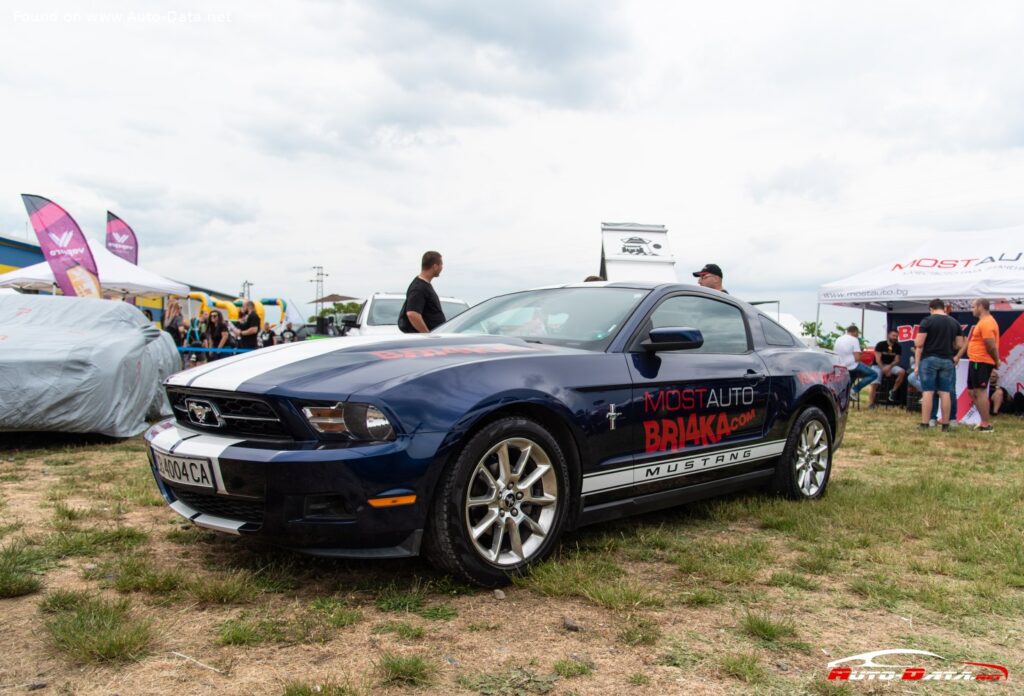
The 2009 facelift for the fifth-generation Mustang brought a refreshed exterior that retained its beloved retro styling while incorporating modern design elements. The Ford Mustang V (facelift 2009) adopted a more aggressive stance with a redesigned front fascia, featuring a larger grille, new headlights, and a power dome hood. The rear also saw updates, including sequential LED taillights – a nod to classic Mustangs – and a restyled bumper. As a coupe body type, it featured two doors and a comfortable four-seat configuration, embodying the classic pony car aesthetic.
Dimensions for the coupe were generous, measuring 188.11 inches (4778 mm) in length, 73.9 inches (1877 mm) in width (80.12 inches or 2035 mm including mirrors), and 55.79 inches (1417 mm) in height. The wheelbase of 107.09 inches (2720 mm) contributed to both its stable ride and classic proportions. Inside, the cabin offered a functional and driver-centric environment. While the overall interior design carried over from the pre-facelift model, materials and finishes saw minor enhancements. Practicality was decent for a sports coupe, with a trunk capacity of 13.38 cu. ft. (379 liters).
Underneath, the Mustang maintained its traditional architecture, featuring an independent MacPherson strut front suspension with a transverse stabilizer bar. The rear, however, continued to utilize a rigid axle suspension with coil springs and a transverse stabilizer. While this solid rear axle design was often a point of contention for handling purists, it contributed to the Mustang’s robust character and drag-racing prowess. Braking was handled by ventilated discs both front (316×30 mm) and rear (300×19 mm), complemented by an Anti-lock Braking System (ABS) for enhanced safety and control. The steering system was a rack and pinion type, now featuring electric power steering (EPAS), which offered improved feel and efficiency over hydraulic systems. The car came with various tire and wheel options, including 225/60 R17, 235/50 R18, and 255/40 R19 tires mounted on 7J x 17, 8J x 18, and 8.5J x 19 wheel rims, respectively, allowing for customization and performance tuning.
Technical Specifications
| Category | Specification | Value |
|---|---|---|
| General Information | ||
| Brand | Ford | |
| Model | Mustang | |
| Generation | Mustang V (facelift 2009) | |
| Type (Engine) | 3.7 V6 (305 Hp) | |
| Start of production | 2010 year | |
| End of production | 2012 year | |
| Powertrain Architecture | Internal Combustion engine | |
| Body type | Coupe | |
| Seats | 4 | |
| Doors | 2 | |
| Performance Specs | ||
| Fuel consumption (economy) – urban | 12.4 l/100 km (19 US mpg) | |
| Fuel consumption (economy) – extra urban | 8.1 l/100 km (29 US mpg) | |
| Fuel consumption (economy) – combined | 10.7 l/100 km (22 US mpg) | |
| Fuel Type | Petrol (Gasoline) | |
| Weight-to-power ratio | 5.1 kg/Hp (194.8 Hp/tonne) | |
| Weight-to-torque ratio | 4.1 kg/Nm (242.7 Nm/tonne) | |
| Engine Specs | ||
| Power | 305 Hp @ 6500 rpm | |
| Power per liter | 81.8 Hp/l | |
| Torque | 380 Nm (280.27 lb.-ft.) @ 4250 rpm | |
| Maximum engine speed | 7000 rpm | |
| Engine layout | Front, Longitudinal | |
| Engine Model/Code | Duratec 37 | |
| Engine displacement | 3727 cm³ (3.7 liters, 227.44 cu. in.) | |
| Number of cylinders | 6 | |
| Engine configuration | V-engine | |
| Cylinder Bore | 95.5 mm (3.76 in.) | |
| Piston Stroke | 86.7 mm (3.41 in.) | |
| Compression ratio | 10.5:1 | |
| Number of valves per cylinder | 4 | |
| Fuel injection system | Multi-port manifold injection | |
| Engine aspiration | Naturally aspirated engine | |
| Valvetrain | DOHC, Ti-VCT | |
| Engine oil capacity | 5.7 l (6.02 US qt) | |
| Coolant | 11.7 l (12.36 US qt) | |
| Space, Volume and Weights | ||
| Kerb Weight | 1566 kg (3452.44 lbs.) | |
| Trunk (boot) space – minimum | 379 l (13.38 cu. ft.) | |
| Fuel tank capacity | 61 l (16.11 US gal) | |
| Permitted trailer load with brakes (12%) | 454 kg (1000.9 lbs.) | |
| Dimensions | ||
| Length | 4778 mm (188.11 in.) | |
| Width | 1877 mm (73.9 in.) | |
| Width including mirrors | 2035 mm (80.12 in.) | |
| Height | 1417 mm (55.79 in.) | |
| Wheelbase | 2720 mm (107.09 in.) | |
| Front track | 1582 mm (62.28 in.) | |
| Rear (Back) track | 1598 mm (62.91 in.) | |
| Minimum turning circle (turning diameter) | 10.3 m (33.79 ft.) | |
| Drivetrain, Brakes and Suspension Specs | ||
| Drivetrain Architecture | The Internal combustion engine (ICE) drives the rear wheels of the vehicle. | |
| Drive wheel | Rear wheel drive | |
| Number of gears and type of gearbox | 6 gears, manual transmission | |
| Front suspension | Independent type McPherson, Transverse stabilizer | |
| Rear suspension | Rigid axle suspension, Transverse stabilizer, Coil spring | |
| Front brakes | Ventilated discs, 316×30 mm | |
| Rear brakes | Ventilated discs, 300×19 mm | |
| Assisting systems | ABS (Anti-lock braking system) | |
| Steering type | Steering rack and pinion | |
| Power steering | Electric Steering | |
| Tires size | 225/60 R17; 235/50 R18; 255/40 R19 | |
| Wheel rims size | 7J x 17; 8J x 18; 8.5J x 19 | |
Legacy and Market Impact
The introduction of the 3.7-liter V6 in the 2010-2012 Ford Mustang V (facelift 2009) was a game-changer for the Mustang lineup and the pony car segment as a whole. For decades, the V6 Mustang was often viewed as the “secretary’s car” or a compromise for those who couldn’t afford the V8 GT. With 305 horsepower, the Duratec 37 engine shattered this perception, transforming the base Mustang into a legitimate performance machine capable of impressive acceleration and handling. This move democratized performance, making a powerful and engaging driving experience accessible to a broader audience.
Its primary competitors in the American market were the Chevrolet Camaro and Dodge Challenger, both of which also offered V6 variants. The Mustang’s updated V6 directly challenged the V6 offerings from its rivals, often outperforming them in terms of raw power and fuel efficiency. While the Camaro and Challenger leaned into their own retro designs, the Mustang’s established heritage and continuous evolution gave it a unique edge. The 3.7 V6 model helped Ford maintain the Mustang’s dominant sales position, proving that a V6 could be both powerful and desirable.
Historically, this generation of Mustang, particularly with the 3.7 V6, played a crucial role in modernizing the pony car concept. It demonstrated that traditional American muscle could embrace contemporary engine technology, such as DOHC and Ti-VCT, without losing its soul. The enhanced performance and efficiency of the V6 also aligned with growing consumer demand for more fuel-conscious vehicles, even in the performance segment. This period cemented the Mustang’s reputation not just as a style icon, but as a vehicle that continually adapted and innovated to remain relevant and competitive. The Ford Mustang V (facelift 2009) 3.7 V6 (305 Hp) stands as a testament to Ford’s commitment to delivering accessible performance and enduring appeal, bridging the gap between its storied past and its technologically advanced future.