The Ford Mustang V (facelift 2012) 3.7 V6 (305 Hp) Automatic: An Overview
The Ford Mustang, an icon of American automotive culture, entered its fifth generation (S197) in 2005, captivating enthusiasts with its retro-futuristic styling that paid homage to the original 1960s models. The subject of this detailed analysis, the Ford Mustang V (facelift 2012) 3.7 V6 (305 Hp) Automatic, represented a significant evolution within this generation. Produced from 2012 to 2014, this particular iteration served as the robust base model, redefining expectations for entry-level performance in the pony car segment. It combined classic Mustang aesthetics with modern engineering, delivering a compelling blend of power, efficiency, and everyday usability that broadened its appeal beyond traditional V8 loyalists.
Positioned as a formidable competitor in the American muscle car landscape, the 2012 Mustang V6 was no longer merely a budget-friendly option. Its potent 3.7-liter V6 engine, coupled with an advanced automatic transmission and traditional rear-wheel-drive architecture, offered a driving experience that was both exhilarating and refined. This facelifted model solidified the S197’s legacy as a successful modern interpretation of a classic, bridging the gap between heritage and contemporary automotive demands.
Engine & Performance: Powering the Ford Mustang V (facelift 2012)
At the heart of the 2012 Ford Mustang V6 lies the acclaimed Duratec 37 engine, a 3.7-liter (3731 cm3 or 227.68 cu. in.) naturally aspirated V-engine. This powerplant was a game-changer for the Mustang’s base model, delivering a robust 305 horsepower at 6500 rpm. This impressive output, especially for a V6, granted the Mustang V6 a power-to-liter ratio of 81.7 Hp/l, showcasing its efficiency and advanced design. Torque figures were equally compelling, peaking at 280.27 lb.-ft. (380 Nm) at a usable 4250 rpm, providing ample thrust for spirited driving and confident highway passing. The engine’s maximum speed of 7000 rpm highlighted its free-revving nature and modern engineering.
The Duratec 37 engine features a sophisticated DOHC (Double Overhead Camshaft) valvetrain with Ti-VCT (Twin Independent Variable Cam Timing). This technology allows for precise control over valve timing on both intake and exhaust camshafts, optimizing performance across the entire rpm range while simultaneously enhancing fuel efficiency and reducing emissions. Fuel is delivered via a multi-port manifold injection system, ensuring reliable and consistent combustion.
Power is channeled to the rear wheels through a smooth and responsive 6-speed automatic transmission. This drivetrain architecture, characteristic of American muscle cars, provides a direct and engaging driving experience. The combination of the powerful V6 and the advanced automatic gearbox resulted in a commendable weight-to-power ratio of 5.2 kg/Hp (190.9 Hp/tonne) and a weight-to-torque ratio of 4.2 kg/Nm (237.8 Nm/tonne), indicating strong acceleration capabilities for its segment.
Despite its performance credentials, the 2012 Mustang V6 also offered respectable fuel economy for a sports coupe. Official figures stood at 19 US mpg in urban driving, an impressive 30.9 US mpg on the extra-urban cycle, and a combined average of 23.1 US mpg. This efficiency, coupled with a 16.11 US gallon (61 liter) fuel tank, provided a practical range for daily commuting and longer road trips, making the V6 a compelling choice for those seeking performance without excessive fuel costs. The engine required 6.02 US quarts (5.7 liters) of oil, while the cooling system held 12.36 US quarts (11.7 liters) of coolant.
Design & Features: The Iconic Stance and Modern Touches
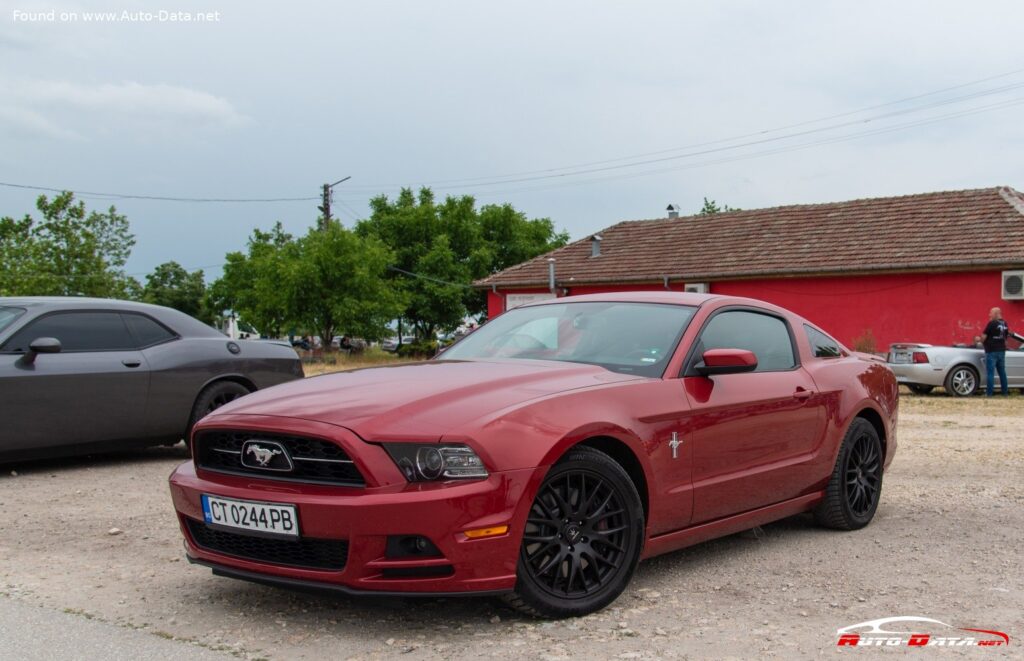
The 2012 Ford Mustang V (facelift 2012) retained the iconic two-door coupe body type, seating four occupants in a 2+2 configuration. Its exterior design was a masterclass in modern retro styling, with the facelift introducing subtle yet effective updates to keep the S197 generation fresh. The overall length measured 188.5 inches (4788 mm), with a width of 73.9 inches (1877 mm) (80.12 inches or 2035 mm including mirrors) and a height of 55.79 inches (1417 mm). These dimensions gave the Mustang its characteristic wide and low stance. The wheelbase of 107.09 inches (2720 mm) contributed to both its stable handling and interior space.
The facelift brought a more aggressive front fascia, featuring a prominent grille, revised headlights often available with HID (High-Intensity Discharge) lighting, and updated front splitter designs. At the rear, the sequential LED taillights, a signature Mustang feature, were refined, and the rear bumper received minor tweaks. These updates ensured the Mustang remained visually striking and contemporary while honoring its heritage.
Inside, the Mustang offered a driver-focused cockpit, blending classic cues with modern amenities. While specific interior features are not detailed in the data, vehicles of this era typically included power windows and locks, air conditioning, and a basic audio system, with options for more advanced infotainment, Bluetooth connectivity, and premium sound systems. The trunk space offered a practical 13.38 cu. ft. (379 liters) of cargo capacity, surprisingly generous for a sports coupe.
Underneath its sculpted body, the 2012 Mustang V6 featured a robust chassis designed for performance. The front suspension utilized an independent McPherson type with a transverse stabilizer, providing precise steering and good road holding. The rear, a point of traditionalist debate, featured a rigid axle suspension with coil springs and a transverse stabilizer. While some competitors had moved to independent rear suspension (IRS), the Mustang’s live axle was lauded for its durability, simplicity, and effectiveness in drag racing, though it could be less refined over rough surfaces.
Braking performance was handled by ventilated discs both front (316×30 mm) and rear (300×19 mm), complemented by an Anti-lock Braking System (ABS) for enhanced safety and control during hard braking. The steering system was a rack and pinion type, assisted by electric power steering (EPAS). EPAS offered variable assist, making the steering lighter at low speeds for maneuverability (minimum turning circle of 33.46 ft or 10.2 m) and firmer at higher speeds for better feedback and stability. The Mustang was available with various tire sizes, including 215/65 R17, 235/50 R18, and 255/40 R19, mounted on corresponding wheel rims (7J x 17, 8J x 18, 8.5J x 19), allowing for different levels of grip and aesthetic preferences. The curb weight of 3522.99 lbs (1598 kg) underscored its solid build.
Technical Specifications
| Category | Specification | Value |
|---|---|---|
General Information |
||
| Brand | Ford | |
| Model | Mustang | |
| Generation | Mustang V (facelift 2012) | |
| Type (Engine) | 3.7 V6 (305 Hp) Automatic | |
| Start of Production | 2012 year | |
| End of Production | 2014 year | |
| Powertrain Architecture | Internal Combustion engine | |
| Body Type | Coupe | |
| Seats | 4 | |
| Doors | 2 | |
Performance Specs |
||
| Fuel Consumption (Urban) | 12.4 l/100 km (19 US mpg) | |
| Fuel Consumption (Extra Urban) | 7.6 l/100 km (30.9 US mpg) | |
| Fuel Consumption (Combined) | 10.2 l/100 km (23.1 US mpg) | |
| Fuel Type | Petrol (Gasoline) | |
| Weight-to-Power Ratio | 5.2 kg/Hp (190.9 Hp/tonne) | |
| Weight-to-Torque Ratio | 4.2 kg/Nm (237.8 Nm/tonne) | |
Engine Specs |
||
| Power | 305 Hp @ 6500 rpm | |
| Power per Liter | 81.7 Hp/l | |
| Torque | 380 Nm (280.27 lb.-ft.) @ 4250 rpm | |
| Maximum Engine Speed | 7000 rpm | |
| Engine Layout | Front, Longitudinal | |
| Engine Model/Code | Duratec 37 | |
| Engine Displacement | 3731 cm3 (227.68 cu. in.) | |
| Number of Cylinders | 6 | |
| Engine Configuration | V-engine | |
| Cylinder Bore | 95.5 mm (3.76 in.) | |
| Piston Stroke | 86.7 mm (3.41 in.) | |
| Compression Ratio | 10.5:1 | |
| Number of Valves per Cylinder | 4 | |
| Fuel Injection System | Multi-port manifold injection | |
| Engine Aspiration | Naturally aspirated engine | |
| Valvetrain | DOHC, Ti-VCT | |
| Engine Oil Capacity | 5.7 l (6.02 US qt) | |
| Coolant Capacity | 11.7 l (12.36 US qt) | |
Space, Volume and Weights |
||
| Kerb Weight | 1598 kg (3522.99 lbs.) | |
| Trunk (Boot) Space – minimum | 379 l (13.38 cu. ft.) | |
| Fuel Tank Capacity | 61 l (16.11 US gal) | |
| Permitted Trailer Load with Brakes (12%) | 454 kg (1000.9 lbs.) | |
Dimensions |
||
| Length | 4788 mm (188.5 in.) | |
| Width | 1877 mm (73.9 in.) | |
| Width including mirrors | 2035 mm (80.12 in.) | |
| Height | 1417 mm (55.79 in.) | |
| Wheelbase | 2720 mm (107.09 in.) | |
| Front Track | 1582 mm (62.28 in.) | |
| Rear (Back) Track | 1598 mm (62.91 in.) | |
| Minimum Turning Circle (Turning Diameter) | 10.2 m (33.46 ft.) | |
Drivetrain, Brakes and Suspension Specs |
||
| Drivetrain Architecture | The Internal combustion engine (ICE) drives the rear wheels of the vehicle. | |
| Drive Wheel | Rear wheel drive | |
| Number of Gears and Type of Gearbox | 6 gears, automatic transmission | |
| Front Suspension | Independent type McPherson, Transverse stabilizer | |
| Rear Suspension | Rigid axle suspension, Transverse stabilizer, Coil spring | |
| Front Brakes | Ventilated discs, 316×30 mm | |
| Rear Brakes | Ventilated discs, 300×19 mm | |
| Assisting Systems | ABS (Anti-lock braking system) | |
| Steering Type | Steering rack and pinion | |
| Power Steering | Electric Steering | |
| Tires Size | 215/65 R17; 235/50 R18; 255/40 R19 | |
| Wheel Rims Size | 7J x 17; 8J x 18; 8.5J x 19 | |
Legacy & Market Impact: Redefining the Base Mustang
The 2012 Ford Mustang V (facelift 2012) 3.7 V6 (305 Hp) Automatic left an indelible mark on the American pony car segment, fundamentally altering perceptions of what a “base model” Mustang could be. Before the introduction of the Duratec 37, the V6 Mustang was often considered a less desirable, underpowered option, primarily serving as a rental fleet vehicle or an entry point for budget-conscious buyers. The 2011 model year, which introduced this potent V6, and its facelifted 2012-2014 iteration, completely rewrote that narrative.
Its 305 horsepower output was not only significantly higher than previous V6 Mustangs but also surpassed the horsepower figures of many V8 Mustangs from previous generations, including the iconic 5.0L HO (High Output) V8s of the Fox Body era. This made the V6 Mustang a genuinely fast and engaging car in its own right, capable of respectable acceleration and dynamic performance that surprised many critics and enthusiasts alike. It offered a compelling combination of power and fuel efficiency (23.1 US mpg combined), making it a viable daily driver that didn’t compromise on the Mustang’s core values of style and performance.
In terms of market impact, the 3.7 V6 Mustang successfully broadened the car’s appeal. It attracted a new demographic of buyers who desired the Mustang’s classic looks and rear-wheel-drive dynamics but were perhaps deterred by the V8’s higher price point, insurance costs, or fuel consumption. It allowed Ford to better compete with the V6 variants of its chief rivals, the Chevrolet Camaro and Dodge Challenger, both of which also offered powerful V6 options in this era. The Mustang’s traditional live axle rear suspension, while a point of contention for some, resonated with purists and those who appreciated its robustness and simplicity, contributing to its distinct driving character.
The legacy of this particular Mustang generation, and especially the potent V6, is significant. It demonstrated Ford’s commitment to offering strong performance across its entire Mustang lineup, not just at the top tier. This strategic move paved the way for future advancements, including the highly successful EcoBoost four-cylinder Mustang that followed, proving that a Mustang didn’t necessarily need eight cylinders to be exciting and relevant. The 2012-2014 V6 Mustang solidified its reputation as a modern classic, a car that successfully blended heritage styling with contemporary performance, efficiency, and technology, ensuring the Mustang’s continued reign as a cultural icon and a formidable sports coupe in the global automotive landscape.