The 2009 Ford Mustang V (facelift) 4.0 V6 Automatic: An American Icon Refined
The Ford Mustang, a quintessential American pony car, has captivated enthusiasts for generations with its blend of accessible performance and distinctive styling. The fifth-generation Mustang, internally designated S197, marked a significant return to its heritage, drawing heavily on the design cues of the original 1960s models. Introduced in 2005, the S197 proved immensely popular, leading to a significant refresh for the 2009 model year (often referred to as the 2010 model year in marketing, but technically released in late 2009). This updated iteration, specifically the Ford Mustang V (facelift 2009) 4.0 V6 Automatic, offered a compelling entry point into the Mustang lineup, combining classic aesthetics with modern refinements and a robust powertrain. As the base model coupe, it aimed to deliver the iconic Mustang experience to a broad audience, balancing everyday usability with the undeniable allure of American muscle car heritage.
Engine and Powertrain Dynamics
Powering the 2009 Ford Mustang V (facelift) 4.0 V6 Automatic was Ford’s venerable 4.0-liter Cologne V6 engine. This naturally aspirated, single overhead camshaft (SOHC) powerplant was a familiar and reliable choice, having seen duty in various Ford and Mercury vehicles for years. In this application, it produced a respectable 210 horsepower at 5300 rpm and a solid 239.71 lb.-ft. of torque at a lower 3500 rpm. While not the fire-breathing V8 of the GT model, this V6 offered ample power for daily driving and highway cruising, providing a smooth and predictable power delivery characteristic of its multi-port manifold injection system.
The engine’s layout was a traditional front-longitudinal configuration, sending power to the rear wheels, a hallmark of classic American performance cars. With a compression ratio of 9.7:1 and two valves per cylinder, the 4.0-liter V6 prioritized durability and low-end torque. The maximum engine speed was set at 6100 rpm. Mated to this V6 was a 5-speed automatic transmission, offering a balance of efficiency and convenience. This automatic gearbox was well-suited for the engine’s torque curve, providing smooth shifts and contributing to the car’s relaxed cruising demeanor.
Fuel economy for the Ford Mustang V (facelift 2009) 4.0 V6 Automatic was competitive for its class, with EPA estimates of 16 US mpg in urban driving conditions and 24 US mpg on the highway. With a 16.11 US gallon fuel tank, the Mustang offered a decent cruising range. The vehicle’s weight-to-power ratio stood at 7.5 kg/Hp (approximately 16.5 lbs/Hp), while the weight-to-torque ratio was 4.8 kg/Nm (approximately 10.6 lbs/Nm), indicating its accessible performance characteristics.
Styling and Interior Appointments
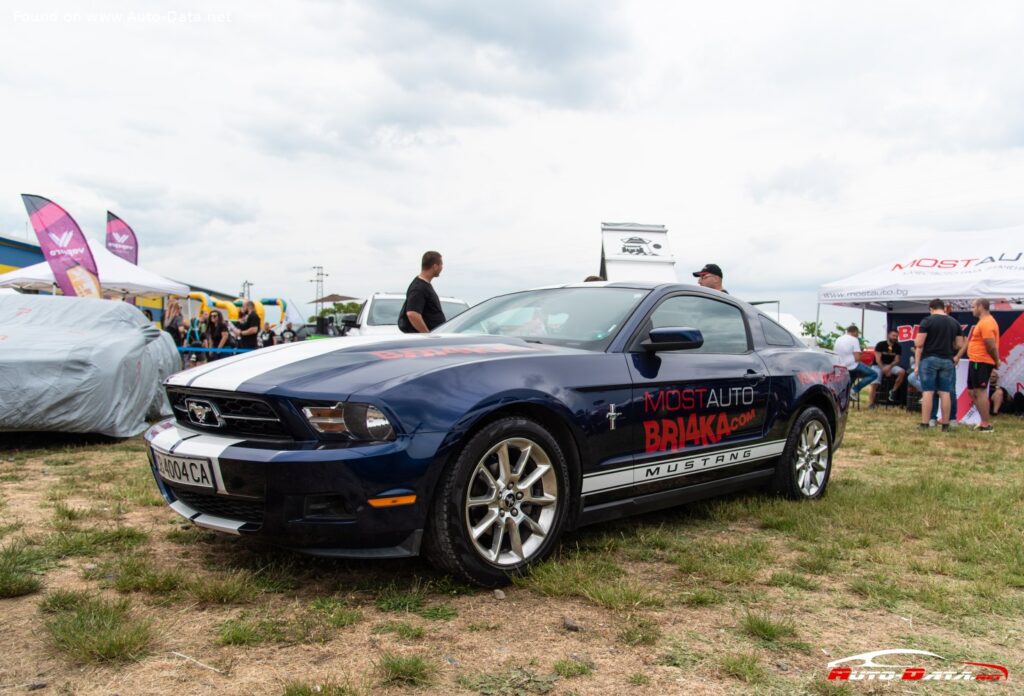
The 2009 facelift brought subtle yet impactful changes to the Mustang’s already successful retro-futuristic design. The Coupe body style, with its two doors and seating for four, remained the core offering. Exterior updates included a redesigned front fascia with a more aggressive grille and new headlights that featured integrated turn signals. The rear received updated taillights, notably incorporating sequential turn signals on all models, a distinctive and highly appreciated feature that harked back to classic Mustangs. These changes sharpened the car’s appearance, giving it a more modern edge while retaining its unmistakable heritage.
Dimensionally, the 2009 Mustang Coupe measured 188.11 inches in length, 73.9 inches in width (80.12 inches including mirrors), and 55.59 inches in height. Its wheelbase of 107.09 inches contributed to a stable ride and classic proportions. The interior continued the retro theme, featuring a dual-cowl dashboard design reminiscent of the 1960s Mustangs, but updated with contemporary materials and technology. Available features for the era included Ford’s SYNC infotainment system, ambient lighting, and improved material quality in certain areas, enhancing the cabin experience. The trunk offered a practical 13.38 cubic feet of cargo space, making the Mustang a surprisingly capable daily driver.
Chassis, Handling, and Safety
The S197 generation Mustang, including the 2009 facelift model, utilized a robust chassis designed to handle its power and provide a comfortable yet engaging driving experience. The front suspension featured an independent MacPherson strut setup with a transverse stabilizer, offering precise steering and good road manners. At the rear, the Mustang retained a solid axle suspension, a traditional choice for American muscle cars, which included coil springs and a transverse stabilizer. While some competitors had moved to independent rear suspension, Ford maintained the solid axle for its simplicity, durability, and cost-effectiveness, which also appealed to the traditionalist Mustang buyer and aftermarket enthusiasts.
Braking performance was handled by ventilated discs at both the front (293×30 mm) and rear (300×19 mm), providing confident stopping power. An Anti-lock Braking System (ABS) was standard, enhancing safety and control during emergency braking. The steering system was a hydraulic rack and pinion setup, offering direct feedback to the driver, a characteristic often preferred by enthusiasts over purely electronic systems. The Mustang came equipped with 215/60 R17 tires on 7J x 17 wheels as standard, with optional 235/50 R18 tires on 8J x 18 rims available for improved grip and aesthetics. With a minimum turning circle of 33.46 feet, the Mustang was surprisingly maneuverable for its size.
Technical Specifications: Ford Mustang V (facelift 2009) 4.0 V6 Automatic
| Category | Specification |
|---|---|
| General Information | |
| Brand | Ford |
| Model | Mustang |
| Generation | Mustang V (facelift 2009) |
| Type (Engine) | 4.0 V6 (210 Hp) Automatic |
| Start of Production | 2009 year |
| End of Production | 2010 year |
| Powertrain Architecture | Internal Combustion engine |
| Body Type | Coupe |
| Seats | 4 |
| Doors | 2 |
| Performance Specs | |
| Fuel Consumption (Urban) | 16 US mpg |
| Fuel Consumption (Extra Urban) | 24 US mpg |
| Fuel Type | Petrol (Gasoline) |
| Weight-to-Power Ratio | 7.5 kg/Hp (134 Hp/tonne) |
| Weight-to-Torque Ratio | 4.8 kg/Nm (207.4 Nm/tonne) |
| Engine Specs | |
| Power | 210 Hp @ 5300 rpm |
| Power per Liter | 52.4 Hp/l |
| Torque | 239.71 lb.-ft. @ 3500 rpm |
| Maximum Engine Speed | 6100 rpm |
| Engine Layout | Front, Longitudinal |
| Engine Model/Code | Cologne |
| Engine Displacement | 4.0 liters (244.64 cu. in.) |
| Number of Cylinders | 6 |
| Engine Configuration | V-engine |
| Cylinder Bore | 3.95 in. (100.4 mm) |
| Piston Stroke | 3.32 in. (84.4 mm) |
| Compression Ratio | 9.7:1 |
| Number of Valves per Cylinder | 2 |
| Fuel Injection System | Multi-port manifold injection |
| Engine Aspiration | Naturally aspirated engine |
| Valvetrain | SOHC |
| Engine Oil Capacity | 4.97 US qt (4.7 l) |
| Coolant Capacity | 12.47 US qt (11.8 l) |
| Space, Volume and Weights | |
| Kerb Weight | 3454.64 lbs. (1567 kg) |
| Trunk (boot) Space – Minimum | 13.38 cu. ft. (379 l) |
| Fuel Tank Capacity | 16.11 US gal (61 l) |
| Permitted Trailer Load (with brakes, 12%) | 1000.9 lbs. (454 kg) |
| Dimensions | |
| Length | 188.11 in. (4778 mm) |
| Width | 73.9 in. (1877 mm) |
| Width Including Mirrors | 80.12 in. (2035 mm) |
| Height | 55.59 in. (1412 mm) |
| Wheelbase | 107.09 in. (2720 mm) |
| Front Track | 62.28 in. (1582 mm) |
| Rear (Back) Track | 62.91 in. (1598 mm) |
| Minimum Turning Circle (Turning Diameter) | 33.46 ft. (10.2 m) |
| Drivetrain, Brakes and Suspension Specs | |
| Drivetrain Architecture | The Internal combustion engine (ICE) drives the rear wheels of the vehicle. |
| Drive Wheel | Rear wheel drive |
| Number of Gears and Type of Gearbox | 5 gears, automatic transmission |
| Front Suspension | Independent type McPherson, Transverse stabilizer |
| Rear Suspension | Rigid axle suspension, Transverse stabilizer, Coil spring |
| Front Brakes | Ventilated discs, 293×30 mm |
| Rear Brakes | Ventilated discs, 300×19 mm |
| Assisting Systems | ABS (Anti-lock braking system) |
| Steering Type | Steering rack and pinion |
| Power Steering | Hydraulic Steering |
| Tires Size | 215/60 R17; 235/50 R18 |
| Wheel Rims Size | 7J x 17; 8J x 18 |
Legacy and Market Standing
The 2009 Ford Mustang V (facelift) 4.0 V6 Automatic occupied a vital position within the Mustang lineup and the broader American automotive market. It served as the accessible entry point, offering the iconic styling and spirit of the Mustang at a more affordable price point and with better fuel economy compared to its V8-powered GT sibling. This made it a popular choice for younger buyers, daily commuters, or those who simply desired the Mustang aesthetic without needing the ultimate performance.
Competitors in its segment included the newly reintroduced Chevrolet Camaro (which debuted in 2010, closely following the Mustang’s facelift) and the Dodge Challenger (relaunched in 2008). While the Camaro and Challenger often offered more potent V6 options, the Mustang’s established legacy, continuous production, and refined retro styling gave it a strong competitive edge. The V6 Mustang was often cross-shopped not only against its direct pony car rivals but also with more mainstream sporty coupes like the Honda Civic Si Coupe or the Hyundai Genesis Coupe, although the Mustang’s unique character firmly set it apart.
The S197 generation, and particularly this facelifted model, is significant for bridging the gap between the “New Edge” SN95 generation and the more technologically advanced, Coyote V8-powered S197 that would follow in 2011. The 2009 model represented the final iteration of the venerable Cologne 4.0-liter V6 in the Mustang, marking the end of an era before Ford transitioned to its more modern, powerful, and efficient 3.7-liter Cyclone V6. Despite being the base model, the Ford Mustang V (facelift 2009) 4.0 V6 Automatic contributed significantly to the Mustang’s enduring appeal, offering a compelling blend of classic American styling, a comfortable ride, and reliable performance that resonated with a wide range of buyers and cemented its place as a beloved part of automotive history. Its robust construction and ample aftermarket support ensure it remains a popular choice for enthusiasts looking for an iconic and customizable American coupe.