The Ford Mustang V (facelift 2009) GT 4.6 V8 (315 Hp) Automatic: A Modern Classic
The Ford Mustang, an icon of American automotive culture, entered its fifth generation (S197) in 2005, marking a significant return to its heritage-inspired design. The generation received a notable facelift for the 2009 model year, bringing updated styling and interior refinements while retaining its potent powertrain options. Among the most popular configurations was the Ford Mustang V (facelift 2009) GT 4.6 V8 (315 Hp) Automatic, a quintessential American muscle car that perfectly blended retro aesthetics with contemporary performance. This particular variant, produced from 2009 to 2010, embodied the spirit of the Mustang GT, offering a compelling package of V8 power, rear-wheel drive dynamics, and an unmistakable road presence. It continued to be a strong contender in the revived pony car segment, appealing to enthusiasts seeking an authentic American driving experience.
Engine and Performance: The Heart of the Ford Mustang V (facelift 2009) GT 4.6 V8 Automatic
At the core of the Ford Mustang V (facelift 2009) GT 4.6 V8 (315 Hp) Automatic lies Ford’s venerable 4.6-liter “Modular” V8 engine. This naturally aspirated powerplant, with its robust V-engine configuration and 8 cylinders, was a hallmark of the S197 GT. For the facelifted model, it delivered a potent 315 horsepower at 6000 rpm, a significant jump from earlier versions, complemented by 325.26 lb.-ft. of torque peaking at a very accessible 4250 rpm. This engine was designed for strong, linear acceleration, characteristic of American muscle cars, providing ample power across the rev range up to its maximum engine speed of 6250 rpm.
The 4.6-liter V8 utilized a Single Overhead Cam (SOHC) valvetrain with 3 valves per cylinder, a setup that balanced performance with reliability and a distinct V8 rumble. Fuel delivery was managed by a multi-port manifold injection system, ensuring efficient combustion. With a compression ratio of 9.8:1, the engine was optimized for regular gasoline, making it a practical choice for daily driving while still offering exhilarating performance.
Power was sent to the rear wheels via a 5-speed automatic transmission, a popular choice for those seeking a balance of spirited driving and comfortable cruising. While manual transmissions were available and often preferred by purists, the automatic offered smooth shifts and allowed the driver to fully exploit the engine’s torque without constant clutch work. This powertrain architecture, with its front, longitudinal engine layout driving the rear wheels, provided the classic muscle car feel and handling characteristics. The car’s weight-to-power ratio of 5.2 kg/Hp (194 Hp/tonne) and weight-to-torque ratio of 3.7 kg/Nm (271.6 Nm/tonne) underscored its performance capabilities, allowing for brisk acceleration and a thrilling driving experience. Fuel economy for this V8, while not its primary selling point, was rated at 17 US mpg in urban conditions and 23.1 US mpg on the highway, respectable figures for a naturally aspirated V8 of its size and power.
Design and Features of the Ford Mustang V (facelift 2009) GT 4.6 V8 Automatic
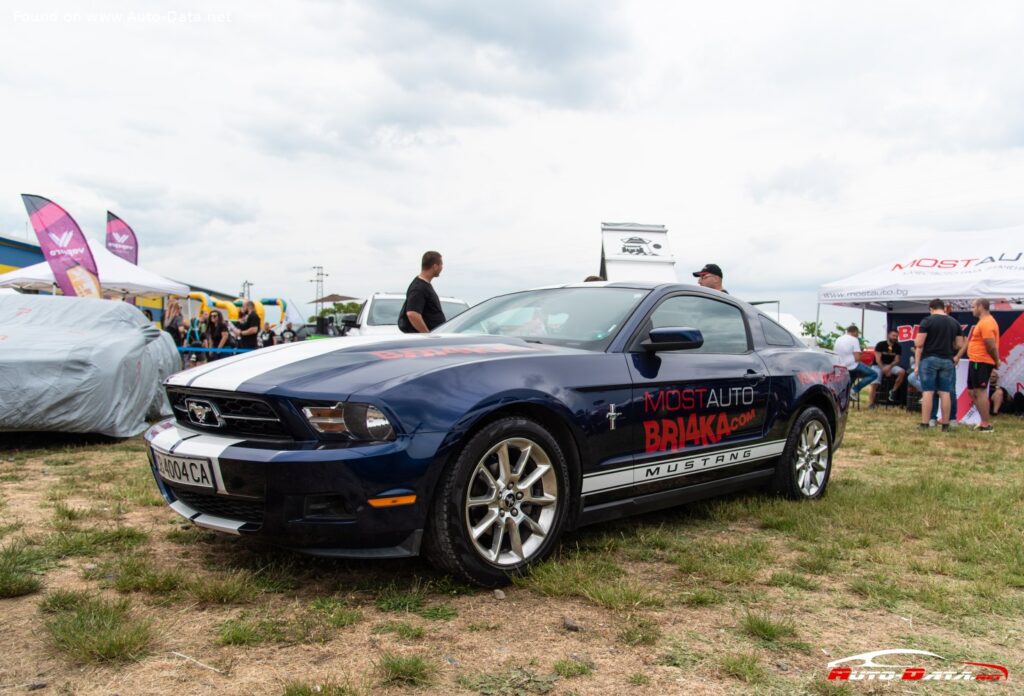
The Ford Mustang V (facelift 2009) GT 4.6 V8 (315 Hp) Automatic maintained the S197 generation’s successful “retro-futuristic” design language, drawing heavily from the iconic first-generation Mustangs of the late 1960s. The facelift for 2009 introduced several key visual updates that refined its aggressive stance. These included a revised front fascia with a more prominent grille and updated headlights, giving the car a sharper, more modern appearance while preserving its classic cues. The rear also received attention, with new sequential LED taillights that harkened back to the original Mustang’s design and a redesigned bumper.
As a 2-door coupe, the Mustang GT offered seating for four, though the rear seats were, as is typical for pony cars, best suited for occasional use or smaller passengers. The interior also benefited from the 2009 facelift, featuring improved materials, updated instrumentation, and a more driver-focused cockpit. The overall design emphasized a blend of modern ergonomics with nostalgic touches, such as the classic dual-cowl dashboard. Key dimensions included a length of 188.11 inches, a width of 73.9 inches (80.12 inches including mirrors), and a height of 55.59 inches, contributing to its muscular and planted stance. The wheelbase measured 107.09 inches, providing stability at speed.
The suspension setup for the S197 Mustang GT featured an independent McPherson strut system at the front with a transverse stabilizer, offering precise steering and good handling. The rear, however, retained a rigid axle suspension with coil springs and a transverse stabilizer. While this solid axle design was often criticized by some for being less sophisticated than independent rear suspensions found in some competitors, it was a cost-effective solution that contributed to the Mustang’s robust character and was highly favored by drag racers for its durability. Braking performance was handled by ventilated disc brakes both front (316×30 mm) and rear (300×19 mm), complemented by an Anti-lock Braking System (ABS) for enhanced safety and control. The car rode on standard 235/50 R18 tires on 8J x 18 wheels, with an option for 245/45 R19 tires on 8.5J x 19 wheels, further enhancing its grip and visual appeal. Power steering was hydraulic, providing direct feedback to the driver.
Technical Specifications: Ford Mustang V (facelift 2009) GT 4.6 V8 (315 Hp) Automatic
| Category | Specification |
|---|---|
| General Information | |
| Brand | Ford |
| Model | Mustang |
| Generation | Mustang V (facelift 2009) |
| Type (Engine) | GT 4.6 V8 (315 Hp) Automatic |
| Start of Production | 2009 year |
| End of Production | 2010 year |
| Powertrain Architecture | Internal Combustion engine |
| Body Type | Coupe |
| Seats | 4 |
| Doors | 2 |
| Performance Specs | |
| Fuel Consumption (Urban) | 13.8 l/100 km (17 US mpg) |
| Fuel Consumption (Extra Urban) | 10.2 l/100 km (23.1 US mpg) |
| Fuel Type | Petrol (Gasoline) |
| Weight-to-Power Ratio | 5.2 kg/Hp (194 Hp/tonne) |
| Weight-to-Torque Ratio | 3.7 kg/Nm (271.6 Nm/tonne) |
| Engine Specs | |
| Power | 315 Hp @ 6000 rpm |
| Power per Liter | 68.5 Hp/l |
| Torque | 441 Nm @ 4250 rpm (325.26 lb.-ft. @ 4250 rpm) |
| Maximum Engine Speed | 6250 rpm |
| Engine Layout | Front, Longitudinal |
| Engine Model/Code | Modular |
| Engine Displacement | 4601 cm3 (280.77 cu. in.) |
| Number of Cylinders | 8 |
| Engine Configuration | V-engine |
| Cylinder Bore | 90.2 mm (3.55 in.) |
| Piston Stroke | 90 mm (3.54 in.) |
| Compression Ratio | 9.8:1 |
| Number of Valves per Cylinder | 3 |
| Fuel Injection System | Multi-port manifold injection |
| Engine Aspiration | Naturally aspirated engine |
| Valvetrain | SOHC |
| Engine Oil Capacity | 5.7 l (6.02 US qt) |
| Coolant Capacity | 12.9 l (13.63 US qt) |
| Space, Volume and Weights | |
| Kerb Weight | 1624 kg (3580.31 lbs) |
| Trunk (Boot) Space – Minimum | 379 l (13.38 cu. ft.) |
| Fuel Tank Capacity | 61 l (16.11 US gal) |
| Permitted Trailer Load with Brakes (12%) | 454 kg (1000.9 lbs) |
| Dimensions | |
| Length | 4778 mm (188.11 in.) |
| Width | 1877 mm (73.9 in.) |
| Width Including Mirrors | 2035 mm (80.12 in.) |
| Height | 1412 mm (55.59 in.) |
| Wheelbase | 2720 mm (107.09 in.) |
| Front Track | 1582 mm (62.28 in.) |
| Rear (Back) Track | 1598 mm (62.91 in.) |
| Minimum Turning Circle (Turning Diameter) | 11.5 m (37.73 ft.) |
| Drivetrain, Brakes and Suspension Specs | |
| Drivetrain Architecture | The Internal combustion engine (ICE) drives the rear wheels of the vehicle. |
| Drive Wheel | Rear wheel drive |
| Number of Gears and Type of Gearbox | 5 gears, automatic transmission |
| Front Suspension | Independent type McPherson, Transverse stabilizer |
| Rear Suspension | Rigid axle suspension, Transverse stabilizer, Coil spring |
| Front Brakes | Ventilated discs, 316×30 mm |
| Rear Brakes | Ventilated discs, 300×19 mm |
| Assisting Systems | ABS (Anti-lock braking system) |
| Steering Type | Steering rack and pinion |
| Power Steering | Hydraulic Steering |
| Tires Size | 235/50 R18; 245/45 R19 |
| Wheel Rims Size | 8J x 18; 8.5J x 19 |
Legacy and Market Impact
The Ford Mustang V (S197) generation, and particularly its facelifted 2009-2010 models like the Ford Mustang V (facelift 2009) GT 4.6 V8 (315 Hp) Automatic, played a crucial role in revitalizing the American muscle car segment. Its retro styling, which drew heavily from the beloved first-generation Mustangs, struck a chord with both nostalgic enthusiasts and new buyers. This generation arrived at a time when its traditional rivals, the Chevrolet Camaro and Dodge Challenger, were either absent from the market or just beginning their own revivals. The S197 Mustang thus enjoyed a significant period as the undisputed king of the pony cars, solidifying its reputation and market dominance.
Competitors for the Mustang GT during this period primarily included the newly reintroduced Dodge Challenger R/T and the Chevrolet Camaro, which made its highly anticipated return in 2010. While the Challenger offered a similar retro aesthetic and a potent HEMI V8, and the Camaro boasted a more modern independent rear suspension, the Mustang GT held its own with a lighter curb weight of 3580.31 lbs and a well-established fan base. The 4.6-liter V8, while perhaps not as powerful as some of its rivals’ larger displacement engines, was lauded for its reliability, tunability, and characteristic exhaust note, which was pure Americana.
The S197 generation, especially the GT models, is remembered for its engaging driving experience, accessible performance, and strong aftermarket support. It offered a relatively affordable entry into V8-powered, rear-wheel-drive performance, making it a popular choice for a wide range of buyers. The automatic transmission variant, in particular, broadened its appeal, making the raw power of the V8 manageable for daily commutes and less experienced drivers, without sacrificing the fun factor. The legacy of the 2009-2010 Mustang GT is one of a successful evolution, bridging the gap between classic muscle car ethos and modern automotive standards, ensuring the Mustang’s continued reign as a cultural icon and a performance benchmark in its class. It cemented the Mustang’s position as a vehicle that is not just about speed, but about a feeling, a style, and a piece of American automotive history that continues to inspire generations.