Ford Mustang V (facelift 2009) GT 5.0 V8 (412 Hp): A Modern Muscle Icon
The Ford Mustang, an enduring icon of American automotive culture, entered its fifth generation (S197) in 2005, blending retro-futuristic styling with modern engineering. The subject of this detailed analysis is the significantly updated Ford Mustang V (facelift 2009) GT 5.0 V8 (412 Hp), a model that marked a pivotal moment in the Mustang’s storied history. Introduced for the 2010 model year and produced through 2012, this iteration brought a refreshed design, enhanced interior, and most notably, the triumphant return of the legendary “5.0” designation, signifying a potent new V8 engine. This particular model firmly re-established the Mustang GT as a formidable contender in the pony car segment, offering an exhilarating blend of classic muscle car appeal and contemporary performance.
Positioned as the performance flagship within the standard Mustang lineup, the GT 5.0 V8 (412 Hp) appealed directly to enthusiasts seeking robust power, engaging driving dynamics, and the unmistakable rumble of a naturally aspirated American V8. Its introduction was a direct response to renewed competition in the segment, particularly from the revitalized Chevrolet Camaro and Dodge Challenger, ushering in a new era of the “pony car wars.”
Engine and Performance: The Return of the Coyote 5.0
At the heart of the Ford Mustang V (facelift 2009) GT 5.0 V8 (412 Hp) lies one of Ford’s most celebrated modern engines: the “Coyote” 5.0-liter V8. This all-new engine, with an exact displacement of 4,951 cubic centimeters (302.13 cubic inches), was a technological marvel for its time, especially compared to its predecessor. Unlike the outgoing 4.6-liter V8, the Coyote featured a modern DOHC (Double Overhead Camshaft) valvetrain with four valves per cylinder and Twin Independent Variable Cam Timing (Ti-VCT). This advanced setup allowed for precise control over valve overlap, optimizing both power output and fuel efficiency across the rev range.
The Coyote V8 delivered an impressive 412 horsepower at 6,500 rpm, a significant jump that elevated the Mustang GT’s performance credentials. Torque output was equally robust, peaking at 390.17 lb.-ft. (529 Nm) at 4,250 rpm, providing ample thrust for spirited acceleration. With a maximum engine speed of 7,000 rpm, the 5.0 V8 was eager to rev, offering a thrilling powerband that was characteristic of classic muscle cars but delivered with modern refinement. Fueling was handled by a multi-port manifold injection system, ensuring efficient and precise fuel delivery to each of its eight cylinders.
Power was exclusively sent to the rear wheels via a robust 6-speed manual transmission, offering enthusiasts a direct and engaging driving experience. This powertrain architecture, combining a powerful front-longitudinal engine with rear-wheel drive, is a hallmark of American performance cars. The vehicle’s curb weight of 3,604.56 lbs (1,635 kg) resulted in a favorable weight-to-power ratio of approximately 4 kg/Hp (252 Hp/tonne), underscoring its performance potential.
Despite its potent output, the GT 5.0 V8 offered a respectable balance of performance and efficiency for its class. Fuel consumption figures were rated at an estimated 17 US mpg in urban driving, 26.1 US mpg on the highway, and a combined average of 19.9 US mpg. These figures, while not groundbreaking, were competitive for a naturally aspirated V8 of this caliber, thanks in part to the advanced engine technology.
Design and Features: Refined Aggression
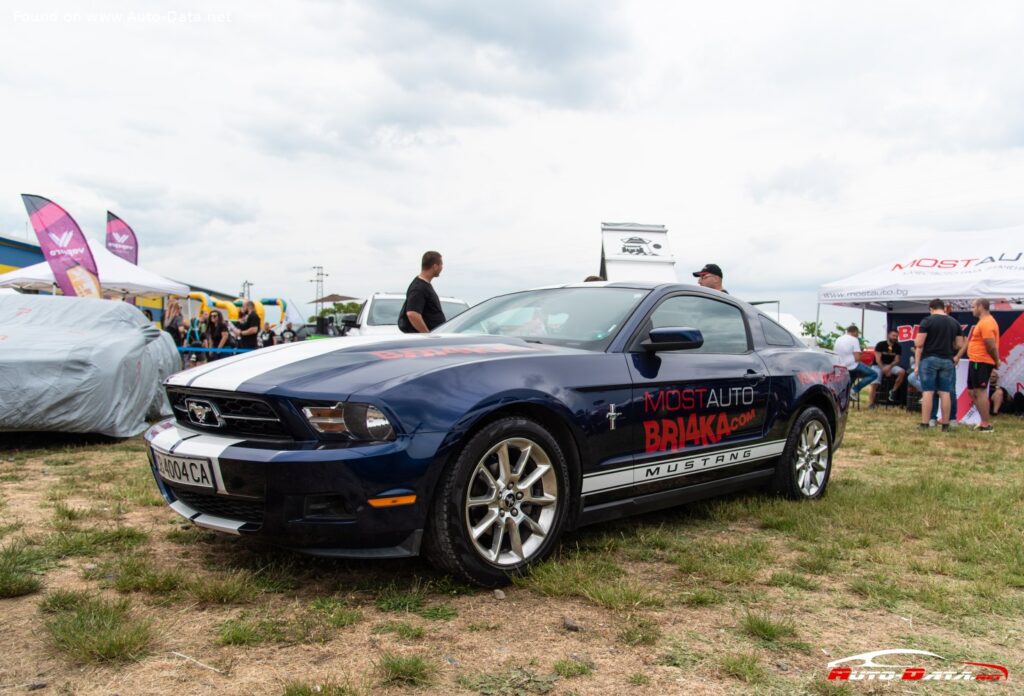
The 2009 facelift of the fifth-generation Mustang brought a more aggressive and refined exterior design to the iconic pony car. The Ford Mustang V (facelift 2009) retained its classic long hood, short deck proportions but received significant updates. The front fascia was redesigned with a more prominent grille and sharper, more angular headlights that incorporated integrated turn signals. A power dome hood was added, hinting at the muscle beneath. The rear of the car featured new sequential LED tail lights, a nod to classic Mustangs, and a redesigned rear bumper and diffuser.
Measuring 188.11 inches (4,778 mm) in length, 73.9 inches (1,877 mm) in width (80.12 inches including mirrors), and 55.79 inches (1,417 mm) in height, the Mustang GT Coupe maintained a substantial and muscular stance. The 107.09-inch (2,720 mm) wheelbase contributed to both stability and interior space for its 4-seat, 2-door coupe configuration.
Inside, the facelifted Mustang GT saw improvements in materials and design. While specific interior features are not detailed in the data, the era’s models typically included Ford’s SYNC infotainment system (optional), improved gauges, and more comfortable seating. Safety was addressed with standard features such as ABS (Anti-lock Braking System), a crucial assisting system for managing the car’s significant power.
Underneath, the chassis received refinements. The front suspension utilized an independent McPherson type with a transverse stabilizer, while the rear retained the traditional rigid axle suspension with coil springs and a transverse stabilizer – a setup that, while often criticized for its simplicity, was a part of the Mustang’s character and allowed for excellent straight-line performance. Braking power was supplied by large ventilated discs, measuring 336×36 mm at the front and 300×19 mm at the rear, ensuring confident stopping performance. Electric power steering offered precise control and improved efficiency. The car rode on a choice of tire sizes, including 235/50 R18, 245/45 R19, or 255/40 R19, mounted on corresponding 8J x 18, 8.5J x 19, or 9J x 19 wheel rims.
Technical Specifications
| Category | Specification |
|---|---|
| General Information | |
| Brand | Ford |
| Model | Mustang |
| Generation | Mustang V (facelift 2009) |
| Type (Engine) | GT 5.0 V8 (412 Hp) |
| Start of Production | 2010 year |
| End of Production | 2012 year |
| Powertrain Architecture | Internal Combustion engine |
| Body type | Coupe |
| Seats | 4 |
| Doors | 2 |
| Performance Specs | |
| Fuel Consumption (Urban) | 13.8 l/100 km (17 US mpg) |
| Fuel Consumption (Extra Urban) | 9 l/100 km (26.1 US mpg) |
| Fuel Consumption (Combined) | 11.8 l/100 km (19.9 US mpg) |
| Fuel Type | Petrol (Gasoline) |
| Weight-to-power ratio | 4 kg/Hp (252 Hp/tonne) |
| Weight-to-torque ratio | 3.1 kg/Nm (323.5 Nm/tonne) |
| Engine Specs | |
| Power | 412 Hp @ 6500 rpm |
| Power per liter | 83.2 Hp/l |
| Torque | 529 Nm (390.17 lb.-ft.) @ 4250 rpm |
| Maximum engine speed | 7000 rpm |
| Engine layout | Front, Longitudinal |
| Engine Model/Code | Coyote |
| Engine displacement | 4951 cm3 (302.13 cu. in.) |
| Number of cylinders | 8 |
| Engine configuration | V-engine |
| Cylinder Bore | 92.2 mm (3.63 in.) |
| Piston Stroke | 92.7 mm (3.65 in.) |
| Compression ratio | 11:1 |
| Number of valves per cylinder | 4 |
| Fuel injection system | Multi-port manifold injection |
| Engine aspiration | Naturally aspirated engine |
| Valvetrain | DOHC, Ti-VCT |
| Engine oil capacity | 7.6 l (8.03 US qt) |
| Engine oil specification | Not specified in data |
| Coolant capacity | 12.3 l (13 US qt) |
| Space, Volume and Weights | |
| Kerb Weight | 1635 kg (3604.56 lbs) |
| Trunk (boot) space – minimum | 379 l (13.38 cu. ft.) |
| Fuel tank capacity | 61 l (16.11 US gal) |
| Permitted trailer load with brakes (12%) | 454 kg (1000.9 lbs) |
| Dimensions | |
| Length | 4778 mm (188.11 in.) |
| Width | 1877 mm (73.9 in.) |
| Width including mirrors | 2035 mm (80.12 in.) |
| Height | 1417 mm (55.79 in.) |
| Wheelbase | 2720 mm (107.09 in.) |
| Front track | 1582 mm (62.28 in.) |
| Rear (Back) track | 1598 mm (62.91 in.) |
| Minimum turning circle | 11.2 m (36.75 ft.) |
| Drivetrain, Brakes and Suspension Specs | |
| Drivetrain Architecture | The Internal combustion engine (ICE) drives the rear wheels of the vehicle. |
| Drive wheel | Rear wheel drive |
| Number of gears and type of gearbox | 6 gears, manual transmission |
| Front suspension | Independent type McPherson, Transverse stabilizer |
| Rear suspension | Rigid axle suspension, Transverse stabilizer, Coil spring |
| Front brakes | Ventilated discs, 336×36 mm |
| Rear brakes | Ventilated discs, 300×19 mm |
| Assisting systems | ABS (Anti-lock braking system) |
| Steering type | Steering rack and pinion |
| Power steering | Electric Steering |
| Tires size | 235/50 R18; 245/45 R19; 255/40 R19 |
| Wheel rims size | 8J x 18; 8.5J x 19; 9J x 19 |
Legacy and Market Impact of the Ford Mustang V (facelift 2009)
The Ford Mustang V (facelift 2009) GT 5.0 V8 (412 Hp) holds a significant place in the annals of Mustang history, primarily due to the reintroduction of the “5.0” moniker and the game-changing Coyote engine. This model not only revitalized the Mustang’s performance image but also cemented its position as a dominant force in the modern muscle car segment. For many enthusiasts, the return of the 5.0-liter V8 was a spiritual successor to the Fox Body Mustang’s legendary 5.0, combining heritage with cutting-edge technology.
Its primary competitors during its production run were the Chevrolet Camaro SS and the Dodge Challenger R/T and SRT8 models. The Mustang GT 5.0 offered a compelling alternative, often praised for its balanced chassis (despite the live rear axle), driver engagement, and the distinctive sound and feel of its DOHC V8. While the live axle was a point of contention for some, it also contributed to the car’s raw, authentic muscle car character, particularly appealing to drag racers and those who appreciated its straightforward approach.
The reputation of this specific Mustang GT generation is overwhelmingly positive. It is widely regarded as one of the best iterations of the S197 platform, bridging the gap between the retro styling of the early 2000s and the more sophisticated performance of the later S550 generation. Its impact was profound, stimulating a new wave of interest in American performance cars and pushing both Ford and its rivals to innovate further.
Historically, the 2010-2012 Mustang GT 5.0 V8 (412 Hp) is celebrated for bringing the Mustang into the modern era of high-horsepower, technologically advanced V8s while retaining its core identity. It showcased Ford’s engineering prowess and commitment to its most iconic nameplate. Today, these models are highly sought after by collectors and enthusiasts alike, valued for their powerful Coyote engine, engaging manual transmission option, and their role in a vibrant period of American automotive performance. The legacy of this Mustang is one of renewed vigor, proving that the pony car could evolve and thrive while staying true to its roots.