Ford Mustang V (Facelift 2009) GT 5.0 V8 Automatic
The Ford Mustang, an icon of American automotive prowess, entered its fifth generation (S197) in 2005, marking a significant return to its retro-futuristic design roots. The model year 2009 facelift, effectively launching for the 2010 model year, brought a host of aesthetic and mechanical enhancements that refined its position in the competitive pony car segment. Among these, the most anticipated and celebrated addition was the reintroduction of the legendary “5.0” V8 engine in the GT variant for the 2011 model year, specifically the Ford Mustang V (facelift 2009) GT 5.0 V8 (412 Hp) Automatic.
Produced from 2010 to 2012, this iteration of the Mustang GT represented a pivotal moment for Ford and muscle car enthusiasts alike. It combined classic Mustang styling cues with modern engineering, delivering a potent blend of performance, heritage, and everyday usability. As a two-door, four-seat coupe, it continued the Mustang’s tradition of offering accessible performance in a stylish package, solidifying its status as a quintessential American sports car.
The Ford Mustang V (facelift 2009) GT 5.0 V8: A Modern Muscle Icon
The 2010 facelift for the S197 generation Mustang brought a sharper, more aggressive exterior design, a higher-quality interior, and, most notably, set the stage for the return of the “5.0” moniker. While the initial 2010 GT models retained the 4.6-liter V8, the 2011 model year (which falls under the 2009 facelift generation, with production starting in 2010) saw the debut of the all-new 5.0-liter “Coyote” V8 engine. This engine was a game-changer, not only for its impressive power output but also for rekindling the passion associated with the historic “5.0” badge that had graced Mustangs of the past.
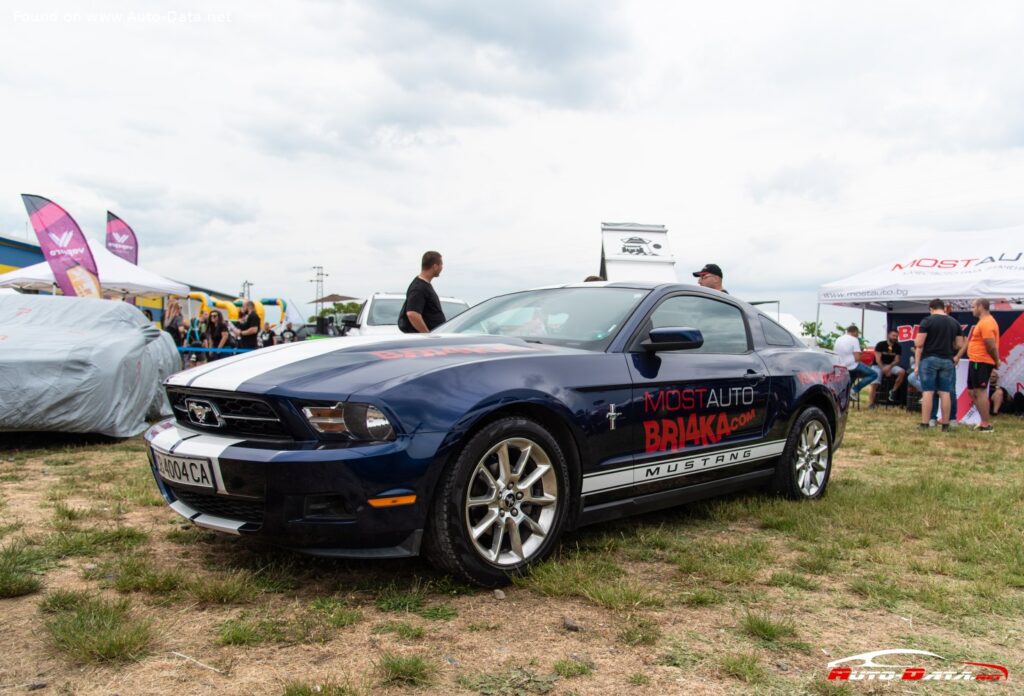
The updated styling, characterized by a more sculpted hood, revised grille, new headlights, and sequential LED taillights, gave the Mustang a contemporary edge while still unmistakably referencing its heritage. Inside, Ford addressed previous criticisms with improved materials, better fit and finish, and enhanced technology, making the cabin a more comfortable and engaging place for both driver and passengers. This particular GT 5.0 V8 variant, equipped with an automatic transmission, aimed to broaden its appeal, offering exhilarating performance with the convenience of a modern automatic gearbox.
Engine & Performance
At the heart of the Ford Mustang V (facelift 2009) GT 5.0 V8 (412 Hp) Automatic lies the celebrated “Coyote” engine, a naturally aspirated 4,951 cubic centimeter (302.13 cu. in.) V8. This all-aluminum powerhouse, designated by the engine code “Coyote,” was a technological marvel for its time, featuring a Double Overhead Cam (DOHC) valvetrain with Ford’s advanced Twin Independent Variable Cam Timing (Ti-VCT). This sophisticated system allowed for precise control over valve overlap, optimizing performance across the entire RPM range and contributing to both impressive power delivery and improved fuel efficiency.
The Coyote V8 generated a robust 412 horsepower at 6500 rpm and a formidable 390.17 lb.-ft. of torque at 4250 rpm. With a high 11:1 compression ratio and multi-port manifold injection, the engine was designed for responsiveness and power. Its ability to rev up to a maximum of 7000 rpm provided a thrilling and engaging driving experience, complemented by the characteristic rumble of an American V8. Power was efficiently channeled to the rear wheels via a 6-speed automatic transmission, offering smooth shifts and contributing to the car’s impressive acceleration. Despite its substantial power, the Coyote engine also demonstrated a commendable balance of performance and efficiency for a V8 of its size, with a combined fuel economy rating of 21 US mpg.
The car’s powertrain architecture, with the engine mounted longitudinally in the front and driving the rear wheels, adhered to the classic muscle car formula. This setup, combined with a kerb weight of 3653.06 lbs, resulted in an excellent weight-to-power ratio of 4 kg/Hp (248.6 Hp/tonne), ensuring dynamic performance capabilities that rivaled more expensive sports cars.
Design & Features
The Ford Mustang V (facelift 2009) GT 5.0 V8 retained the muscular, retro-inspired design that made the S197 generation so popular, but with key updates that modernized its aesthetic. The exterior received a more aggressive front fascia, including a power-dome hood that hinted at the potent engine beneath, redesigned headlights with integrated turn signals, and a more prominent grille. The rear was equally refreshed, featuring revised LED taillights with three distinct vertical bars that illuminated sequentially, a nod to classic Mustangs, and a redesigned rear bumper with an integrated diffuser.
As a two-door coupe with seating for four, the Mustang GT offered a practical yet sporty interior. While the data does not detail specific interior features, the facelifted S197 generation was known for its upgraded cabin materials, improved ergonomics, and available technology features for the time, such as Ford’s SYNC infotainment system. The driver-focused cockpit featured clear instrumentation and controls, designed to enhance the driving experience. Standard safety features included an Anti-lock Braking System (ABS), which worked in conjunction with the ventilated disc brakes (336×36 mm front, 300×19 mm rear) to provide confident stopping power. The car rode on either 18-inch or optional 19-inch wheels, shod with performance-oriented tires (235/50 R18; 245/45 R19), further enhancing its grip and handling. The electric power steering system offered precise control and improved fuel efficiency over traditional hydraulic systems.
Underneath, the Mustang GT featured an independent McPherson strut front suspension with a transverse stabilizer, providing responsive steering and handling. The rear, however, retained a rigid axle suspension with coil springs and a transverse stabilizer, a characteristic choice for muscle cars that offered durability and strong straight-line performance, albeit with some compromises in handling over rough terrain compared to fully independent setups.
Technical Specifications
| Category | Specification |
|---|---|
| General Information | |
| Brand | Ford |
| Model | Mustang |
| Generation | Mustang V (facelift 2009) |
| Type (Engine) | GT 5.0 V8 (412 Hp) Automatic |
| Start of Production | 2010 year |
| End of Production | 2012 year |
| Powertrain Architecture | Internal Combustion engine |
| Body type | Coupe |
| Seats | 4 |
| Doors | 2 |
| Performance Specs | |
| Fuel consumption (urban) | 13.1 l/100 km (18 US mpg) |
| Fuel consumption (extra urban) | 9.4 l/100 km (25 US mpg) |
| Fuel consumption (combined) | 11.2 l/100 km (21 US mpg) |
| Fuel Type | Petrol (Gasoline) |
| Weight-to-power ratio | 4 kg/Hp (248.6 Hp/tonne) |
| Weight-to-torque ratio | 3.1 kg/Nm (319.3 Nm/tonne) |
| Engine Specs | |
| Power | 412 Hp @ 6500 rpm |
| Power per liter | 83.2 Hp/l |
| Torque | 529 Nm (390.17 lb.-ft.) @ 4250 rpm |
| Maximum engine speed | 7000 rpm |
| Engine layout | Front, Longitudinal |
| Engine Model/Code | Coyote |
| Engine displacement | 4951 cm3 (302.13 cu. in.) |
| Number of cylinders | 8 |
| Engine configuration | V-engine |
| Cylinder Bore | 92.2 mm (3.63 in.) |
| Piston Stroke | 92.7 mm (3.65 in.) |
| Compression ratio | 11:1 |
| Number of valves per cylinder | 4 |
| Fuel injection system | Multi-port manifold injection |
| Engine aspiration | Naturally aspirated engine |
| Valvetrain | DOHC, Ti-VCT |
| Engine oil capacity | 7.6 l (8.03 US qt) |
| Coolant capacity | 12.3 l (13 US qt) |
| Space, Volume and Weights | |
| Kerb Weight | 1657 kg (3653.06 lbs) |
| Trunk (boot) space – minimum | 379 l (13.38 cu. ft.) |
| Fuel tank capacity | 61 l (16.11 US gal) |
| Permitted trailer load with brakes (12%) | 454 kg (1000.9 lbs) |
| Dimensions | |
| Length | 4778 mm (188.11 in.) |
| Width | 1877 mm (73.9 in.) |
| Width including mirrors | 2035 mm (80.12 in.) |
| Height | 1417 mm (55.79 in.) |
| Wheelbase | 2720 mm (107.09 in.) |
| Front track | 1582 mm (62.28 in.) |
| Rear (Back) track | 1598 mm (62.91 in.) |
| Minimum turning circle (diameter) | 11.2 m (36.75 ft.) |
| Drivetrain, Brakes and Suspension Specs | |
| Drivetrain Architecture | Internal combustion engine (ICE) drives the rear wheels. |
| Drive wheel | Rear wheel drive |
| Number of gears and type of gearbox | 6 gears, automatic transmission |
| Front suspension | Independent type McPherson, Transverse stabilizer |
| Rear suspension | Rigid axle suspension, Transverse stabilizer, Coil spring |
| Front brakes | Ventilated discs, 336×36 mm |
| Rear brakes | Ventilated discs, 300×19 mm |
| Assisting systems | ABS (Anti-lock braking system) |
| Steering type | Steering rack and pinion |
| Power steering | Electric Steering |
| Tires size | 235/50 R18; 245/45 R19 |
| Wheel rims size | 8J x 18; 8.5J x 19 |
Legacy & Market Impact
The Ford Mustang V (facelift 2009) GT 5.0 V8 (412 Hp) Automatic left an indelible mark on the American automotive landscape. Its introduction, particularly the return of the 5.0-liter Coyote V8, was met with widespread acclaim from enthusiasts and critics alike. It signaled Ford’s renewed commitment to performance and its understanding of the Mustang’s heritage. The “5.0” badge, dormant for over a decade, instantly re-energized the Mustang brand and directly challenged its reborn competitors.
In its primary market, the United States, the Mustang GT 5.0 V8 competed fiercely with the Chevrolet Camaro SS and the Dodge Challenger R/T and SRT8. These three American muscle cars were locked in a modern horsepower war, each vying for supremacy in a segment that celebrated raw power, iconic styling, and a deep connection to automotive history. The Mustang’s advantage often lay in its lighter weight, more refined interior (post-facelift), and the immediate recognition and affection for the “5.0” engine. While the Camaro offered a more modern independent rear suspension, the Mustang’s traditional solid rear axle was improved and still delivered impressive drag strip performance, appealing to a core segment of its buyer base.
The 2010-2012 Mustang GT 5.0 V8 solidified the S197 generation’s reputation as a true modern classic. It proved that a retro-styled car could still be at the forefront of performance technology. The Coyote engine, in particular, became a benchmark for naturally aspirated V8s and laid the groundwork for future high-performance Ford products. Its blend of power, distinctive exhaust note, and relatively accessible price point made it a dream car for many, ensuring its place in the pantheon of great American performance vehicles. Even today, these models are highly sought after by collectors and enthusiasts who appreciate their blend of heritage and modern performance capabilities, representing a golden era for the Mustang and American muscle cars.