Introduction to the Ford Mustang VI 2.3 EcoBoost (309 Hp) Automatic
The sixth generation of the Ford Mustang, internally codenamed S550, marked a pivotal moment in the storied history of the iconic American pony car. Launched for the 2015 model year, this iteration was the first Mustang designed from the ground up to be a global vehicle, sold in over 100 countries worldwide. Among its most significant powertrain offerings for this international expansion was the Ford Mustang VI 2.3 EcoBoost (309 Hp) Automatic. This particular variant, produced from 2015 to 2017, represented a strategic shift for Ford, introducing a turbocharged four-cylinder engine alongside the traditional V6 and V8 options. It aimed to deliver a compelling blend of modern performance, improved fuel efficiency, and a more accessible entry point into Mustang ownership, particularly appealing to markets with higher fuel prices or displacement-based taxation. The fastback body style, a timeless Mustang hallmark, was retained, combining classic aesthetics with contemporary engineering and a sophisticated independent rear suspension system, a first for a mass-produced Mustang.
Engine and Performance: The EcoBoost Revolution in the Ford Mustang VI
At the heart of the Ford Mustang VI 2.3 EcoBoost (309 Hp) Automatic lies a sophisticated 2.3-liter (2264 cm3 or 138.16 cu. in.) inline-four engine, part of Ford’s renowned EcoBoost family. This powerplant is a testament to modern engine technology, featuring direct fuel injection, a twin-scroll turbocharger, and an intercooler, all working in concert to produce impressive output for its size. With a DOHC (Dual Overhead Camshaft) valvetrain and four valves per cylinder, the engine is engineered for optimal breathing and efficiency. It generates a robust 309 horsepower at 5500 rpm, a figure that rivals many V8 engines of previous generations. More critically for everyday driving and spirited acceleration, the EcoBoost delivers a substantial 300.19 lb.-ft. of torque across a broad rev range, specifically between 2500 and 4500 rpm. This wide torque band ensures responsive acceleration and strong pulling power without constantly needing to rev the engine high.
Power is channeled to the rear wheels via a smooth-shifting 6-speed automatic transmission, which was well-suited for both relaxed cruising and more dynamic driving. The combination of the potent EcoBoost engine and the automatic gearbox provided a refined driving experience, contributing to the Mustang’s broader appeal. Despite its considerable power, the 2.3 EcoBoost also offered commendable fuel economy for a sports coupe. The combined fuel consumption was rated at 9.4 liters per 100 km, equating to approximately 25 US miles per gallon. This efficiency, coupled with a curb weight of 3522.99 lbs (1598 kg), resulted in a respectable weight-to-power ratio of 5.2 kg/Hp and a weight-to-torque ratio of 3.9 kg/Nm, underscoring its performance credentials. The front-longitudinal engine layout and rear-wheel-drive architecture maintained the Mustang’s traditional dynamic character, ensuring an engaging driving experience.
Design and Features of the Mustang VI EcoBoost Fastback
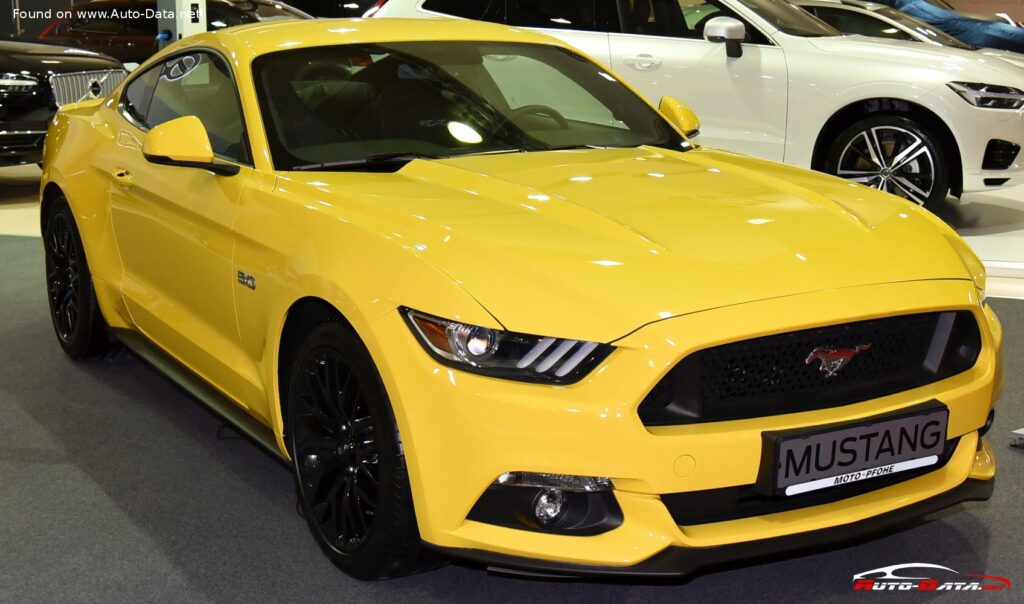
The design of the sixth-generation Mustang, including the Ford Mustang VI 2.3 EcoBoost (309 Hp) Automatic, represented a masterful evolution of the iconic pony car aesthetic. Ford successfully blended classic Mustang cues with a contemporary, athletic stance, making it instantly recognizable yet thoroughly modern. The fastback body type, a beloved silhouette, was a key design choice, giving the car a sleek, aerodynamic profile with a drag coefficient (Cd) of 0.32. Its dimensions – a length of 188.31 inches (4783 mm), a width of 75.39 inches (1915 mm), and a height of 54.41 inches (1382 mm) – contributed to its muscular road presence. The long hood, short deck, and aggressive grille with the iconic running pony emblem were all present, updated with sharper lines and modern lighting.
Inside, the Mustang VI offered a driver-focused cockpit with a blend of retro-inspired toggle switches and modern digital displays. It featured a 2-door, 4-seat configuration, providing comfortable seating for two adults up front and occasional seating for two smaller passengers in the rear. A significant engineering upgrade for this generation was the adoption of an independent multi-link rear suspension, replacing the live axle of previous generations. This, combined with an independent McPherson-type front suspension and transverse stabilizers at both ends, dramatically improved ride quality, handling, and cornering stability, bringing the Mustang’s dynamics in line with international sports coupe standards.
Safety and driver assistance features for its time included a robust Anti-lock Braking System (ABS) as standard, complementing the powerful ventilated disc brakes on both the front and rear axles. The steering system utilized an electric rack and pinion setup, offering precise control and customizable steering feel. Standard tires were 235/55 R17, mounted on 7.5J x 17-inch wheel rims, providing a good balance of grip and ride comfort. The 15.32 US gallon (58-liter) fuel tank capacity offered a decent cruising range, especially given the EcoBoost’s efficiency.
Technical Specifications: Ford Mustang VI 2.3 EcoBoost (309 Hp) Automatic
| Category | Specification | Metric / US Units |
|---|---|---|
General Information |
||
| Brand | Ford | |
| Model | Mustang VI | |
| Type (Engine) | 2.3 EcoBoost (309 Hp) Automatic | |
| Start of Production | 2015 year | |
| End of Production | 2017 year | |
| Powertrain Architecture | Internal Combustion engine | |
| Body Type | Fastback | |
| Seats | 4 | |
| Doors | 2 | |
Performance Specs |
||
| Fuel Consumption (Urban) | 11.2 l/100 km | 21 US mpg |
| Fuel Consumption (Extra Urban) | 7.3 l/100 km | 32.2 US mpg |
| Fuel Consumption (Combined) | 9.4 l/100 km | 25 US mpg |
| Fuel Type | Petrol (Gasoline) | |
| Weight-to-Power Ratio | 5.2 kg/Hp | 193.4 Hp/tonne |
| Weight-to-Torque Ratio | 3.9 kg/Nm | 254.7 Nm/tonne |
Engine Specs |
||
| Power | 309 Hp @ 5500 rpm | |
| Power per Liter | 136.5 Hp/l | |
| Torque | 407 Nm @ 2500-4500 rpm | 300.19 lb.-ft. @ 2500-4500 rpm |
| Engine Layout | Front, Longitudinal | |
| Engine Model/Code | EcoBoost | |
| Engine Displacement | 2264 cm3 | 138.16 cu. in. |
| Number of Cylinders | 4 | |
| Engine Configuration | Inline | |
| Cylinder Bore | 87.55 mm | 3.45 in. |
| Piston Stroke | 94 mm | 3.7 in. |
| Compression Ratio | 9.5:1 | |
| Number of Valves per Cylinder | 4 | |
| Fuel Injection System | Direct injection | |
| Engine Aspiration | Turbocharger, Intercooler | |
| Valvetrain | DOHC | |
| Engine Oil Capacity | 5.4 l | 5.71 US qt |
| Coolant Capacity | 8.96 l | 9.47 US qt |
Space, Volume and Weights |
||
| Kerb Weight | 1598 kg | 3522.99 lbs. |
| Fuel Tank Capacity | 58 l | 15.32 US gal |
Dimensions |
||
| Length | 4783 mm | 188.31 in. |
| Width | 1915 mm | 75.39 in. |
| Width with Mirrors Folded | 2080 mm | 81.89 in. |
| Height | 1382 mm | 54.41 in. |
| Wheelbase | 2720 mm | 107.09 in. |
| Front Track | 1582 mm | 62.28 in. |
| Rear (Back) Track | 1648 mm | 64.88 in. |
| Drag Coefficient (Cd) | 0.32 | |
| Minimum Turning Circle | 11.12 m | 36.48 ft. |
Drivetrain, Brakes and Suspension Specs |
||
| Drivetrain Architecture | The Internal combustion engine (ICE) drives the rear wheels of the vehicle. | |
| Drive Wheel | Rear wheel drive | |
| Number of Gears and Type of Gearbox | 6 gears, automatic transmission | |
| Front Suspension | Independent type McPherson, Transverse stabilizer | |
| Rear Suspension | Independent multi-link suspension, Transverse stabilizer | |
| Front Brakes | Ventilated discs | |
| Rear Brakes | Ventilated discs | |
| Assisting Systems | ABS (Anti-lock braking system) | |
| Steering Type | Steering rack and pinion | |
| Power Steering | Electric Steering | |
| Tires Size | 235/55 R17 | |
| Wheel Rims Size | 7.5J x 17 | |
Legacy and Market Impact of the Ford Mustang VI 2.3 EcoBoost
The introduction of the sixth-generation Mustang, and particularly the Ford Mustang VI 2.3 EcoBoost (309 Hp) Automatic, profoundly reshaped the car’s global perception and market impact. For decades, the Mustang was primarily an American icon, synonymous with V8 power and straight-line performance. The S550, with its independent rear suspension and the efficient yet powerful EcoBoost engine, transformed it into a genuine global sports coupe capable of competing on an international stage. This move was crucial for Ford, allowing the Mustang to meet global emissions and fuel economy standards while still offering compelling performance.
In its primary American market, the 2.3 EcoBoost offered a compelling alternative to the traditional V8 GT, providing impressive performance with significantly better fuel economy and a lower entry price. It appealed to a new demographic of buyers who desired Mustang styling and rear-wheel-drive dynamics but prioritized efficiency or were less concerned with raw V8 rumble. Globally, this engine option was a game-changer. In markets like Europe and Asia, where fuel is expensive and engine displacement often dictates tax rates, the EcoBoost Mustang became a viable and attractive option. It allowed enthusiasts in these regions to own a piece of American automotive legend without the prohibitive running costs associated with larger V8s.
The Mustang VI EcoBoost faced competition from a diverse range of vehicles. In the US, it continued its rivalry with the Chevrolet Camaro, which also offered a four-cylinder turbo option. Internationally, it competed with European sports coupes like the Audi TT, BMW 2 Series Coupe, and even some variants of the Porsche Cayman, offering a more distinctive American flavor at a competitive price point. Japanese rivals like the Nissan 370Z also presented a challenge. The Mustang’s legacy from this era is one of successful globalization and modernization. It proved that a classic American muscle car could adapt to changing global demands, offering efficiency and sophisticated handling without sacrificing its essential character. The 2.3 EcoBoost variant played a crucial role in expanding the Mustang’s audience and ensuring its continued relevance in the 21st century automotive landscape, solidifying its status not just as an American icon, but as a truly international performance vehicle.