The Ford Mustang VI 3.7 V6 Automatic: A Modern Interpretation of an American Icon
The Ford Mustang VI, internally designated as the S550, marked a significant chapter in the storied history of the iconic American pony car. Launched for the 2015 model year, this generation was particularly notable for being the first Mustang designed from the ground up to be a global vehicle, sold in markets around the world. Among its initial powertrain offerings, the Ford Mustang VI 3.7 V6 Automatic served as a compelling entry point into the Mustang ownership experience from its production start in 2015 until its discontinuation in 2017. This particular variant, featuring a robust 3.7-liter V6 engine paired with a smooth automatic transmission, offered a blend of performance, style, and everyday usability that appealed to a broad spectrum of buyers.
The S550 generation represented a paradigm shift for the Mustang, introducing an independent rear suspension (IRS) across the entire lineup, a move long-awaited by enthusiasts and critics alike. This, combined with a more sophisticated and aerodynamic design, transformed the Mustang from a quintessential American muscle car into a more refined, globally competitive sports coupe. The 3.7 V6 variant, specifically the Fastback body type, embodied this evolution, providing a potent package that upheld the Mustang’s legacy while embracing modern engineering principles.
Engine and Performance: The Duratec 37 Heartbeat
At the core of the Ford Mustang VI 3.7 V6 Automatic lies the venerable Duratec 37 engine, a naturally aspirated V-engine configured with six cylinders. This 3.7-liter (3726 cm3 or 227.37 cu. in.) powerplant was a proven performer, having seen duty in various Ford and Lincoln vehicles prior to its Mustang application. In this iteration, it delivered a respectable 304 horsepower at 6500 rpm, translating to a power-per-liter output of 81.6 Hp/l. Torque figures were equally impressive for a naturally aspirated V6, peaking at 366 Nm (269.95 lb.-ft.) at 4000 rpm, providing ample thrust for spirited driving and confident highway passing.
The engine’s architecture featured a DOHC (Dual Overhead Camshaft) valvetrain with four valves per cylinder, promoting efficient breathing and higher rev capabilities. Fuel delivery was handled by a multi-port manifold injection system, ensuring precise fuel metering. With a compression ratio of 10.5:1, the Duratec 37 was designed for optimal performance on regular unleaded gasoline. Power was channeled to the rear wheels via a 6-speed automatic transmission, offering smooth and responsive shifts that complemented the engine’s power delivery. This drivetrain architecture, classic to the Mustang, ensured a traditional sports car feel.
Despite its performance credentials, the 3.7 V6 Automatic also offered reasonable fuel economy for its class. Combined fuel consumption was rated at 10.7 l/100 km (22 US mpg), with urban figures at 12.4 l/100 km (19 US mpg) and extra-urban at 8.4 l/100 km (28 US mpg). This balance of power and efficiency made it an attractive option for those seeking a daily-drivable sports coupe.
Design and Features: A Global Fastback
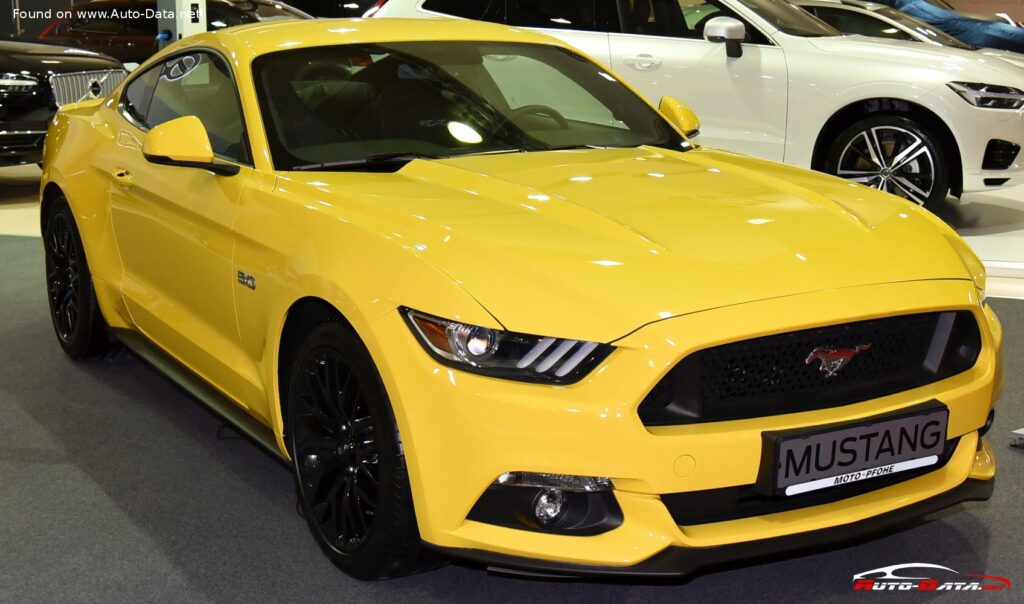
The S550 Mustang’s design was a masterful blend of heritage and contemporary aesthetics. The Fastback body type of the Ford Mustang VI 3.7 V6 Automatic exuded a powerful and athletic stance, characterized by its long hood, short deck, and aggressive “shark bite” front fascia. Measuring 188.31 inches in length, 75.39 inches in width (81.89 inches with mirrors folded), and 54.41 inches in height, the car possessed substantial road presence. The 107.09-inch wheelbase contributed to both stability and interior space, while the low drag coefficient of 0.32 underscored its aerodynamic efficiency.
Key features of this generation included the aforementioned independent rear suspension, which dramatically improved ride quality and handling dynamics compared to previous solid-axle Mustangs. The steering system utilized electric power steering, offering customizable feedback settings to suit driver preferences. Braking was handled by ventilated discs both front and rear, complemented by an Anti-lock Braking System (ABS) for enhanced safety and control. The vehicle rode on 235/55 R17 tires mounted on 17-inch wheel rims, providing a good balance of grip and ride comfort.
Inside, the Mustang VI presented a driver-focused cockpit with improved materials and ergonomics. While this V6 model was typically a more accessible trim, it still offered a comfortable and engaging environment for four occupants, though the rear seats were, as is common for pony cars, best suited for smaller adults or short journeys.
Technical Specifications
| Category | Specification |
|---|---|
| General Information | |
| Brand | Ford |
| Model | Mustang |
| Generation | Mustang VI (S550) |
| Type (Engine) | 3.7 V6 (304 Hp) Automatic |
| Start of production | 2015 year |
| End of production | 2017 year |
| Powertrain Architecture | Internal Combustion engine |
| Body type | Fastback |
| Seats | 4 |
| Doors | 2 |
| Performance Specs | |
| Fuel consumption (economy) – urban | 12.4 l/100 km (19 US mpg) |
| Fuel consumption (economy) – extra urban | 8.4 l/100 km (28 US mpg) |
| Fuel consumption (economy) – combined | 10.7 l/100 km (22 US mpg) |
| Fuel Type | Petrol (Gasoline) |
| Weight-to-power ratio | 5.3 kg/Hp, 189.9 Hp/tonne |
| Weight-to-torque ratio | 4.4 kg/Nm, 228.6 Nm/tonne |
| Engine Specs | |
| Power | 304 Hp @ 6500 rpm |
| Power per liter | 81.6 Hp/l |
| Torque | 366 Nm (269.95 lb.-ft.) @ 4000 rpm |
| Engine layout | Front, Longitudinal |
| Engine Model/Code | Duratec 37 |
| Engine displacement | 3726 cm3 (227.37 cu. in.) |
| Number of cylinders | 6 |
| Engine configuration | V-engine |
| Cylinder Bore | 95.5 mm (3.76 in.) |
| Piston Stroke | 86.7 mm (3.41 in.) |
| Compression ratio | 10.5:1 |
| Number of valves per cylinder | 4 |
| Fuel injection system | Multi-port manifold injection |
| Engine aspiration | Naturally aspirated engine |
| Valvetrain | DOHC |
| Engine oil capacity | 5.7 l (6.02 US qt) |
| Engine oil specification | Not specified in provided data |
| Coolant capacity | 11.7 l (12.36 US qt) |
| Space, Volume and Weights | |
| Kerb Weight | 1601 kg (3529.6 lbs.) |
| Fuel tank capacity | 60 l (15.85 US gal) |
| Dimensions | |
| Length | 4783 mm (188.31 in.) |
| Width | 1915 mm (75.39 in.) |
| Width with mirrors folded | 2080 mm (81.89 in.) |
| Height | 1382 mm (54.41 in.) |
| Wheelbase | 2720 mm (107.09 in.) |
| Front track | 1582 mm (62.28 in.) |
| Rear (Back) track | 1648 mm (64.88 in.) |
| Drag coefficient (Cd) | 0.32 |
| Minimum turning circle (turning diameter) | 11.12 m (36.48 ft.) |
| Drivetrain, Brakes and Suspension Specs | |
| Drivetrain Architecture | The Internal combustion engine (ICE) drives the rear wheels of the vehicle. |
| Drive wheel | Rear wheel drive |
| Number of gears and type of gearbox | 6 gears, automatic transmission |
| Front brakes | Ventilated discs |
| Rear brakes | Ventilated discs |
| Assisting systems | ABS (Anti-lock braking system) |
| Steering type | Steering rack and pinion |
| Power steering | Electric Steering |
| Tires size | 235/55 R17 |
| Wheel rims size | 17 inches |
Legacy and Market Impact of the Ford Mustang VI
The S550 generation, and specifically the Ford Mustang VI 3.7 V6 Automatic, played a crucial role in expanding the Mustang’s global footprint and evolving its image. For decades, the Mustang had been synonymous with a solid rear axle, a characteristic that, while part of its raw charm, limited its dynamic capabilities compared to European and Asian sports coupes. The introduction of the independent rear suspension in the S550 was a monumental shift, allowing the Mustang to genuinely compete on a global stage in terms of handling and ride comfort.
The 3.7-liter V6, while not the most powerful engine in the lineup (that honor went to the 5.0-liter Coyote V8 in the GT model), served as an excellent entry-level option. It offered performance that far exceeded previous base Mustang engines, providing a genuinely sporty experience with 304 horsepower. This made the Mustang accessible to a broader audience who desired the iconic styling and spirit without the higher cost or more aggressive performance of the V8. Its competitors in the American market included the Chevrolet Camaro and Dodge Challenger, both of which also offered V6 entry-level options. The Mustang V6 typically offered a more refined driving experience than its rivals, particularly with the new IRS.
However, the 3.7 V6’s tenure was relatively short-lived in the S550. Ford introduced the 2.3-liter EcoBoost turbocharged four-cylinder engine as another base option, which, despite having slightly less horsepower (310 hp in some iterations), offered significantly more torque (320 lb.-ft.) and superior fuel economy. This led to the phasing out of the naturally aspirated V6 for the 2018 model year, as the EcoBoost became the new standard entry-level engine. Despite its discontinuation, the 3.7 V6 Mustang VI holds a significant place in the model’s history, representing the last of the naturally aspirated V6 Mustangs and a bridge between the traditional and globally-oriented eras of the legendary pony car. It solidified the Mustang’s reputation as a versatile and aspirational vehicle, capable of delivering both everyday practicality and thrilling performance.