Ford Mustang VI (Facelift 2017) 2.3 GTDi EcoBoost (310 Hp) SelectShift: A Modern American Icon
The Ford Mustang, an enduring symbol of American performance and freedom, entered its sixth generation in 2015, marking a significant evolution in its storied history. For the 2017 model year, Ford introduced a comprehensive facelift for the S550 generation, bringing refined styling, updated technology, and enhanced performance across its lineup. Among the key offerings was the Ford Mustang VI (facelift 2017) 2.3 GTDi EcoBoost (310 Hp) SelectShift, a variant that solidified the four-cylinder Mustang’s place not just as an entry-level option, but as a legitimate performance contender. This model, produced from 2017 to 2023, represented a modern interpretation of the pony car, blending traditional Mustang aesthetics with cutting-edge powertrain technology and a global appeal, particularly in markets where smaller displacement engines are favored. Its Fastback body style, combined with a sophisticated turbocharged engine and a quick-shifting automatic transmission, presented a compelling package for a new generation of Mustang enthusiasts.
Engine and Performance: The EcoBoost Revolution in the Ford Mustang VI (facelift 2017)
At the heart of this particular Mustang variant lies Ford’s acclaimed 2.3-liter GTDi EcoBoost engine. This inline four-cylinder powertrain, featuring Gasoline Turbocharged Direct Injection (GTDi) and an intercooler, was a testament to Ford’s commitment to efficiency without sacrificing performance. Producing a robust 310 horsepower at 5500 rpm and a substantial 350.34 lb.-ft. of torque at a low 3000 rpm, the EcoBoost engine delivered a surprisingly potent punch for its displacement. Its power-per-liter ratio of 137.5 Hp/l highlighted its advanced engineering, allowing the relatively small engine to compete with larger, naturally aspirated units.
The engine’s layout is front, longitudinal, driving the rear wheels, maintaining the classic Mustang performance architecture. With a bore of 3.44 inches and a stroke of 3.7 inches, combined with a 9.5:1 compression ratio, the engine was designed for optimal turbocharging efficiency and responsiveness. The direct injection system precisely meters fuel into the combustion chambers, contributing to both power output and fuel economy.
Mated to this dynamic engine was Ford’s advanced 10-speed SelectShift automatic transmission. This gearbox was a significant upgrade, offering more ratios than its predecessor, which translated to improved acceleration, smoother shifts, and enhanced fuel efficiency. The SelectShift system allowed drivers to manually control gear changes via paddle shifters, providing a more engaging driving experience when desired, blurring the lines between a traditional automatic and a full manual transmission. This combination resulted in a highly balanced vehicle, capable of delivering thrilling acceleration while also achieving respectable fuel economy figures of 25 US mpg combined (21 US mpg city, 32.2 US mpg highway). With a weight-to-power ratio of 5.2 kg/Hp (approximately 11.46 lbs/Hp), the EcoBoost Mustang offered a spirited drive that defied its four-cylinder configuration.
Design and Features: Modern Muscle Aesthetics
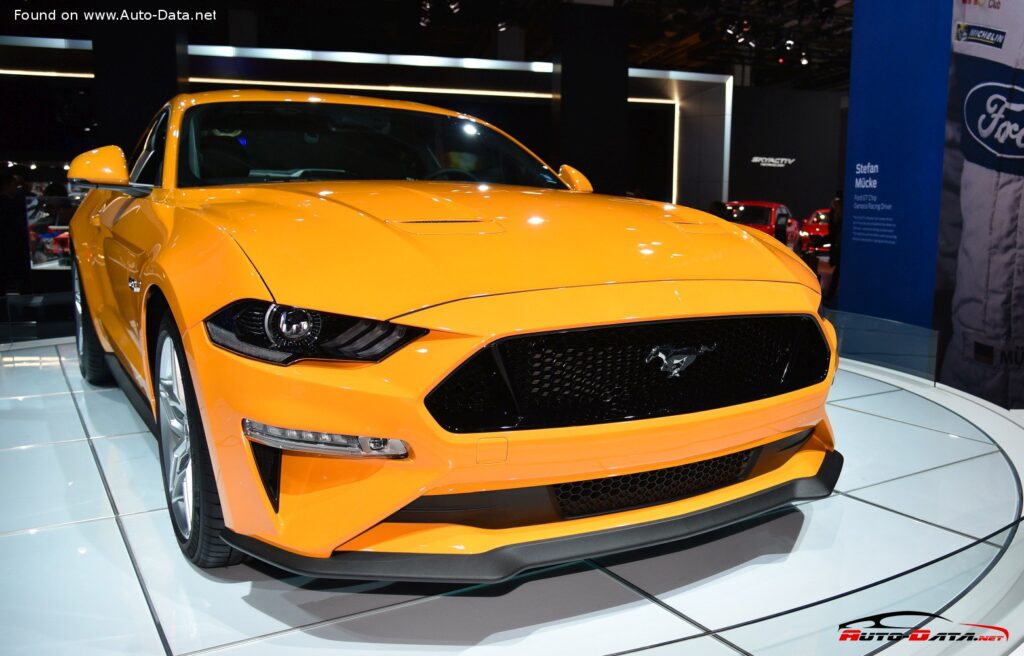
The 2017 facelift of the Ford Mustang VI brought subtle yet impactful design changes that sharpened its aggressive stance while retaining its iconic pony car identity. The Fastback body type, a timeless silhouette, remained central to its appeal. The front fascia received a more aggressive look with a redesigned grille, revised LED headlamps, and a more sculpted hood, enhancing its aerodynamic profile and road presence. At the rear, new LED taillights and a reworked bumper completed the visual update.
Inside, the Mustang offered a driver-focused cockpit with a blend of modern technology and classic design cues. The four-seat configuration, while offering limited rear passenger space typical of a pony car, provided ample comfort for front occupants. The updated model often featured Ford’s SYNC 3 infotainment system, offering intuitive control over navigation, audio, and connectivity features. Safety was also a key consideration, with standard features like ABS (Anti-lock Braking System) ensuring confident stopping power. The independent front McPherson strut suspension with coil springs and an anti-roll bar, paired with an independent multi-link rear suspension with a stabilizer, provided a sophisticated ride and handling balance, a notable departure from the live-axle Mustangs of generations past. This independent suspension setup was crucial for the Mustang’s global market expansion, offering improved ride comfort and cornering dynamics. The stopping power was managed by ventilated disc brakes on both the front and rear axles, ensuring consistent performance under demanding conditions.
Dimensionally, the 2017 Mustang Fastback measured 188.5 inches in length, 75.39 inches in width (81.89 inches including mirrors), and 54.29 inches in height, with a wheelbase of 107.09 inches. These proportions contributed to its muscular, low-slung appearance. The curb weight of 3534.01 lbs. underscored its solid construction, while the 13.49 cu. ft. of trunk space offered practical utility for a sports coupe.
Technical Specifications
| Category | Specification | Value |
|---|---|---|
| General Information | Brand | Ford |
| Model | Mustang | |
| Generation | Mustang VI (facelift 2017) | |
| Type (Engine) | 2.3 GTDi EcoBoost (310 Hp) SelectShift | |
| Start of Production | 2017 year | |
| End of Production | 2023 year | |
| Powertrain Architecture | Internal Combustion engine | |
| Body type | Fastback | |
| Seats | 4 | |
| Doors | 2 | |
| Performance Specs | Fuel consumption (economy) – urban | 11.2 l/100 km (21 US mpg) |
| Fuel consumption (economy) – extra urban | 7.3 l/100 km (32.2 US mpg) | |
| Fuel consumption (economy) – combined | 9.4 l/100 km (25 US mpg) | |
| Fuel Type | Petrol (Gasoline) | |
| Weight-to-power ratio | 5.2 kg/Hp (11.46 lbs/Hp) | |
| Weight-to-torque ratio | 3.4 kg/Nm (7.5 lbs/Nm) | |
| Engine Specs | Power | 310 Hp @ 5500 rpm |
| Power per liter | 137.5 Hp/l | |
| Torque | 475 Nm (350.34 lb.-ft.) @ 3000 rpm | |
| Engine layout | Front, Longitudinal | |
| Engine Model/Code | EcoBoost | |
| Engine displacement | 2254 cm3 (2.3 L / 137.55 cu. in.) | |
| Number of cylinders | 4 | |
| Engine configuration | Inline | |
| Cylinder Bore | 87.5 mm (3.44 in.) | |
| Piston Stroke | 94 mm (3.7 in.) | |
| Compression ratio | 9.5:1 | |
| Fuel injection system | Direct injection | |
| Engine aspiration | Turbocharger, Intercooler | |
| Engine oil capacity | 5.67 l (5.99 US qt) | |
| Coolant | 8.96 l (9.47 US qt) | |
| Space, Volume and Weights | Kerb Weight | 1603 kg (3534.01 lbs.) |
| Trunk (boot) space – minimum | 382 l (13.49 cu. ft.) | |
| Fuel tank capacity | 59 l (15.59 US gal) | |
| Dimensions | Length | 4788 mm (188.5 in.) |
| Width | 1915 mm (75.39 in.) | |
| Width with mirrors folded | 1933 mm (76.1 in.) | |
| Width including mirrors | 2080 mm (81.89 in.) | |
| Height | 1379 mm (54.29 in.) | |
| Wheelbase | 2720 mm (107.09 in.) | |
| Front track | 1585 mm (62.4 in.) | |
| Rear (Back) track | 1654 mm (65.12 in.) | |
| Drivetrain, Brakes and Suspension Specs | Drivetrain Architecture | Internal Combustion engine drives the rear wheels. |
| Drive wheel | Rear wheel drive | |
| Number of gears and type of gearbox | 10 gears, automatic transmission SelectShift | |
| Front suspension | Independent, type McPherson with coil spring and anti-roll bar | |
| Rear suspension | Independent multi-link spring suspension with stabilizer | |
| Front brakes | Ventilated discs | |
| Rear brakes | Ventilated discs | |
| Assisting systems | ABS (Anti-lock braking system) | |
| Steering type | Steering rack and pinion | |
| Wheel rims size | 17 inches |
Legacy and Market Impact: Broadening the Mustang’s Appeal
The introduction of the EcoBoost engine in the Mustang lineup, particularly with the refined 2017 facelift, marked a pivotal moment in the car’s legacy. Historically, the Mustang was synonymous with V8 power, but the 2.3-liter EcoBoost allowed Ford to expand the Mustang’s appeal significantly, transforming it into a true global player. While the V8-powered GT models continued to cater to traditional muscle car enthusiasts, the EcoBoost variant offered a more efficient, yet still highly engaging, alternative.
In the North American market, the EcoBoost Mustang found its niche among buyers seeking the iconic styling and rear-wheel-drive dynamics of a Mustang but with better fuel economy and a lower entry price point than the V8. It competed against other performance-oriented four-cylinder coupes and sedans, such as the Subaru BRZ/Toyota 86 twins, and even some higher-trim compact sports cars. Its sophisticated independent suspension system, a standard feature across the sixth generation, allowed it to handle with a precision previously unseen in a Mustang, making it a credible rival to European sports coupes in terms of driving dynamics.
Globally, the EcoBoost Mustang was a revelation. In markets with high fuel prices or engine displacement taxes, the 2.3-liter turbocharged engine made the Mustang a viable and attractive option where the V8 might have been prohibitively expensive or inefficient. This strategy significantly boosted Mustang sales in Europe, Asia, and Australia, cementing its status as the world’s best-selling sports coupe for several years running.
The Ford Mustang VI (facelift 2017) 2.3 GTDi EcoBoost (310 Hp) SelectShift demonstrated that a Mustang didn’t necessarily need a V8 to deliver an exciting driving experience. Its blend of modern technology, respectable power, improved efficiency, and the undeniable appeal of the Mustang badge allowed it to carve out a unique and important place in the automotive landscape, ensuring the Mustang’s relevance and success well into the 21st century. It proved that the spirit of the pony car could evolve, adapting to changing market demands while remaining true to its roots as an accessible, performance-driven icon.