The Ford Mustang VI (facelift 2017) Mach 1 5.0 Ti-VCT V8 (460 Hp) Automatic: A Track-Bred Icon Returns
The Ford Mustang, an enduring symbol of American automotive prowess and freedom, continued its storied legacy with the sixth generation, known internally as the S550. Unveiled in 2013 for the 2015 model year, this iteration marked a significant departure, embracing independent rear suspension across the lineup for the first time, enhancing its appeal to a global audience. Following a significant facelift in 2017, which brought updated styling, technology, and powertrain refinements, Ford reignited a legendary nameplate with the introduction of the Mach 1. The Ford Mustang VI (facelift 2017) Mach 1 5.0 Ti-VCT V8 (460 Hp) Automatic, produced from 2020 to 2023, was designed to bridge the performance gap between the Mustang GT and the more extreme Shelby GT350 and GT500 models, offering a highly capable, track-focused pony car with distinctive styling and enhanced dynamics. This special edition resurrected the Mach 1 moniker for the 21st century, combining heritage with modern engineering to deliver an exhilarating driving experience.
Engine and Performance: The Heart of the Ford Mustang VI (facelift 2017) Mach 1 5.0 Ti-VCT V8 (460 Hp) Automatic
At the core of the Mach 1’s formidable performance lies a specially tuned version of Ford’s revered 5.0-liter “Coyote” V8 engine. This naturally aspirated powerhouse, designated as a Ti-VCT (Twin Independent Variable Cam Timing) unit, delivers a robust 460 horsepower at a screaming 7250 RPM. Torque figures are equally impressive, with 390.17 lb.-ft. available at 4900 RPM, ensuring strong acceleration across a broad rev range. The engine’s advanced architecture includes a dual fuel injection system, combining both direct injection and multi-port manifold injection. This innovative setup optimizes fuel delivery for both power and efficiency, contributing to the engine’s impressive power per liter of 91.3 horsepower per liter.
Power is channeled to the rear wheels via a sophisticated 10-speed automatic transmission. This gearbox, developed in collaboration with General Motors, is known for its quick shifts and intelligent gear selection, allowing the driver to extract maximum performance from the V8 engine. The combination of the potent V8 and the responsive automatic transmission results in blistering acceleration, with the Mach 1 capable of sprinting from 0 to 60 mph in a mere 4.2 seconds. Its top speed is electronically limited to 154.72 mph, a testament to its track-ready capabilities. The Mach 1 also boasts a quick stopping distance, requiring just 31.9 meters (104.7 feet) to come to a halt from 100 km/h (62 mph), thanks to its high-performance braking system.
Despite its performance focus, the Mach 1 incorporates modern engine technologies aimed at optimizing fuel consumption. The combined fuel economy (WLTP) is rated at 20.1 US mpg (11.7 l/100 km), with urban consumption at 15 US mpg (15.7 l/100 km) and extra-urban at 23.1 US mpg (10.2 l/100 km). While these figures reflect its high-performance nature, they also demonstrate Ford’s commitment to integrating efficiency where possible, including features like a particulate filter. The engine’s impressive weight-to-power ratio of 3.9 kg/Hp (257.6 Hp/tonne) and weight-to-torque ratio of 3.4 kg/Nm (296.2 Nm/tonne) underscore its exceptional power delivery relative to its curb weight of 3937.46 lbs (1786 kg).
Design and Features: A Purposeful Aesthetic
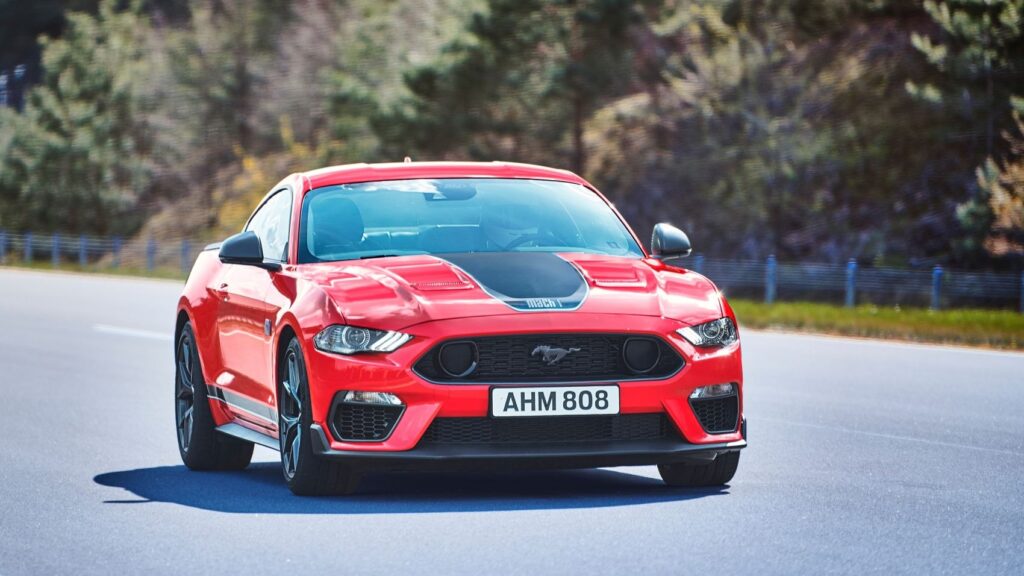
The Ford Mustang VI (facelift 2017) Mach 1 5.0 Ti-VCT V8 (460 Hp) Automatic takes the iconic Fastback body style and elevates it with functional aerodynamic and aesthetic enhancements. The two-door, four-seat coupe boasts a distinctive design that pays homage to its predecessors while incorporating modern performance cues. Key exterior features include a unique grille with retro-inspired round intakes, a prominent front splitter, redesigned side skirts, and a rear spoiler, all contributing to improved downforce and cooling for track use. Special Mach 1 badging and distinctive stripe packages further differentiate this model, giving it an undeniable presence.
Underneath its muscular exterior, the Mach 1 is equipped with a chassis tuned for precision and agility. It features an independent McPherson strut front suspension with coil springs and an anti-roll bar, complemented by an independent multi-link rear spring suspension with a stabilizer. This setup ensures excellent handling characteristics, providing both stability at high speeds and responsiveness in corners. Braking performance is handled by large ventilated discs, measuring 380×34 mm at the front and 330×25 mm at the rear, ensuring consistent stopping power. The vehicle also benefits from an electric power steering system and a rack and pinion steering type, providing precise feedback to the driver. Safety is addressed with an Anti-lock Braking System (ABS) as standard.
The Mach 1 rides on staggered wheel and tire sizes, with 255/40 R19 tires on 9.5J x 19 rims at the front and wider 275/40 R19 tires on 10J x 19 rims at the rear. This configuration, along with the wider rear track of 64.8 inches (1646 mm) compared to the front track of 62.76 inches (1594 mm), enhances grip and stability. Inside, the cabin maintains the driver-focused layout of the Mustang, with Mach 1 specific trim, unique badging, and potentially performance-oriented seating. The overall dimensions of the vehicle are 188.86 inches (4797 mm) in length, 75.43 inches (1916 mm) in width (81.93 inches or 2081 mm including mirrors), and 54.41 inches (1382 mm) in height, with a wheelbase of 107.09 inches (2720 mm).
Technical Specifications
| Category | Specification |
|---|---|
| Brand | Ford |
| Model | Mustang |
| Generation | Mustang VI (facelift 2017) |
| Type (Engine) | Mach 1 5.0 Ti-VCT V8 (460 Hp) Automatic |
| Start of Production | 2020 year |
| End of Production | 2023 year |
| Powertrain Architecture | Internal Combustion engine |
| Body Type | Fastback |
| Seats | 4 |
| Doors | 2 |
| Performance Specs | |
| Combined Fuel Consumption (WLTP) | 20.1 US mpg (11.7 l/100 km) |
| CO2 Emissions (WLTP) | 270 g/km |
| Fuel Consumption (Economy) – Urban | 15 US mpg (15.7 l/100 km) |
| Fuel Consumption (Economy) – Extra Urban | 23.1 US mpg (10.2 l/100 km) |
| Fuel Consumption (Economy) – Combined | 18 US mpg (13.1 l/100 km) |
| Fuel Type | Petrol (Gasoline) |
| Acceleration 0 – 60 mph | 4.2 sec |
| Maximum Speed | 154.72 mph (249 km/h) |
| Braking 100 km/h – 0 | 31.9 m (104.7 ft) |
| Weight-to-Power Ratio | 3.9 kg/Hp, 257.6 Hp/tonne |
| Weight-to-Torque Ratio | 3.4 kg/Nm, 296.2 Nm/tonne |
| Engine Specs | |
| Power | 460 Hp @ 7250 rpm |
| Power per Liter | 91.3 Hp/l |
| Torque | 390.17 lb.-ft. @ 4900 rpm (529 Nm) |
| Engine Layout | Front, Longitudinal |
| Engine Displacement | 307.44 cu. in. (5038 cm3) |
| Number of Cylinders | 8 |
| Engine Configuration | V-engine |
| Cylinder Bore | 3.66 in. (93 mm) |
| Piston Stroke | 3.65 in. (92.7 mm) |
| Compression Ratio | 12:1 |
| Number of Valves per Cylinder | 4 |
| Fuel Injection System | Direct injection and Multi-port manifold injection |
| Valvetrain | DOHC, Ti-VCT |
| Engine Oil Capacity | 10.04 US qt (9.5 l) |
| Coolant Capacity | 13.61 US qt (12.88 l) |
| Engine Systems | Particulate filter |
| Space, Volume and Weights | |
| Kerb Weight | 3937.46 lbs (1786 kg) |
| Max. Weight | 4739.94 lbs (2150 kg) |
| Max Load | 802.48 lbs (364 kg) |
| Trunk (Boot) Space – Minimum | 14.41 cu. ft. (408 l) |
| Fuel Tank Capacity | 16.11 US gal (61 l) |
| Dimensions | |
| Length | 188.86 in. (4797 mm) |
| Width | 75.43 in. (1916 mm) |
| Width with Mirrors Folded | 77.05 in. (1957 mm) |
| Width Including Mirrors | 81.93 in. (2081 mm) |
| Height | 54.41 in. (1382 mm) |
| Wheelbase | 107.09 in. (2720 mm) |
| Front Track | 62.76 in. (1594 mm) |
| Rear (Back) Track | 64.8 in. (1646 mm) |
| Ride Height (Ground Clearance) | 4.72 in. (120 mm) |
| Minimum Turning Circle (Turning Diameter) | 40.03 ft. (12.2 m) |
| Drivetrain, Brakes and Suspension Specs | |
| Drivetrain Architecture | Rear wheel drive, Internal Combustion engine |
| Drive Wheel | Rear wheel drive |
| Number of Gears and Type of Gearbox | 10 gears, automatic transmission |
| Front Suspension | Independent, type McPherson with coil spring and anti-roll bar |
| Rear Suspension | Independent multi-link spring suspension with stabilizer |
| Front Brakes | Ventilated discs, 380×34 mm |
| Rear Brakes | Ventilated discs, 330×25 mm |
| Assisting Systems | ABS (Anti-lock braking system) |
| Steering Type | Steering rack and pinion |
| Power Steering | Electric Steering |
| Tires Size | Front: 255/40 R19, Rear: 275/40 R19 |
| Wheel Rims Size | Front: 9.5J x 19, Rear: 10J x 19 |
Legacy and Market Impact
The reintroduction of the Mach 1 nameplate for the sixth-generation Mustang was a strategic move by Ford to inject a dose of heritage and track-focused performance into its lineup. Positioned above the standard GT but below the more extreme Shelby models, the Ford Mustang VI (facelift 2017) Mach 1 5.0 Ti-VCT V8 (460 Hp) Automatic carved out a unique niche. It appealed to enthusiasts who desired a raw, engaging driving experience with significant track capability, without the higher cost or exclusivity of a Shelby.
The Mach 1’s reputation quickly solidified as a highly competent and enjoyable performance machine. Its blend of the powerful Coyote V8, sophisticated chassis tuning (often including components borrowed from the GT350 and GT500 like the intake manifold, oil cooler, and subframe components), and unique aerodynamic elements made it a formidable competitor. In the competitive landscape of American muscle cars, the Mach 1 went head-to-head with rivals such as the Chevrolet Camaro SS 1LE and the Dodge Challenger R/T Scat Pack. While each offered a distinct flavor of performance, the Mach 1 stood out with its precise handling, balanced dynamics, and the iconic Mustang heritage it proudly carried.
Historically, the Mach 1 has always represented a performance-oriented variant of the Mustang, dating back to its original introduction in 1969. The 2020-2023 iteration successfully revived this legacy, blending nostalgic styling cues with contemporary engineering. Its limited production run further enhanced its desirability among collectors and enthusiasts, ensuring its place as a significant chapter in the Mustang’s storied history. The Mach 1 served as a testament to the Mustang’s adaptability and Ford’s commitment to delivering diverse performance options, maintaining its relevance and appeal in an ever-evolving automotive market. It was a fitting tribute to a legendary name, offering a compelling package of power, handling, and iconic design.