Ford Mustang VII 2.3 EcoBoost (315 Hp) SelectShift: A Modern Evolution of an American Icon
The Ford Mustang, an undisputed icon of American automotive culture, entered its seventh generation in 2023, continuing its storied legacy with a blend of classic muscle car aesthetics and contemporary technology. Among its diverse powertrain offerings, the Ford Mustang VII 2.3 EcoBoost (315 Hp) SelectShift stands as a compelling choice for enthusiasts seeking a balance of spirited performance, modern efficiency, and everyday usability. This variant, available as both a Coupe and a Fastback, represents Ford’s commitment to evolving the Mustang for a new era, leveraging advanced turbocharged four-cylinder technology to deliver an engaging driving experience without solely relying on the traditional V8.
Launched in 2023, the seventh-generation Mustang builds upon its predecessors’ success, retaining its rear-wheel-drive architecture and distinctive styling while introducing a host of mechanical and technological enhancements. The 2.3 EcoBoost model, in particular, targets a segment of buyers who appreciate the Mustang’s heritage but also demand improved fuel economy and a more agile feel, making it a formidable contender in the modern sports coupe market.
Engine and Performance of the Ford Mustang VII 2.3 EcoBoost (315 Hp) SelectShift
At the heart of the Ford Mustang VII 2.3 EcoBoost (315 Hp) SelectShift lies a highly sophisticated 2.3-liter (2261 cm3 or 137.97 cubic inches) EcoBoost inline-four engine. This powerplant is a testament to Ford’s engineering prowess, demonstrating how a smaller displacement engine can deliver impressive performance through advanced forced induction. The engine features a robust architecture with four cylinders arranged in an inline configuration, a DOHC (Double Overhead Camshaft) valvetrain with four valves per cylinder, and Ford’s Ti-VCT (Twin Independent Variable Camshaft Timing) system, which optimizes valve timing for both power and efficiency across the RPM range.
Key to its energetic output is a twin-scroll turbocharger coupled with an intercooler, ensuring rapid throttle response and sustained power delivery. The fuel injection system is a hybrid setup, combining direct injection with multi-port manifold injection. This dual-injection strategy allows for precise fuel delivery under various operating conditions, enhancing both performance and fuel efficiency while minimizing emissions. The engine produces a substantial 315 horsepower at 5500 rpm, yielding an impressive power per liter of 139.3 HP/l. Torque output is equally significant, with 350.34 lb.-ft. (475 Nm) available at a relatively low 3000 rpm, providing strong acceleration from a standstill and robust mid-range pull.
Power is channeled to the rear wheels via an advanced 10-speed SelectShift automatic transmission. This gearbox is engineered for quick, precise shifts, optimizing the engine’s power band for both exhilarating acceleration and relaxed cruising. Its multiple ratios help keep the engine in its most efficient range, contributing to the model’s commendable fuel economy. The vehicle boasts a weight-to-power ratio of 5.2 kg/Hp (193.6 Hp/tonne) and a weight-to-torque ratio of 3.4 kg/Nm (291.9 Nm/tonne), indicating a well-balanced performance package for its class.
Fuel efficiency for the 2.3 EcoBoost is a notable highlight. The combined EPA estimate stands at 26.1 US mpg (9.0 L/100 km), with urban consumption at 22 US mpg (10.7 L/100 km) and extra-urban (highway) driving achieving 33.1 US mpg (7.1 L/100 km). These figures are excellent for a performance-oriented sports coupe, especially one with a curb weight of 3586.92 lbs (1627 kg). Further aiding efficiency is a standard Start & Stop System, which automatically shuts off the engine when the vehicle is stationary, reducing fuel consumption and emissions in city traffic.
Design and Features
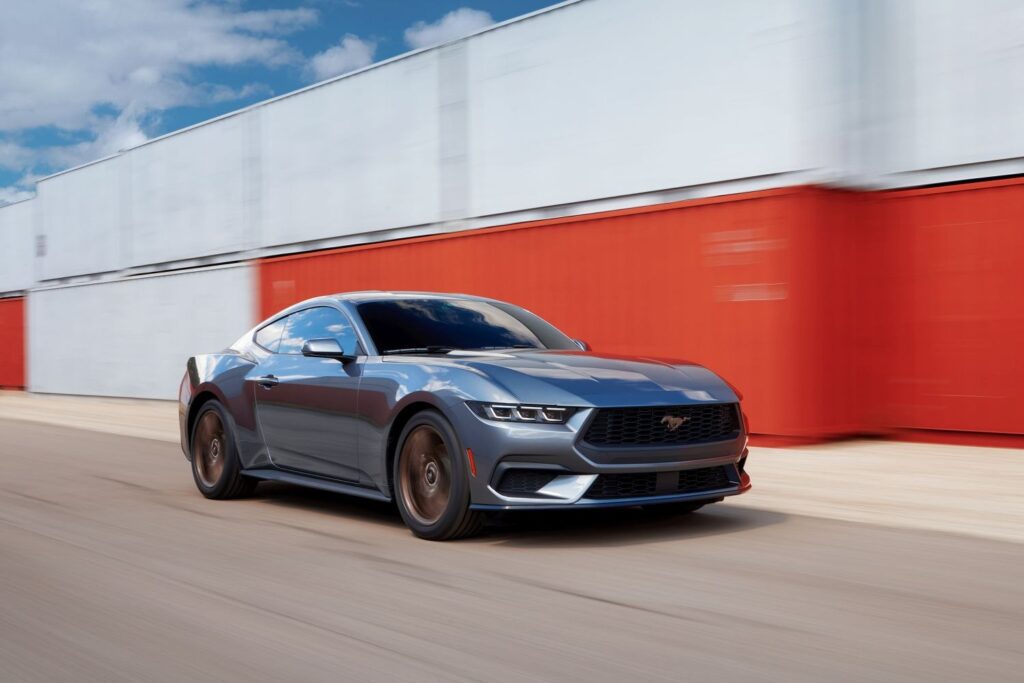
The seventh-generation Mustang, including the Ford Mustang VII 2.3 EcoBoost (315 Hp) SelectShift, maintains its classic pony car proportions while adopting a more aggressive and modern aesthetic. Available in both Coupe and Fastback body styles, it features a sleek, two-door design that comfortably seats four occupants. Its dimensions – a length of 189.41 inches (4811 mm), a width of 75.39 inches (1915 mm), and a height of 55 inches (1397 mm) – give it a commanding road presence while maintaining a sporty stance. The wheelbase measures 107.01 inches (2718 mm), contributing to its stable handling characteristics.
From a design perspective, the Mustang VII showcases sharper lines, a more pronounced grille, and updated lighting signatures that blend modern aggression with historical cues. Inside, the cabin receives a significant overhaul, featuring a driver-centric cockpit with advanced digital displays and improved material quality. While specific interior features beyond seating are not detailed in the provided data, modern Mustangs are typically equipped with an array of infotainment, connectivity, and driver-assistance technologies.
The chassis and suspension setup are engineered for dynamic driving. The front suspension employs an independent McPherson strut design with coil springs and an anti-roll bar, providing precise steering and good road holding. At the rear, an independent multi-link spring suspension with a stabilizer bar ensures excellent traction and ride comfort. This sophisticated independent rear suspension, a feature that has evolved significantly in the Mustang lineage, is crucial for its contemporary handling prowess.
Braking performance is handled by ventilated discs measuring 320×30 mm at the front and solid discs measuring 320×12 mm at the rear. An Anti-lock Braking System (ABS) is standard, enhancing safety and control during emergency stops. Steering is managed by an electric power-assisted rack and pinion system, offering responsive feedback and ease of maneuverability. The Mustang VII 2.3 EcoBoost comes with a range of tire and wheel options, from 235/55 R17 on 7.5J x 17 rims up to 265/35 R20 on 9J x 20 rims, allowing owners to customize their vehicle’s look and handling profile.
Technical Specifications
| Category | Specification |
|---|---|
| General Information | |
| Brand | Ford |
| Model | Mustang |
| Generation | Mustang VII |
| Type (Engine) | 2.3 EcoBoost (315 Hp) SelectShift |
| Start of Production | 2023 year |
| Powertrain Architecture | Internal Combustion engine |
| Body Type | Coupe, Fastback |
| Seats | 4 |
| Doors | 2 |
| Performance Specs | |
| Fuel Consumption (City) | 22 US mpg (10.7 l/100 km) |
| Fuel Consumption (Highway) | 33.1 US mpg (7.1 l/100 km) |
| Fuel Consumption (Combined) | 26.1 US mpg (9.0 l/100 km) |
| Fuel Type | Petrol (Gasoline) |
| Weight-to-Power Ratio | 5.2 kg/Hp (193.6 Hp/tonne) |
| Weight-to-Torque Ratio | 3.4 kg/Nm (291.9 Nm/tonne) |
| Engine Specs | |
| Power | 315 Hp @ 5500 rpm |
| Power per Liter | 139.3 Hp/l |
| Torque | 350.34 lb.-ft. (475 Nm) @ 3000 rpm |
| Engine Layout | Front, Longitudinal |
| Engine Model/Code | EcoBoost |
| Engine Displacement | 2.3 liters (2261 cm3, 137.97 cu. in.) |
| Number of Cylinders | 4 |
| Engine Configuration | Inline |
| Cylinder Bore | 3.31 in. (84 mm) |
| Piston Stroke | 4.02 in. (102 mm) |
| Compression Ratio | 10.6:1 |
| Number of Valves per Cylinder | 4 |
| Fuel Injection System | Direct injection and Multi-port manifold injection |
| Engine Aspiration | Twin-scroll turbo, Intercooler |
| Valvetrain | DOHC, Ti-VCT |
| Engine Oil Capacity | 6.02 US qt (5.7 l) |
| Engine Oil Specification | Not specified |
| Coolant Capacity | 10.46 US qt (9.9 l) |
| Engine Systems | Start & Stop System |
| Space, Volume and Weights | |
| Curb Weight | 3586.92 lbs (1627 kg) |
| Trunk Space – Minimum | 13.49 cu. ft. (382 l) |
| Fuel Tank Capacity | 16.11 US gal (61 l) |
| Dimensions | |
| Length | 189.41 in. (4811 mm) |
| Width | 75.39 in. (1915 mm) |
| Width with Mirrors Folded | 76.1 in. (1933 mm) |
| Width Including Mirrors | 81.89 in. (2080 mm) |
| Height | 55 in. (1397 mm) |
| Wheelbase | 107.01 in. (2718 mm) |
| Front Track | 62.01 in. (1575 mm) |
| Rear Track | 64.69 in. (1643 mm) |
| Drivetrain, Brakes and Suspension Specs | |
| Drivetrain Architecture | Internal combustion engine (ICE) drives the rear wheels of the vehicle. |
| Drive Wheel | Rear wheel drive |
| Number of Gears and Gearbox Type | 10 gears, automatic transmission SelectShift |
| Front Suspension | Independent, type McPherson with coil spring and anti-roll bar |
| Rear Suspension | Independent multi-link spring suspension with stabilizer |
| Front Brakes | Ventilated discs, 320×30 mm |
| Rear Brakes | Disc, 320×12 mm |
| Assisting Systems | ABS (Anti-lock braking system) |
| Steering Type | Steering rack and pinion |
| Power Steering | Electric Steering |
| Tire Sizes | 235/55 R17; 235/50 R18; 255/40 R19; 265/35 R20 |
| Wheel Rim Sizes | 7.5J x 17; 8J x 18; 8.5J x 19; 9J x 20 |
Legacy and Market Impact of the Ford Mustang VII 2.3 EcoBoost (315 Hp) SelectShift
The Ford Mustang’s legacy is deeply embedded in American automotive history, representing freedom, performance, and accessible sportiness. The seventh generation, and specifically the Ford Mustang VII 2.3 EcoBoost (315 Hp) SelectShift, continues this tradition while strategically adapting to contemporary market demands. Its introduction underscores a significant shift in the performance car landscape, where efficiency and advanced technology play an increasingly vital role alongside raw power.
The 2.3 EcoBoost model serves a crucial purpose within the Mustang lineup. It offers a more fuel-efficient and often more affordable entry point into Mustang ownership compared to its V8-powered GT siblings, without sacrificing the core Mustang experience. With 315 horsepower, it provides ample performance for most drivers, capable of delivering thrilling acceleration and engaging dynamics. Its lighter engine also contributes to a more balanced weight distribution, potentially offering a slightly more nimble feel in certain driving scenarios compared to the heavier V8 models.
In the competitive sports coupe segment, the Mustang EcoBoost faces rivals such as the Chevrolet Camaro 2.0T, the Toyota GR Supra (with its four-cylinder option), and potentially even performance-oriented variants of European coupes like the BMW 2 Series. The Mustang distinguishes itself with its iconic styling, strong brand heritage, and the unique appeal of an American pony car. Its rear-wheel-drive layout, combined with the independent suspension, ensures it remains a driver’s car, appealing to those who prioritize driving engagement.
The historical significance of the EcoBoost Mustang lies in its ability to broaden the model’s appeal. It demonstrates that the Mustang can evolve, embracing modern engine technology to meet stricter emissions regulations and consumer demands for better fuel economy, while still delivering on its promise of an exciting and stylish performance car. This strategic move ensures the Mustang’s relevance and longevity in a rapidly changing automotive world, solidifying its reputation as a versatile and enduring icon.
Ultimately, the Ford Mustang VII 2.3 EcoBoost (315 Hp) SelectShift is more than just a base model; it’s a sophisticated, performance-oriented sports coupe that offers a compelling blend of power, efficiency, and modern technology, all wrapped in the unmistakable styling of an American legend. It proves that the spirit of the Mustang can thrive in diverse forms, continuing to captivate enthusiasts globally.