Introduction: The Ford Mustang VII Dark Horse
The Ford Mustang, an icon of American automotive performance and culture, entered its seventh generation in 2023, continuing a legacy that spans nearly six decades. Among the most anticipated variants of this new generation is the Ford Mustang VII Dark Horse, a track-focused, high-performance model designed to push the boundaries of the naturally aspirated muscle car. Positioned above the standard GT, the Dark Horse represents a significant step up in performance and handling, embodying Ford’s commitment to internal combustion engine (ICE) enthusiasts in an increasingly electrified automotive landscape.
Unveiled as a pinnacle of the S650 generation, the Ford Mustang VII Dark Horse is specifically engineered for enthusiasts seeking a more visceral and engaging driving experience, both on the street and on the racetrack. It combines raw V8 power with enhanced chassis dynamics, unique styling, and a suite of performance-oriented features, making it a formidable contender in the performance coupe segment. This model serves as a direct descendant of previous track-ready Mustangs, such as the Mach 1 and Boss 302, carrying forward the tradition of offering accessible, high-performance driving.
Engine and Performance: The Heart of the Ford Mustang VII Dark Horse
Powertrain Configuration
At the core of the Ford Mustang VII Dark Horse lies a specially tuned version of Ford’s renowned Coyote 5.0-liter V8 engine, specifically designated as the Coyote engine code. This naturally aspirated powerhouse delivers a formidable 500 horsepower at a high-revving 7250 rpm, coupled with 418.2 lb.-ft. of torque peaking at 4900 rpm. With a robust power-to-liter ratio of 99.2 Hp/l, this engine showcases Ford Performance’s meticulous engineering. The engine’s architecture features a V-engine configuration with eight cylinders, each equipped with four valves, totaling 32 valves.
The 5.0-liter (5038 cm3 or 307.44 cu. in.) displacement is achieved through a cylinder bore of 3.66 inches (93 mm) and a piston stroke of 3.65 inches (92.7 mm). A high compression ratio of 12:1 contributes to the engine’s efficiency and power output. Advanced valvetrain technology, including Dual Overhead Camshafts (DOHC) and Twin Independent Variable Cam Timing (Ti-VCT), ensures optimal valve control across the entire rev range, enhancing both power and fuel efficiency. The fuel injection system utilizes a sophisticated combination of direct injection and multi-port manifold injection, allowing for precise fuel delivery under varying load conditions. As a naturally aspirated engine, it delivers linear power delivery and a distinctive V8 soundtrack, qualities highly cherished by enthusiasts. For environmental considerations and economy, the engine also incorporates a Start & Stop System.
Performance Metrics and Drivetrain
The Ford Mustang VII Dark Horse channels its considerable power to the rear wheels via a robust 6-speed manual transmission, offering a direct and engaging connection between driver and machine. This rear-wheel-drive architecture is fundamental to the Mustang’s dynamic character. With a curb weight of 3948.48 lbs. (1791 kg), the Dark Horse boasts an impressive weight-to-power ratio of 3.6 kg/Hp (279.2 Hp/tonne) and a weight-to-torque ratio of 3.2 kg/Nm (316.6 Nm/tonne), indicating its strong acceleration capabilities.
Fuel economy figures for the Dark Horse reflect its high-performance nature. In urban driving, it achieves approximately 14 US mpg (16.8 l/100 km). On the highway, it improves to 22 US mpg (10.7 l/100 km), with a combined average of around 17 US mpg (13.8 l/100 km). These figures are typical for a high-output, naturally aspirated V8 engine in this segment, emphasizing performance over outright efficiency. The fuel tank capacity stands at 16.11 US gallons (61 liters), providing a reasonable range for spirited driving.
Design and Features: A Modern Muscle Icon
Exterior Aesthetics and Aerodynamics
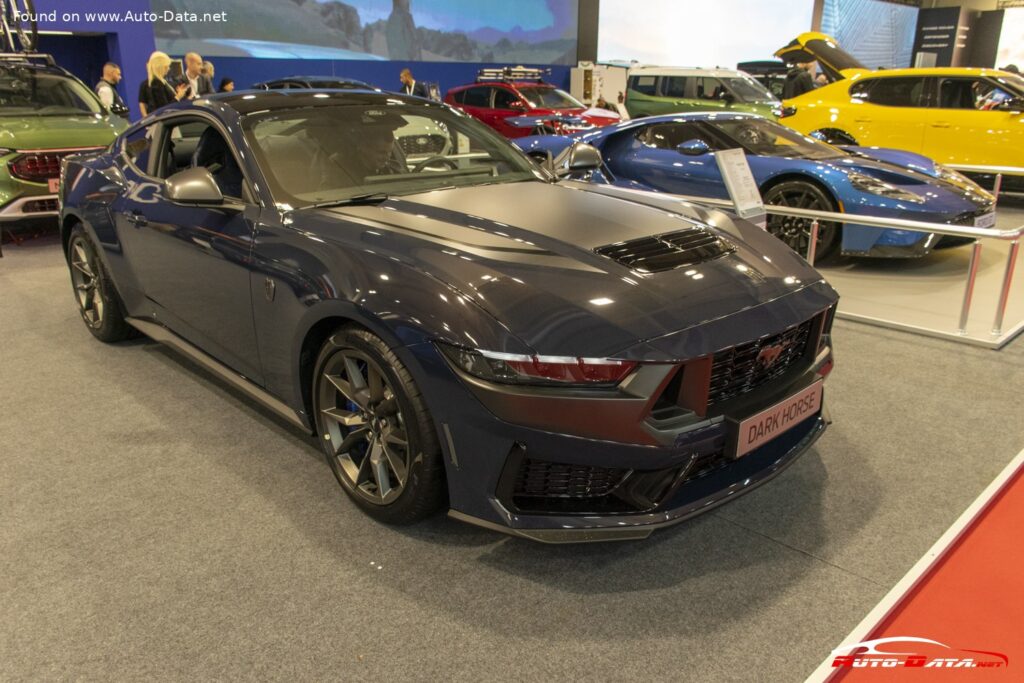
The Ford Mustang VII Dark Horse adopts the sleek and aggressive styling of the seventh-generation Mustang, enhancing it with unique design elements that signify its performance pedigree. Available in both Coupe and Fastback body types, it maintains the classic two-door, four-seat configuration that has defined the Mustang for decades. The vehicle measures 189.69 inches (4818 mm) in length, 75.51 inches (1918 mm) in width (81.89 inches or 2080 mm including mirrors), and stands 55.2 inches (1402 mm) tall. Its wheelbase spans 107.01 inches (2718 mm), contributing to its stable and athletic stance.
Distinctive Dark Horse styling cues include unique badging, darker exterior accents, and potentially more aggressive aerodynamic elements designed to improve downforce and cooling for track use. The front track measures 62.2 inches (1580 mm), while the rear track is 63.9 inches (1623 mm), providing a wide, planted footprint. The car rides on staggered wheel and tire setups, with front wheel tires sized 255/40 R19 or 305/30 R19, mounted on 9.5J x 19 or 10.5J x 19 rims. The rear features wider 275/40 R19 or 315/30 R19 tires on 10J x 19 or 11J x 19 rims, optimizing traction for the powerful rear-wheel-drive system.
Chassis and Interior Enhancements
To match its potent engine, the Dark Horse features a significantly upgraded chassis. The front suspension employs an independent McPherson-type setup with coil springs and an anti-roll bar, while the rear utilizes an independent multi-link spring suspension with a stabilizer, both tuned for high-performance driving. Braking is handled by large ventilated discs on all four corners: 15.35×1.42 inches (390×36 mm) at the front and 13.98×1.10 inches (355×28 mm) at the rear, ensuring robust stopping power. An Anti-lock Braking System (ABS) is standard, providing crucial safety and control under hard braking.
Steering is managed by a rack-and-pinion system with electric power steering, offering precise feedback and adjustability. Inside, the Dark Horse is expected to feature a driver-centric cockpit with performance seats, unique trim, and modern digital displays, emphasizing its dual role as a street-legal muscle car and a track-capable machine. The trunk space offers 13.49 cu. ft. (382 liters) of capacity, providing practicality for daily use or weekend trips to the track.
Technical Specifications
| Category | Specification |
|---|---|
| General Information | |
| Brand | Ford |
| Model | Mustang |
| Generation | Mustang VII |
| Type (Engine) | Dark Horse 5.0 V8 (500 Hp) |
| Start of Production | 2023 year |
| Powertrain Architecture | Internal Combustion engine |
| Body type | Coupe, Fastback |
| Seats | 4 |
| Doors | 2 |
| Performance Specs | |
| Fuel consumption (economy) – urban | 16.8 l/100 km (14 US mpg) |
| Fuel consumption (economy) – extra urban | 10.7 l/100 km (22 US mpg) |
| Fuel consumption (economy) – combined | 13.8 l/100 km (17 US mpg) |
| Fuel Type | Petrol (Gasoline) |
| Weight-to-power ratio | 3.6 kg/Hp (279.2 Hp/tonne) |
| Weight-to-torque ratio | 3.2 kg/Nm (316.6 Nm/tonne) |
| Engine Specs | |
| Power | 500 Hp @ 7250 rpm |
| Power per liter | 99.2 Hp/l |
| Torque | 567 Nm (418.2 lb.-ft.) @ 4900 rpm |
| Engine layout | Front, Longitudinal |
| Engine Model/Code | Coyote |
| Engine displacement | 5038 cm3 (5.0 Liters / 307.44 cu. in.) |
| Number of cylinders | 8 |
| Engine configuration | V-engine |
| Cylinder Bore | 93 mm (3.66 in.) |
| Piston Stroke | 92.7 mm (3.65 in.) |
| Compression ratio | 12:1 |
| Number of valves per cylinder | 4 |
| Fuel injection system | Direct injection and Multi-port manifold injection |
| Engine aspiration | Naturally aspirated engine |
| Valvetrain | DOHC, Ti-VCT |
| Engine oil capacity | 9.5 l (10.04 US qt) |
| Engine oil specification | Specific details not provided in data |
| Coolant capacity | 11.1 l (11.73 US qt) |
| Engine systems | Start & Stop System |
| Space, Volume and Weights | |
| Kerb Weight | 1791 kg (3948.48 lbs.) |
| Trunk (boot) space – minimum | 382 l (13.49 cu. ft.) |
| Fuel tank capacity | 61 l (16.11 US gal) |
| Dimensions | |
| Length | 4818 mm (189.69 in.) |
| Width | 1918 mm (75.51 in.) |
| Width with mirrors folded | 1933 mm (76.1 in.) |
| Width including mirrors | 2080 mm (81.89 in.) |
| Height | 1402 mm (55.2 in.) |
| Wheelbase | 2718 mm (107.01 in.) |
| Front track | 1580 mm (62.2 in.) |
| Rear (Back) track | 1623 mm (63.9 in.) |
| Drivetrain, Brakes and Suspension Specs | |
| Drivetrain Architecture | The Internal combustion engine (ICE) drives the rear wheels of the vehicle. |
| Drive wheel | Rear wheel drive |
| Number of gears and type of gearbox | 6 gears, manual transmission |
| Front suspension | Independent, type McPherson with coil spring and anti-roll bar |
| Rear suspension | Independent multi-link spring suspension with stabilizer |
| Front brakes | Ventilated discs, 390×36 mm |
| Rear brakes | Ventilated discs, 355×28 mm |
| Assisting systems | ABS (Anti-lock braking system) |
| Steering type | Steering rack and pinion |
| Power steering | Electric Steering |
| Tires size Front wheel tires | 255/40 R19; 305/30 R19 |
| Tires size Rear wheel tires | 275/40 R19; 315/30 R19 |
| Wheel rims size Front wheel rims | 9.5J x 19; 10.5J x 19 |
| Wheel rims size Rear wheel rims | 10J x 19; 11J x 19 |
Legacy and Market Impact
The Ford Mustang VII Dark Horse arrives at a pivotal moment for performance vehicles, representing a strong statement from Ford regarding the enduring appeal of the traditional American muscle car. As electrification gains momentum across the industry, the Dark Horse stands as a testament to the raw, unadulterated power and visceral experience of a naturally aspirated V8 engine paired with a manual transmission. Its introduction reinforces the Mustang’s position as a global performance icon, while specifically catering to a demographic that values driving purity and track capability.
Within the United States market, the Dark Horse directly competes with high-performance variants of its traditional rivals, such as the Chevrolet Camaro SS 1LE and ZL1, and the various Dodge Challenger Scat Pack and Hellcat models. While the Challenger emphasizes brute straight-line force and the Camaro offers sharp handling, the Dark Horse aims to blend these attributes with a unique aesthetic and a focus on balanced track performance. Its 500-horsepower output slots it comfortably into the upper echelons of the segment, offering a compelling alternative to more expensive European sports coupes.
Historically, the Mustang has always been a car for the masses, offering performance and style at an accessible price point. The Dark Horse, while a more specialized and premium offering within the Mustang lineup, continues this tradition by providing a factory-tuned, track-ready package that doesn’t require extensive aftermarket modifications. It builds on the heritage of performance-oriented Mustangs like the Boss 302, Shelby GT350, and Mach 1, offering a modern interpretation of what a truly engaging and capable Mustang can be.
The Ford Mustang VII Dark Horse is more than just a new trim level; it’s a halo car for the seventh generation, showcasing the engineering prowess of Ford Performance and signaling a continued commitment to enthusiast drivers. Its existence in a rapidly changing automotive landscape underscores a belief in the enduring passion for high-revving V8s and manual transmissions. As such, the Dark Horse is poised to carve out its own significant niche in Mustang lore, celebrated by those who cherish the thrill of a pure, unadulterated American muscle car. Its blend of power, precision, and heritage ensures its place as a significant model in the Mustang’s storied history and the broader performance car market.