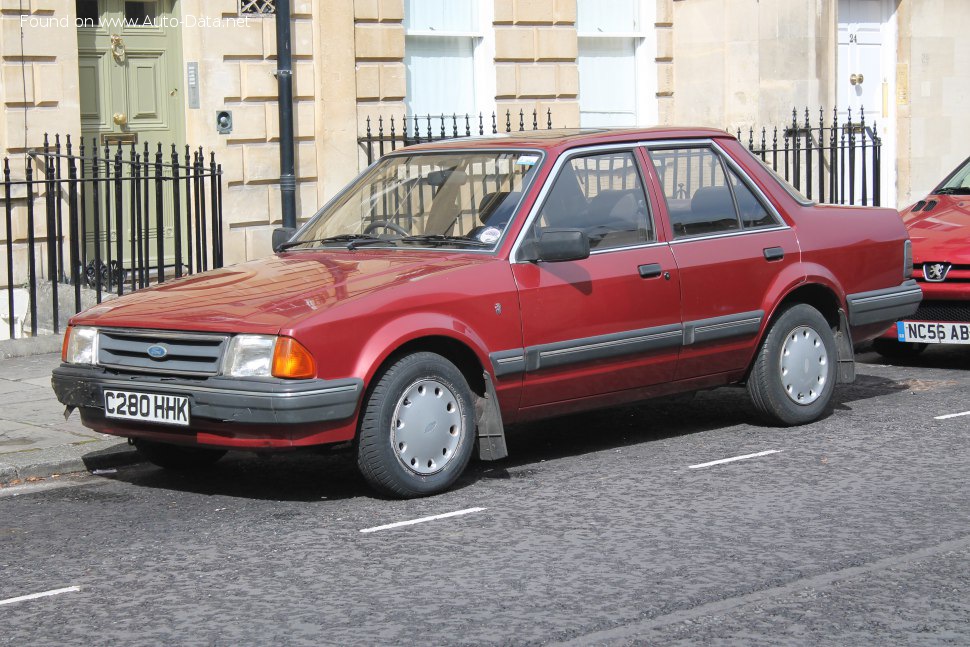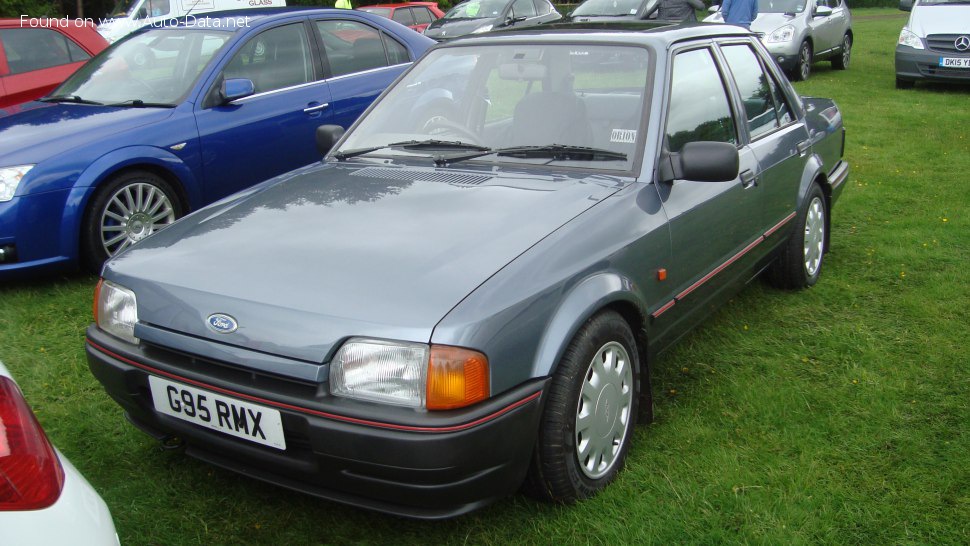
Ford Orion II (AFF) 1.4 (73 Hp): A European Compact Sedan Legacy
The Ford Orion II (AFF) represents a significant chapter in Ford’s European automotive history during the late 1980s. Introduced in 1986 as the second generation of the Orion nameplate, this compact sedan was primarily designed for the European market, where it served as a more upscale, three-box variant of the highly successful Ford Escort. Unlike its hatchback sibling, the Orion offered a conventional trunk, appealing to buyers who preferred the more traditional styling and perceived security of a sedan. The Ford Orion II (AFF) 1.4 (73 Hp) was a particularly popular configuration, offering a pragmatic balance of economy and adequate performance for daily driving.
Positioned to compete in the highly contested C-segment, the Orion aimed to attract families and company car drivers seeking a reliable, practical, and affordable vehicle with a touch more sophistication than its Escort counterpart. Its production run from 1986 to 1990 cemented its status as a ubiquitous sight on European roads, embodying the design and engineering philosophies prevalent at Ford of Europe during that era. While never officially sold in the United States, the Orion exemplifies Ford’s global strategy of adapting core platforms to suit regional market demands, offering a distinct product for European consumers who valued sedan practicality within a compact footprint.
Engine & Performance: The Heart of the Ford Orion II (AFF)
Under the hood, the Ford Orion II (AFF) 1.4 (73 Hp) was equipped with a 1.4-liter naturally aspirated gasoline engine, delivering a modest but functional 73 horsepower. This powertrain architecture, common for compact family cars of its time, prioritized fuel efficiency, ease of maintenance, and low running costs over outright speed or dynamic performance. The 1.4-liter unit was a prominent member of Ford’s popular “CVH” (Compound Valve-angle Hemispherical) engine family, which was widely used across Ford’s European lineup during the 1980s.
The CVH engine was known for its decent torque delivery at lower RPMs, which translated into responsive acceleration in urban driving conditions, and its robust construction, contributing to its reputation for reliability. While 73 HP might seem modest by today’s standards, for a vehicle like the Orion II in the late 1980s, it provided sufficient motivation for urban commuting and comfortable highway cruising, albeit without setting any performance records. The naturally aspirated design meant predictable power delivery and simpler mechanics compared to more complex turbocharged units that would become prevalent in later decades. This simplicity also contributed to the vehicle’s overall affordability and ease of service.
Drivers appreciated the engine’s consistent performance and the relatively low cost of ownership, crucial factors for its target demographic of families and fleet operators. The engine was typically paired with a manual transmission, offering a direct and engaging driving experience characteristic of European Fords of the period. This combination allowed drivers to extract the most from the 73 horsepower, making the Orion feel nimble enough for its class. The focus was squarely on delivering a practical, dependable, and economical vehicle, and the 1.4-liter engine package perfectly aligned with these objectives for the Ford Orion II (AFF).
Design & Features of the Ford Orion II (AFF)
The Ford Orion II (AFF) maintained the distinctive sedan body type that set it apart from its Escort hatchback sibling. Its design language was unmistakably late-1980s Ford, characterized by clean lines, a relatively aerodynamic profile for its time, and a pragmatic approach to aesthetics. The “AFF” designation referred to the platform, shared with the Escort and Sierra, signifying Ford’s modular approach to vehicle development, which allowed for cost efficiencies and commonality of parts.
The second-generation Orion saw subtle refinements over its predecessor, with updated front and rear fascias that gave it a slightly more modern and integrated look. The conventional three-box sedan shape provided a generous trunk capacity, a significant selling point for families needing space for luggage or shopping, and for business users who required secure storage. This dedicated trunk space was a key differentiator from the hatchback, offering better sound insulation and a more formal appearance that appealed to a segment of the market.
Inside, the Orion II offered a functional and ergonomic cabin. While not luxurious, the interior was designed for durability and ease of use, with clear instrumentation and logically placed controls. Material quality was typical for a compact car of its era, prioritizing hard-wearing plastics and comfortable, albeit not opulent, cloth upholstery. Features, depending on the trim level, might have included a basic radio-cassette player, manual winding windows, and a simple heating and ventilation system. Power steering was often an option rather than standard, especially on lower trims, reflecting the cost-conscious nature of the segment.
Safety features, by 1980s standards, were primarily passive, relying on the car’s inherent structural integrity and three-point seatbelts for all occupants. Airbags, anti-lock brakes (ABS), and advanced driver-assistance systems were not standard fare at this time for compact cars. The emphasis was on practicality, with comfortable seating for four adults and adequate storage compartments within the cabin. The Orion’s design reflected its role as a reliable, no-nonsense family car or fleet vehicle, prioritizing utility and affordability over flamboyant styling or cutting-edge technology. Its discreet appearance made it a popular choice for those seeking understated reliability and a traditional automotive package.
Technical Specifications
| Ford Orion II (AFF) 1.4 (73 Hp) Technical Specifications | |
|---|---|
| Brand | Ford |
| Model | Orion |
| Generation | Orion II (AFF) |
| Type (Engine) | 1.4 (73 Hp) |
| Start of Production | 1986 year |
| End of Production | 1990 year |
| Powertrain Architecture | Internal Combustion engine |
| Body Type | Sedan |
| Fuel Type | Petrol (Gasoline) |
| Power | 73 Hp |
| Engine Aspiration | Naturally aspirated engine |
Legacy & Market Impact of the Ford Orion II (AFF)
The Ford Orion II (AFF) carved out a significant niche for itself in the European automotive landscape during its production run, solidifying its reputation as a dependable and accessible family sedan. Its legacy is one of practicality, reliability, and widespread appeal. While perhaps not remembered for groundbreaking innovation or thrilling performance, the Orion II excelled at its primary mission: providing dependable and economical transportation for millions of families and businesses across Europe. It was often perceived as a more mature and conservative alternative to the highly popular Escort hatchback, appealing specifically to buyers who preferred a traditional sedan’s aesthetics, larger and more secure separate trunk, and a slightly more formal image.
In the highly competitive European C-segment, the Orion II faced stiff competition from a range of well-established rivals. Key competitors included the Opel/Vauxhall Astra (and its sedan variant, the Belmont), the Volkswagen Jetta (the sedan version of the Golf), the Peugeot 309, and the Renault 19. Against these formidable adversaries, the Orion often held its own through a combination of Ford’s extensive dealer network, competitive pricing, and a strong reputation for solid, if not spectacular, engineering. Its commonality with the immensely popular Escort meant that parts were readily available, and mechanics were widely familiar with its systems, contributing significantly to its lower running costs and ease of ownership—crucial factors for its target market.
The Orion II’s historical significance lies in its role as a workhorse of the late 1980s. It represented an era when car design was becoming more sophisticated and aerodynamically efficient but still retained a degree of mechanical simplicity that made vehicles relatively easy to maintain and repair. It was a car that many Europeans learned to drive in, used for countless family vacations, and relied upon for daily commutes and business travel. While it might not command high prices on the classic car market today, its impact was profound in its time, providing millions with reliable personal transport during a period of economic growth and increasing car ownership.
The Ford Orion II (AFF) successfully bridged the gap between basic utility and a desire for slightly more refined aesthetics than a pure hatchback could offer. It demonstrated Ford of Europe’s strategic acumen in catering to diverse customer preferences within a common, cost-effective platform strategy. The {original_focus_keyword} played a vital role in Ford of Europe’s continued success during a pivotal period, leaving an indelible mark on the automotive fabric of the continent and serving as a testament to the enduring appeal of the compact, practical sedan.