Ford Orion III (GAL) 1.8 TD (90 Hp): A European Mainstay
The Ford Orion III (GAL) 1.8 TD (90 Hp) represents a significant chapter in Ford of Europe’s history, serving as a popular compact sedan within the fiercely competitive European market during its production run from 1992 to 1993. Positioned as the four-door sedan variant of the immensely successful Ford Escort, the Orion offered a more traditional and conservative alternative to its hatchback sibling, appealing to buyers who preferred a separate trunk and a more conventional silhouette. This particular iteration, the Orion III, corresponded to the fifth generation of the Escort (often referred to as Mk5 or Mk5b after its 1992 facelift), integrating updated styling and mechanical refinements. The 1.8-liter Turbo Diesel engine, with its 90 horsepower output, was a particularly crucial offering, catering to the strong European demand for fuel-efficient and robust diesel powertrains, especially for long-distance travel and lower running costs. While never officially sold in the United States, the Ford Orion III (GAL) was a ubiquitous sight on European roads, embodying Ford’s strategy to provide a comprehensive range of vehicles tailored to regional preferences.
The Ford Orion III (GAL) in its European Context
Ford’s strategy for the Orion was clear: to capture the segment of the market that still favored traditional sedans over the burgeoning popularity of hatchbacks. In many European countries, a sedan was perceived as more prestigious or practical for families, particularly for those who needed secure, separate luggage space. The Orion III (GAL) therefore played a vital role, providing a direct competitor to other popular compact sedans of the era, such as the Volkswagen Jetta, Opel Astra Sedan (or its Vauxhall equivalent in the UK), and the Renault 19 Chamade.
The “GAL” designation for the Orion III indicates its platform lineage, directly sharing components and much of its front-end styling with the Escort Mk5/Mk5b. The 1992 update saw the Orion adopt the more rounded and refined aesthetics of the facelifted Escort, moving away from the squarer lines of earlier generations. This refresh was crucial for Ford to maintain competitiveness against newer rivals entering the market. For European consumers, the availability of a diesel engine was often a primary consideration. Diesel fuel was typically cheaper, and diesel engines offered superior fuel economy and higher torque at lower RPMs, making them ideal for highway cruising and heavy loads. The 1.8 TD engine in the Orion III was a direct response to this market demand, providing a balance of performance and economy that resonated with a broad customer base.
Engine and Performance: The Robust 1.8 TD Powerplant
At the heart of the Ford Orion III (GAL) 1.8 TD was its turbocharged diesel engine, a unit that delivered 90 horsepower. This 1.8-liter powerplant, known by its internal Ford engine codes RFD, RFK, and RFS, was a workhorse for the company, appearing in various Ford models across Europe. The inclusion of a turbocharger was key to its performance, significantly boosting power output and torque compared to naturally aspirated diesel engines of similar displacement from the era. For a compact sedan in the early 1990s, 90 horsepower from a diesel engine provided respectable acceleration and ample power for highway speeds, allowing for comfortable long-distance travel without feeling underpowered.
The engine’s design emphasized durability and efficiency, characteristics highly valued by European consumers. While specific torque figures are not provided, a 90 Hp turbocharged diesel of this size would typically generate substantial torque at low RPMs, contributing to good drivability and reduced need for frequent gear changes. The diesel fuel type was central to its appeal, offering better mileage per gallon (or liter per 100 kilometers) compared to its gasoline counterparts, which translated into lower running costs – a significant factor for families and business users. The engine oil capacity was specified at 5.1 liters (5.39 US quarts), and the coolant capacity at 9.3 liters (9.83 US quarts), indicating standard maintenance requirements for the period. These fluid capacities are important details for vehicle upkeep, reflecting the engineering considerations for thermal management and lubrication of a turbocharged unit.
Design and Features: A Practical Sedan
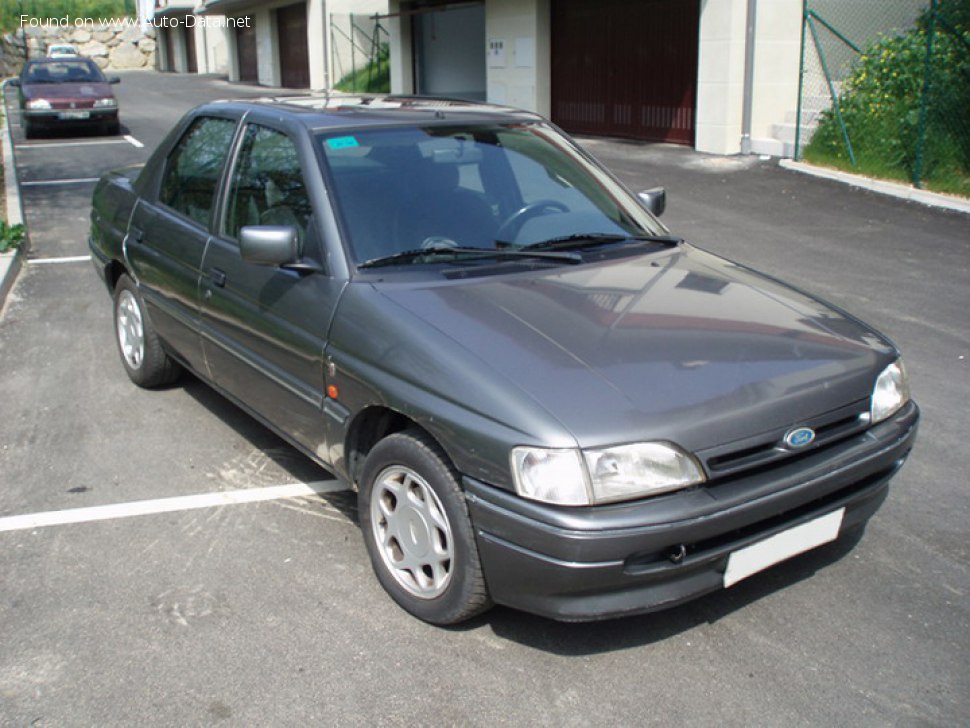
The Ford Orion III (GAL) maintained its identity as a classic sedan, distinct from the hatchback Escort through its elongated rear section that incorporated a conventional trunk. This body type appealed to buyers who preferred the security and aesthetics of a separate luggage compartment, often perceived as more refined than a hatchback. The design language of the Orion III was largely aligned with the updated Escort Mk5b, featuring smoother lines, revised headlights, and a more aerodynamic profile compared to its predecessor. Its appearance was understated and functional, designed to appeal to a broad, mainstream audience rather than to stand out with flamboyant styling.
Inside, the Orion III offered a practical and ergonomic cabin. While luxury was not its primary focus, Ford designed the interior for durability and ease of use, utilizing robust materials capable of withstanding the rigors of family life. Depending on the trim level, features common for the early 1990s might have included power steering, central locking, electric front windows, and a basic audio system. Safety features for the era were primarily passive, consisting of seatbelts for all occupants, and potentially a driver’s side airbag on higher trim levels or as an optional extra, though this was not universally standard in the compact segment at the time. The emphasis was on providing a comfortable, reliable, and functional environment for its occupants, with a focus on practicality and straightforward operation. The spacious trunk, a hallmark of the sedan body style, was a key selling point for families needing to transport luggage, groceries, or sports equipment.
Technical Specifications
| Feature | Specification |
|---|---|
| Brand | Ford |
| Model | Orion |
| Generation | Orion III (GAL) |
| Engine Type | 1.8 TD (Turbo Diesel) |
| Production Start | 1992 |
| Production End | 1993 |
| Powertrain Architecture | Internal Combustion Engine |
| Body Type | Sedan |
| Fuel Type | Diesel |
| Power Output | 90 Hp |
| Engine Model/Code | RFD, RFK, RFS |
| Engine Aspiration | Turbocharger |
| Engine Oil Capacity | 5.1 liters (5.39 US quarts) |
| Coolant Capacity | 9.3 liters (9.83 US quarts) |
Legacy and Market Impact
The Ford Orion III (GAL) 1.8 TD (90 Hp) left a lasting impression as a testament to Ford of Europe’s understanding of its market. Its reputation was built on reliability, practicality, and, particularly with the 1.8 TD engine, excellent fuel economy. The Orion served as a crucial bridge within Ford’s lineup, offering a traditional sedan form factor that appealed to a segment of buyers who found the Escort hatchback too utilitarian or the larger Sierra/Mondeo too expensive. It successfully carved out its niche as a dependable family car and a popular choice for fleet operations across the continent.
In its competitive landscape, the Orion faced formidable rivals. Beyond the aforementioned Volkswagen Jetta and Opel Astra/Vectra sedans, it also contended with models like the Peugeot 306 Sedan and the Citroën ZX Sedan (Volcane/Aura), all vying for the same value-conscious, family-oriented customer base. The 1.8 TD engine, in particular, was a significant factor in its competitiveness, as diesel technology was rapidly improving and becoming a preferred option for many European motorists due to its efficiency and lower fuel costs.
Historically, the Orion nameplate eventually faded, as Ford streamlined its global strategy. The subsequent generations of Ford’s compact offerings, notably the Focus, increasingly blurred the lines between sedan and hatchback, with the Focus sedan eventually absorbing the role once held by the Orion. The Orion’s legacy, however, is firmly cemented as a symbol of the European compact sedan market of the late 1980s and early 1990s. It represented an era where car manufacturers provided distinct body styles for different tastes, and where the robust, economical diesel engine was king for many practical-minded buyers. The Ford Orion III (GAL) 1.8 TD (90 Hp) stands as a reminder of Ford’s ability to deliver a car that perfectly met the needs of its target audience in a specific and demanding market segment.