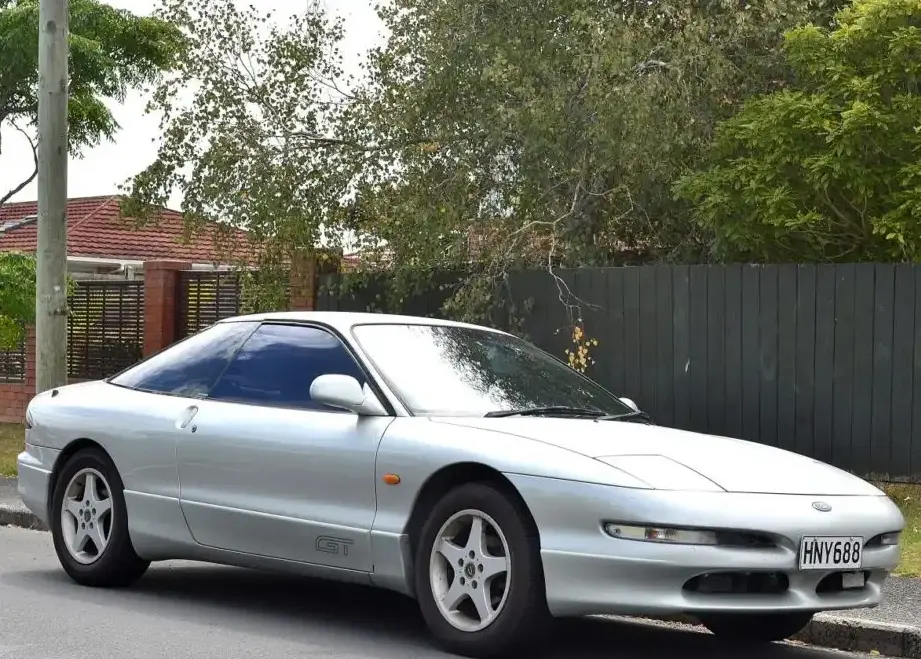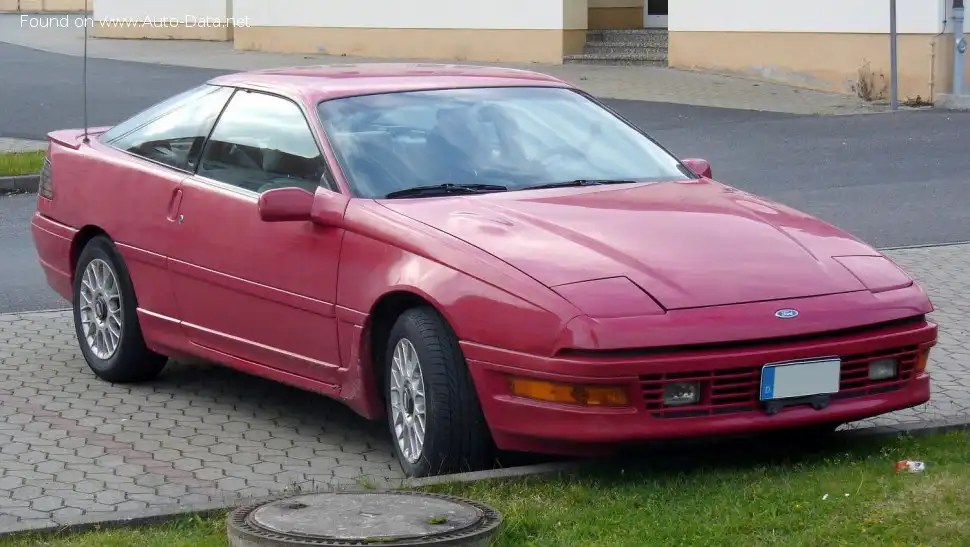
The Ford Probe I 3.0 V6 Automatic, produced between 1989 and 1991, represented a significant departure for Ford, moving away from the traditional Mustang-based platform for a more modern, aerodynamic coupe. Positioned as a sporty and technologically advanced offering, the Probe aimed to attract buyers seeking a blend of performance and style. It was built on Ford’s MN12 platform, shared with the Mazda MX-6, reflecting a growing collaboration between the two manufacturers. This variant, equipped with the 3.0-liter V6 engine and a four-speed automatic transmission, occupied a mid-range position within the Probe lineup, offering a balance between the base 2.2-liter four-cylinder models and the more performance-focused turbocharged variants that would arrive in later years.
Technical Specifications
| Brand | Ford |
| Model | Probe |
| Generation | Probe I |
| Type (Engine) | 3.0 V6 (140 Hp) Automatic |
| Start of production | 1989 |
| End of production | 1991 |
| Powertrain Architecture | Internal Combustion engine |
| Body type | Coupe |
| Seats | 4 |
| Doors | 3 |
| Fuel consumption (urban) | 11.8-12.4 l/100 km (19.9 – 21 US mpg) |
| Fuel consumption (extra urban) | 8.4-9.4 l/100 km (28 – 25 US mpg) |
| Fuel consumption (combined) | 10.2-11.2 l/100 km (23.1 – 21 US mpg) |
| Fuel Type | Petrol (Gasoline) |
| Power | 140 Hp @ 4800 rpm |
| Power per litre | 46.9 Hp/l |
| Torque | 217 Nm @ 3000 rpm (160.05 lb.-ft. @ 3000 rpm) |
| Engine layout | Front, Transverse |
| Engine Model/Code | Vulcan |
| Engine displacement | 2986 cm3 (182.22 cu. in.) |
| Number of cylinders | 6 |
| Engine configuration | V-engine |
| Cylinder Bore | 89 mm (3.5 in.) |
| Piston Stroke | 80 mm (3.15 in.) |
| Compression ratio | 9.3:1 |
| Number of valves per cylinder | 2 |
| Fuel injection system | Multi-port manifold injection |
| Engine aspiration | Naturally aspirated engine |
| Valvetrain | OHV |
| Engine oil capacity | 4.3 l (4.54 US qt | 3.78 UK qt) |
| Coolant capacity | 9.4 l (9.93 US qt | 8.27 UK qt) |
| Trunk (boot) space (minimum) | 337 l (11.9 cu. ft.) |
| Trunk (boot) space (maximum) | 1158 l (40.89 cu. ft.) |
| Fuel tank capacity | 57 l (15.06 US gal | 12.54 UK gal) |
| Length | 4496 mm (177.01 in.) |
| Width | 1725 mm (67.91 in.) |
| Height | 1316 mm (51.81 in.) |
| Wheelbase | 2515 mm (99.02 in.) |
| Front track | 1455 mm (57.28 in.) |
| Rear track | 1466 mm (57.72 in.) |
| Drag coefficient (Cd) | 0.308 |
| Minimum turning circle | 11.4 m (37.4 ft.) |
| Drivetrain Architecture | Front wheel drive |
| Number of gears | 4 |
| Gearbox type | Automatic transmission |
| Front suspension | Independent, McPherson with coil spring and anti-roll bar |
| Rear suspension | McPherson, Transverse stabilizer, Trailing arm |
| Front brakes | Ventilated discs, 264 mm |
| Rear brakes | Disc, 259 mm |
| Steering type | Steering rack and pinion |
| Power steering | Hydraulic |
| Tires size | 195/70 R14; 205/60 HR15 |
| Wheel rims size | 6J x 14; 6J x 15 |
Powertrain & Engine Architecture
The heart of this Probe variant was Ford’s Vulcan 3.0-liter V6 engine. This engine, a member of Ford’s Essex family, was known for its durability and relatively simple design. It featured a 90-degree V-angle, overhead valve (OHV) valvetrain with two valves per cylinder, and multi-port fuel injection. The Vulcan engine produced 140 horsepower at 4800 rpm and 217 Nm (160.05 lb-ft) of torque at 3000 rpm. The four-speed automatic transmission, a Ford-sourced unit, was designed to provide smooth shifts and acceptable acceleration. While not a performance-oriented transmission, it was well-suited to the engine’s torque curve and the intended cruising nature of the vehicle.
Driving Characteristics
The 3.0 V6 with the automatic transmission delivered a comfortable and refined driving experience. Acceleration was adequate for everyday driving, but noticeably slower than the manual transmission versions or the later turbocharged models. The automatic transmission’s gear ratios were geared towards fuel efficiency and smooth cruising, rather than aggressive acceleration. The Probe I, even with the V6, wasn’t a sports car in the purest sense. It prioritized comfort and style over outright performance. Steering was light and precise, making it easy to maneuver in urban environments.
Equipment & Trim Levels
The 3.0 V6 Automatic Probe I typically came standard with features like air conditioning, power windows and locks, and an AM/FM stereo. Upholstery was typically cloth, with options for upgraded materials. Optional extras included a sunroof, upgraded sound system, and alloy wheels. The interior design was modern for its time, featuring a driver-focused cockpit with easy-to-read gauges.
Chassis & Braking
The Probe I utilized an independent front suspension with McPherson struts and coil springs, coupled with a trailing arm rear suspension. This setup provided a comfortable ride and decent handling characteristics. Brakes were discs on all four wheels, with ventilated discs up front for improved cooling. The braking system was adequate for the vehicle’s weight and performance capabilities. Stabilizer bars were included at both the front and rear to reduce body roll during cornering.
Market Reception & Comparison
The Ford Probe I 3.0 V6 Automatic was generally well-received by critics as a stylish and comfortable coupe. However, some reviewers noted that the automatic transmission dulled the engine’s performance compared to the manual versions. Fuel economy was considered average for the time, falling in line with other V6-powered coupes. Compared to the base 2.2-liter four-cylinder models, the 3.0 V6 offered a significant boost in power and refinement. However, it came at a higher price point.
Legacy
The Ford Probe I, while not a long-lived model, left a lasting impression as a forward-thinking and stylish coupe. The 3.0-liter Vulcan V6 engine proved to be remarkably durable, and many examples are still on the road today. The automatic transmission, while not known for its sportiness, has also proven to be relatively reliable. In the used car market, the Probe I 3.0 V6 Automatic is often sought after by enthusiasts looking for a classic Ford coupe with a comfortable driving experience and a touch of 1990s flair. Its relatively simple mechanicals make it a relatively easy car to maintain and repair, contributing to its continued presence on the roads.