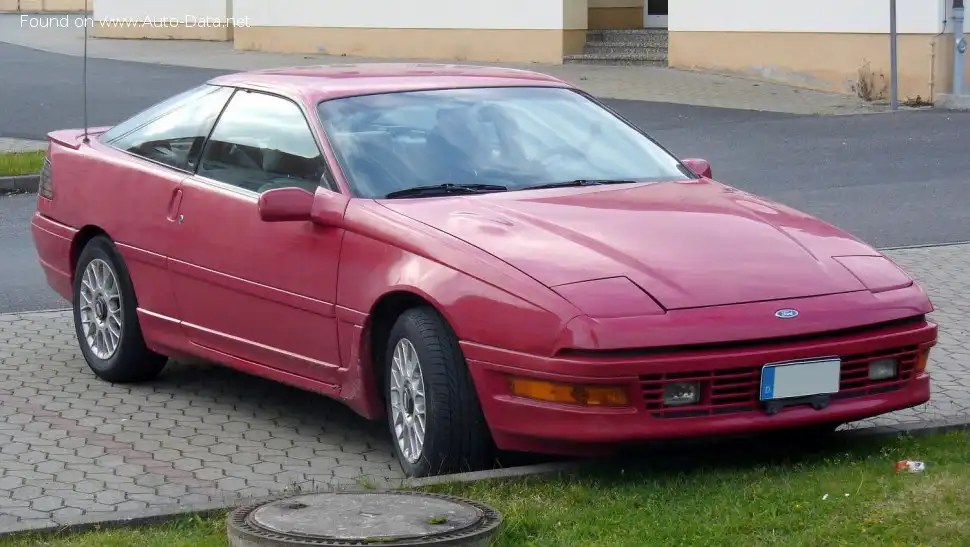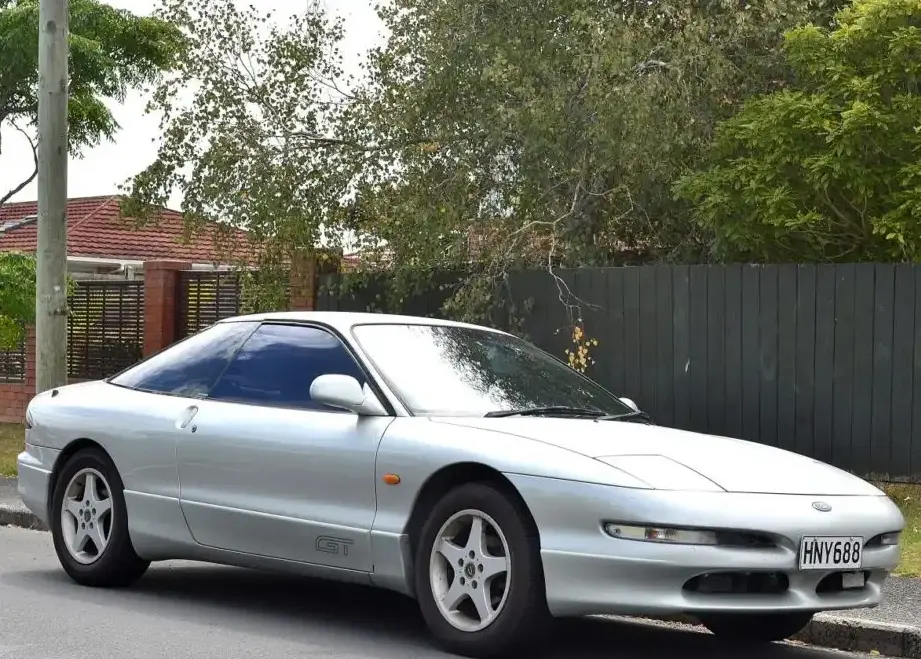
The Ford Probe II, specifically the 2.0 liter 16-valve (115 horsepower) variant, was a coupe produced by Ford between August 1992 and June 1997. Positioned as a sporty, yet affordable option, it represented Ford’s attempt to capture a segment of the market increasingly interested in more stylish and performance-oriented vehicles. The Probe II was built on the ECP (European Car Program) platform, a collaborative effort between Ford and Mazda, and shared many components with the Mazda MX-6. This particular 2.0L 16V model occupied a middle ground in the Probe II lineup, offering a balance between performance and fuel economy, slotting below the more powerful supercharged variants and above the base 2.0L engine.
Technical Specifications
| Brand | Ford |
| Model | Probe |
| Generation | Probe II (ECP) |
| Type (Engine) | 2.0 16V (115 Hp) |
| Start of production | August, 1992 |
| End of production | June, 1997 |
| Powertrain Architecture | Internal Combustion engine |
| Body type | Coupe |
| Seats | 4 |
| Doors | 2 |
| Fuel consumption (urban) | 9.5 l/100 km (24.8 US mpg) |
| Fuel consumption (extra urban) | 6.1-7.9 l/100 km (38.6 – 29.8 US mpg) |
| Fuel Type | Petrol (Gasoline) |
| Acceleration 0 – 100 km/h | 10.6 sec |
| Acceleration 0 – 62 mph | 10.6 sec |
| Acceleration 0 – 60 mph | 10.1 sec |
| Maximum speed | 204 km/h (126.76 mph) |
| Weight-to-power ratio | 10.6 kg/Hp |
| Weight-to-torque ratio | 7.2 kg/Nm |
| Power | 115 Hp @ 5500 rpm |
| Torque | 170 Nm @ 4500 rpm (125.39 lb.-ft. @ 4500 rpm) |
| Engine layout | Front, Transverse |
| Engine Model/Code | FS |
| Engine displacement | 1991 cm3 (121.5 cu. in.) |
| Number of cylinders | 4 |
| Engine configuration | Inline |
| Cylinder Bore | 83 mm (3.27 in.) |
| Piston Stroke | 92 mm (3.62 in.) |
| Compression ratio | 9.2:1 |
| Number of valves per cylinder | 4 |
| Fuel injection system | Multi-port manifold injection |
| Engine aspiration | Naturally aspirated engine |
| Valvetrain | DOHC |
| Engine oil capacity | 3.5 l (3.7 US qt | 3.08 UK qt) |
| Coolant capacity | 7 l (7.4 US qt | 6.16 UK qt) |
| Kerb Weight | 1220 kg (2689.64 lbs.) |
| Max. weight | 1620 kg (3571.49 lbs.) |
| Max load | 400 kg (881.85 lbs.) |
| Trunk (boot) space – minimum | 360 l (12.71 cu. ft.) |
| Trunk (boot) space – maximum | 1000 l (35.31 cu. ft.) |
| Fuel tank capacity | 59 l (15.59 US gal | 12.98 UK gal) |
| Max. roof load | 100 kg (220.46 lbs.) |
| Permitted trailer load with brakes (12%) | 1500 kg (3306.93 lbs.) |
| Permitted towbar download | 75 kg (165.35 lbs.) |
| Length | 4585 mm (180.51 in.) |
| Width | 1773 mm (69.8 in.) |
| Height | 1310 mm (51.57 in.) |
| Wheelbase | 2614 mm (102.91 in.) |
| Front track | 1519 mm (59.8 in.) |
| Rear (Back) track | 1519 mm (59.8 in.) |
| Minimum turning circle | 11.7 m (38.39 ft.) |
| Drivetrain Architecture | Front wheel drive |
| Number of gears | 5 gears, manual transmission |
| Front suspension | Independent, type McPherson with coil spring and anti-roll bar |
| Rear suspension | McPherson, Transverse stabilizer, Trailing arm |
| Front brakes | Ventilated discs |
| Rear brakes | Disc |
| Assisting systems | ABS (Anti-lock braking system) |
| Steering type | Steering rack and pinion |
| Power steering | Hydraulic Steering |
| Tires size | 195/65 R14; 205/55 R15 |
| Wheel rims size | 5.5J x 14; 6J x 15 |
Powertrain & Engine Architecture
The heart of this Probe II variant was the Ford FS engine, a 1.991-liter inline-four cylinder gasoline engine. This engine featured a double overhead camshaft (DOHC) valvetrain with four valves per cylinder, contributing to its relatively high output for its displacement. Fuel delivery was handled by a multi-port fuel injection system, optimizing the air-fuel mixture for improved efficiency and performance. The engine’s 9.2:1 compression ratio was a compromise between performance and the ability to run on readily available fuel grades. The engine was transversely mounted in the front of the vehicle, driving the front wheels. The standard transmission was a 5-speed manual, but a 4-speed automatic transmission was also available, and is the focus of this article. This automatic transmission, while providing convenience, did impact acceleration and fuel economy compared to the manual version.
Driving Characteristics
The 115 horsepower and 170 lb-ft of torque offered by the 2.0L engine, when paired with the 4-speed automatic transmission, resulted in a driving experience geared more towards comfortable cruising than outright performance. Acceleration from 0-60 mph took approximately 10.1 seconds, which was noticeably slower than the manual transmission equipped models. The automatic transmission’s gear ratios were tuned for fuel efficiency and smooth operation, rather than aggressive shifts. While adequate for everyday driving, the automatic transmission could feel somewhat sluggish when attempting quick overtaking maneuvers or climbing hills. The power delivery was relatively linear, with peak torque arriving at 4500 rpm. The front-wheel-drive configuration provided predictable handling, but lacked the dynamic capabilities of rear-wheel-drive alternatives.
Equipment & Trim Levels
The 2.0L 16V automatic Probe II typically came with a reasonable level of standard equipment. Interior features included cloth upholstery, a basic stereo system, power windows and locks, and air conditioning. Optional extras included a sunroof, upgraded sound system, and alloy wheels. The interior design was functional and driver-focused, with a relatively simple dashboard layout. Trim levels varied slightly depending on the year, but generally, this variant represented a mid-range offering, providing a step up in features from the base model without the added cost of the higher-performance trims.
Chassis & Braking
The Probe II utilized an independent McPherson strut suspension setup at the front, providing a comfortable ride and decent handling characteristics. The rear suspension employed a trailing arm design with a transverse stabilizer bar, further enhancing stability. Braking duties were handled by ventilated discs at the front and solid discs at the rear. An anti-lock braking system (ABS) was standard, improving braking performance and safety. The chassis was designed to balance rigidity with weight savings, contributing to the car’s overall handling dynamics.
Market Reception & Comparison
The 2.0L 16V automatic Probe II received mixed reviews from automotive critics. While praised for its stylish design and comfortable ride, it was often criticized for its lack of outright performance, particularly when equipped with the automatic transmission. Compared to the supercharged Probe II variants, it felt significantly underpowered. However, it offered better fuel economy and lower maintenance costs. Against competitors like the Honda Prelude and Toyota Camry Coupe, the Probe II offered a more aggressive styling and a slightly more sporty driving experience, but often fell short in terms of refinement and reliability.
Legacy
The Ford Probe II, including the 2.0L 16V automatic variant, has developed a modest following among enthusiasts. The FS engine, while not known for exceptional durability, is generally considered reliable with proper maintenance. The automatic transmission, however, can be prone to issues with age, particularly if fluid changes were neglected. Today, well-maintained examples of the Probe II are becoming increasingly rare, and are sought after by collectors and those seeking a nostalgic reminder of 1990s automotive design. The Probe II represents a unique chapter in Ford’s history, showcasing the company’s attempt to create a stylish and affordable coupe for the growing market of performance-minded buyers.