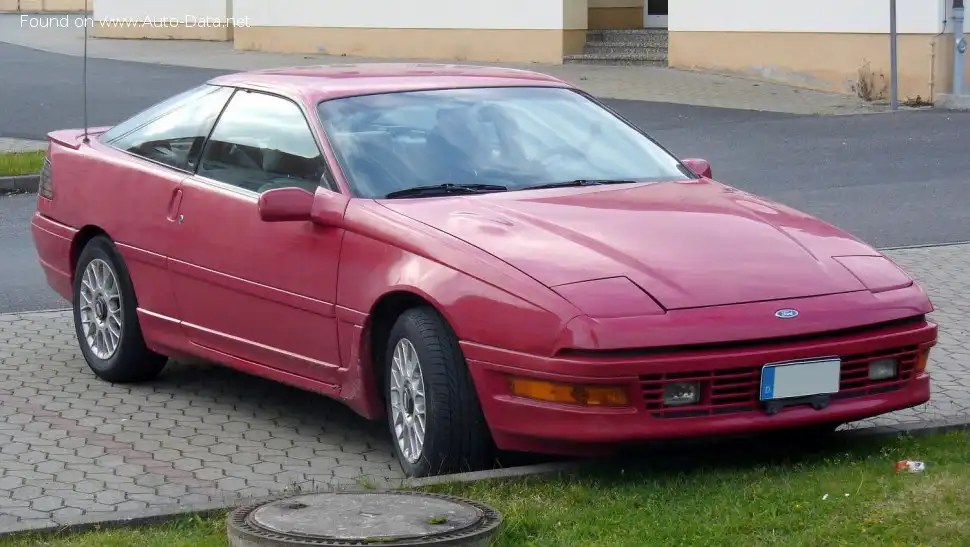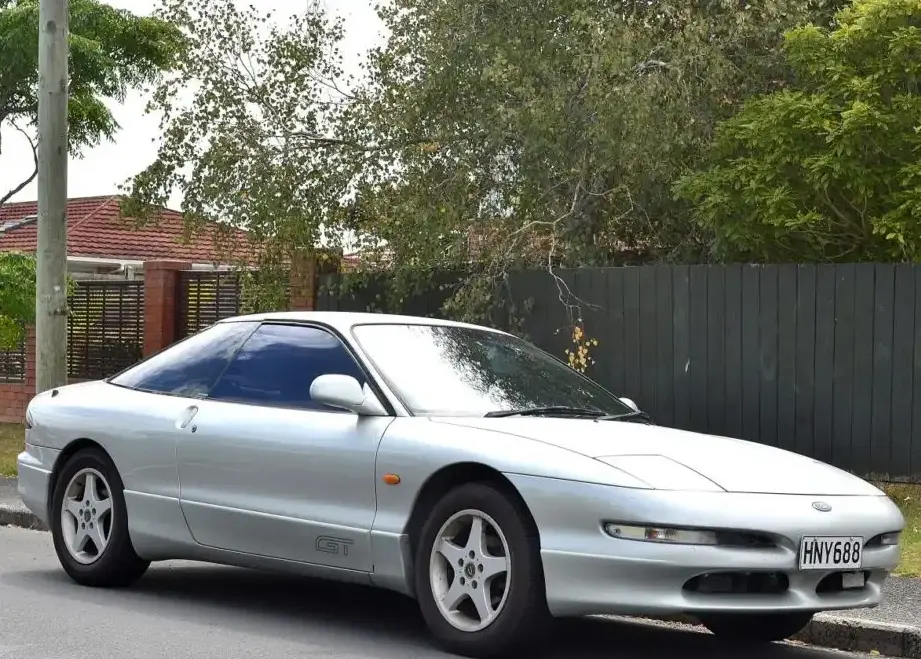
The Ford Probe II GT, specifically the 2.5-liter V6 24V variant producing 165 horsepower, was a key model in Ford’s attempt to capture the sporty coupe market during the early to mid-1990s. Produced from August 1992 through June 1997, it represented the second generation of the Probe, designated internally as the ECP. The Probe II was built to replace the first-generation Probe, and aimed to offer a more refined and powerful alternative to competitors like the Toyota Celica and Mazda MX-6. It shared its platform with the Mazda MX-6, a result of Ford and Mazda’s joint venture at the time. This particular 2.5 V6 GT trim sat at the top of the Probe II lineup, offering the most potent engine option and a more comprehensive feature set.
Technical Specifications
| Brand | Ford |
| Model | Probe |
| Generation | Probe II (ECP) |
| Type (Engine) | GT 2.5 V6 24V (165 Hp) |
| Start of production | August, 1992 |
| End of production | June, 1997 |
| Powertrain Architecture | Internal Combustion engine |
| Body type | Coupe |
| Seats | 4 |
| Doors | 2 |
| Fuel consumption (urban) | 12.5 l/100 km (18.8 US mpg) |
| Fuel consumption (extra urban) | 7.8-9.9 l/100 km (30.2 – 23.8 US mpg) |
| Fuel Type | Petrol (Gasoline) |
| Acceleration 0 – 100 km/h | 8.5 sec |
| Acceleration 0 – 62 mph | 8.5 sec |
| Acceleration 0 – 60 mph | 8.1 sec |
| Maximum speed | 220 km/h (136.7 mph) |
| Weight-to-power ratio | 7.8 kg/Hp |
| Weight-to-torque ratio | 6 kg/Nm |
| Power | 165 Hp @ 5500 rpm |
| Power per litre | 66.1 Hp/l |
| Torque | 212 Nm @ 4800 rpm (156.36 lb.-ft. @ 4800 rpm) |
| Engine layout | Front, Transverse |
| Engine Model/Code | KL-DE |
| Engine displacement | 2497 cm3 (152.38 cu. in.) |
| Number of cylinders | 6 |
| Engine configuration | V-engine |
| Cylinder Bore | 84.5 mm (3.33 in.) |
| Piston Stroke | 74.2 mm (2.92 in.) |
| Compression ratio | 9.2:1 |
| Number of valves per cylinder | 4 |
| Fuel injection system | Multi-port manifold injection |
| Engine aspiration | Naturally aspirated engine |
| Valvetrain | DOHC |
| Engine oil capacity | 4 l (4.23 US qt | 3.52 UK qt) |
| Coolant | 7.5 l (7.93 US qt | 6.6 UK qt) |
| Kerb Weight | 1280 kg (2821.92 lbs.) |
| Max. weight | 1690 kg (3725.81 lbs.) |
| Max load | 410 kg (903.9 lbs.) |
| Trunk (boot) space – minimum | 360 l (12.71 cu. ft.) |
| Trunk (boot) space – maximum | 1000 l (35.31 cu. ft.) |
| Fuel tank capacity | 59 l (15.59 US gal | 12.98 UK gal) |
| Max. roof load | 100 kg (220.46 lbs.) |
| Permitted trailer load with brakes (12%) | 1500 kg (3306.93 lbs.) |
| Permitted towbar download | 75 kg (165.35 lbs.) |
| Length | 4585 mm (180.51 in.) |
| Width | 1773 mm (69.8 in.) |
| Height | 1315 mm (51.77 in.) |
| Wheelbase | 2614 mm (102.91 in.) |
| Front track | 1510 mm (59.45 in.) |
| Rear (Back) track | 1510 mm (59.45 in.) |
| Minimum turning circle | 11.7 m (38.39 ft.) |
| Drivetrain Architecture | Front wheel drive |
| Drive wheel | Front wheel drive |
| Number of gears and type of gearbox | 5 gears, manual transmission |
| Front suspension | Independent, type McPherson with coil spring and anti-roll bar |
| Rear suspension | McPherson, Transverse stabilizer, Trailing arm |
| Front brakes | Ventilated discs |
| Rear brakes | Disc |
| Assisting systems | ABS (Anti-lock braking system) |
| Steering type | Steering rack and pinion |
| Power steering | Hydraulic Steering |
| Tires size | 225/50 R16 |
| Wheel rims size | 7J x 16 |
Powertrain & Engine Architecture
The heart of the Probe II GT was the KL-DE 2.5-liter V6 engine. This engine, a product of Ford and Mazda collaboration, featured a 60-degree V-angle and a dual overhead camshaft (DOHC) design with four valves per cylinder. The multi-port fuel injection system delivered fuel directly to each intake port, optimizing combustion efficiency. The engine’s 9.2:1 compression ratio was a compromise between performance and the ability to run on readily available 87 octane gasoline. The 5-speed manual transmission was the standard offering, providing drivers with full control over the engine’s power band. The engine was transversely mounted, contributing to a more compact engine bay and improved weight distribution.
Driving Characteristics
The 165-horsepower V6, coupled with the 5-speed manual transmission, provided a reasonably spirited driving experience. Acceleration from 0-60 mph took approximately 8.1 seconds, making it competitive with other sporty coupes of the era. The engine delivered a smooth power delivery, with peak torque arriving at 4800 rpm. While not a high-revving engine, it offered sufficient power for both daily commuting and more enthusiastic driving. The front-wheel-drive configuration, while common for the time, could exhibit some torque steer under hard acceleration. The gear ratios were well-matched to the engine’s characteristics, providing good acceleration in each gear. Compared to the base model Probe with its smaller four-cylinder engine, the GT offered a significant performance upgrade.
Equipment & Trim Levels
The Probe II GT came standard with a number of features designed to enhance the driving experience and comfort. These included power windows, power door locks, air conditioning, and a decent sound system. The interior featured sport seats upholstered in cloth, with a sporty dashboard design. Optional extras included a sunroof, upgraded sound system with a CD player, and alloy wheels. The GT trim also featured a rear spoiler, adding to its sporty appearance. The interior materials, while durable, were not particularly luxurious, reflecting the Probe’s positioning as an affordable sports coupe.
Chassis & Braking
The Probe II utilized an independent McPherson strut suspension in the front, providing responsive handling and a comfortable ride. The rear suspension employed a trailing arm setup with a transverse stabilizer bar, further enhancing stability. The GT model featured ventilated disc brakes in the front and solid discs in the rear, providing adequate stopping power for its weight and performance. Anti-lock brakes (ABS) were standard, improving safety in emergency braking situations. The steering was rack-and-pinion with hydraulic power assist, offering precise and responsive steering feel.
Market Reception & Comparison
The Ford Probe II GT was generally well-received by automotive critics, who praised its sporty styling, comfortable ride, and potent V6 engine. However, some critics noted that the interior materials were somewhat lacking in quality compared to some of its competitors. Fuel economy was reasonable for a V6-powered coupe, averaging around 18.8 mpg in the city and 30.2 mpg on the highway. Compared to the four-cylinder Probe models, the GT offered a significant performance boost, but at a higher price point. The Probe II GT competed directly with the Toyota Celica, Mazda MX-6, and Honda Prelude, offering a compelling alternative in the sporty coupe segment.
Legacy
The Ford Probe II, while not a runaway sales success, remains a fondly remembered vehicle among enthusiasts. The 2.5-liter V6 engine proved to be relatively reliable, although regular maintenance is crucial to prevent issues such as oil leaks and timing belt failure. Today, well-maintained Probe II GTs are becoming increasingly collectible, particularly those with low mileage and original features. The Probe II represents a unique chapter in Ford’s history, showcasing the company’s willingness to experiment with new designs and technologies. Its blend of sporty styling, decent performance, and affordability continues to appeal to a dedicated following of enthusiasts.