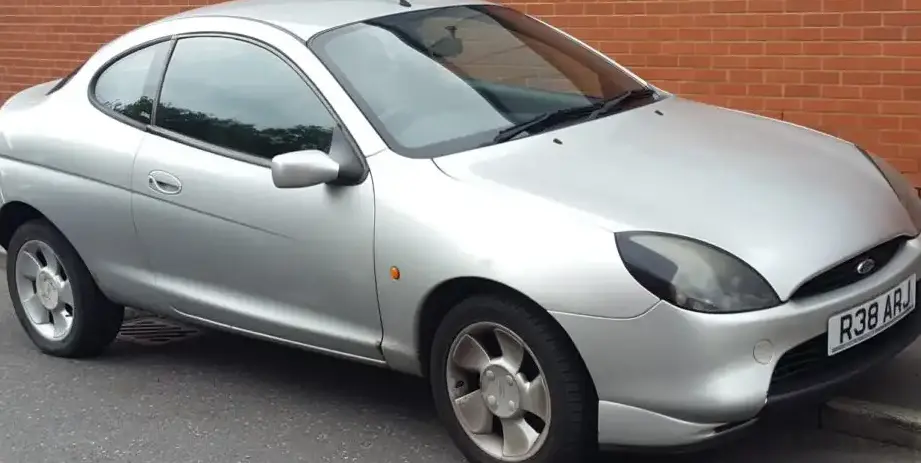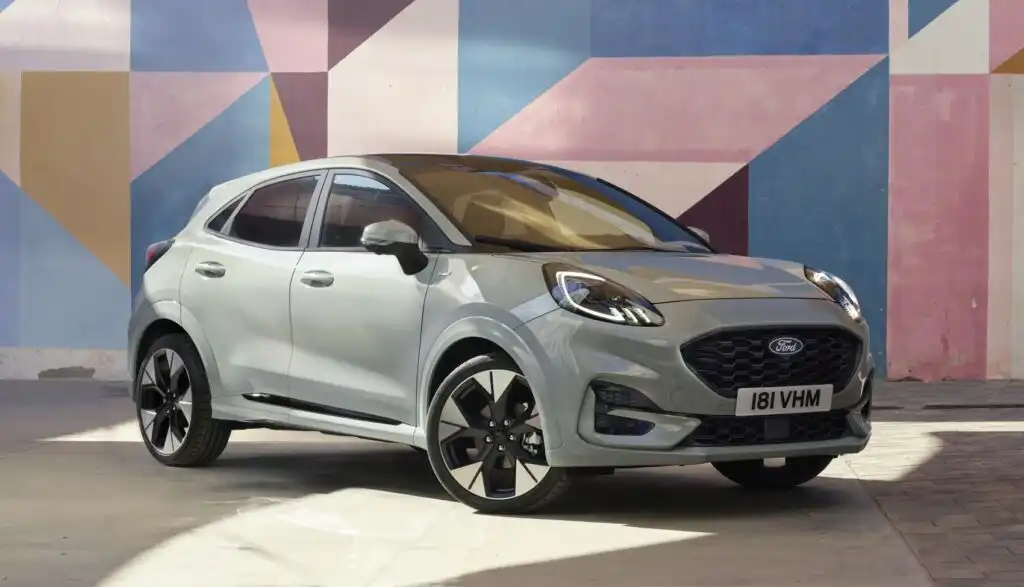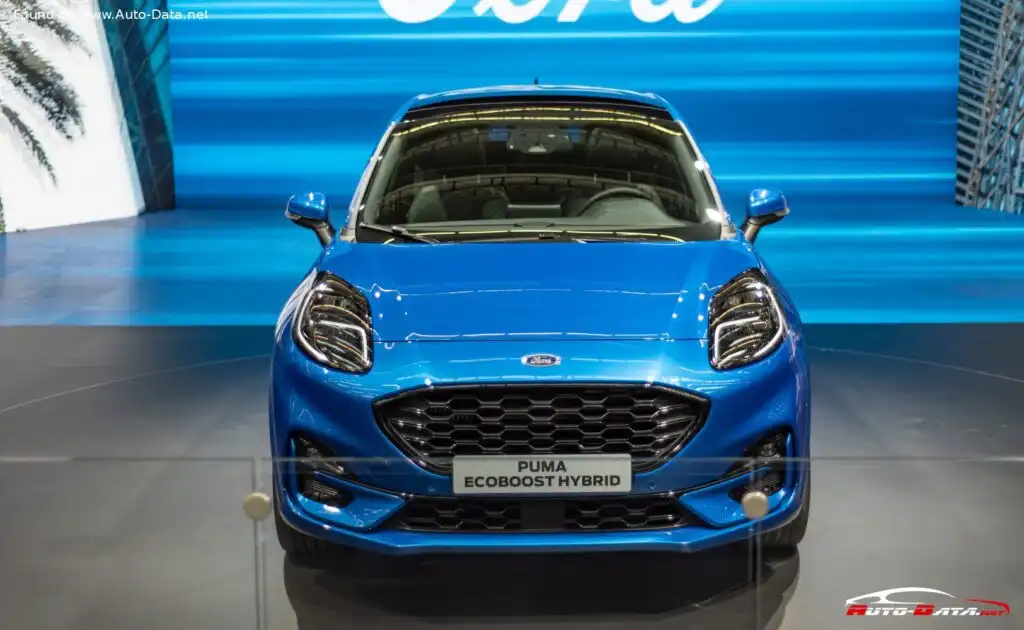
The Ford Puma 1.5 EcoBlue (120 hp) represents a significant entry point into the revived Puma lineup, launched in June 2020 and continuing through December 2021. Positioned as a fuel-efficient and practical crossover, this variant aimed to capture a broad segment of the European market seeking a compact SUV with diesel economy. It’s built on Ford’s B3 platform, shared with the Fiesta, and represents a departure from the earlier, smaller Puma models of the 1990s. This iteration of the Puma was designed to compete with vehicles like the Renault Captur, Peugeot 2008, and Volkswagen T-Cross, offering a blend of style, practicality, and modern technology.
| Brand | Ford |
| Model | Puma |
| Generation | Puma |
| Type (Engine) | 1.5 EcoBlue (120 Hp) |
| Start of production | June, 2020 |
| End of production | December, 2021 |
| Powertrain Architecture | Internal Combustion engine |
| Body type | SUV, Crossover |
| Seats | 5 |
| Doors | 5 |
| Fuel consumption at Low speed (WLTP) | 5.2-5.7 l/100 km (45.2 – 41.3 US mpg) |
| Fuel consumption at Medium speed (WLTP) | 4.3-4.8 l/100 km (54.7 – 49 US mpg) |
| Fuel consumption at high speed (WLTP) | 3.8-4.4 l/100 km (61.9 – 53.5 US mpg) |
| Fuel consumption at very high speed (WLTP) | 4.9-5.5 l/100 km (48 – 42.8 US mpg) |
| Combined fuel consumption (WLTP) | 4.5-5 l/100 km (52.3 – 47 US mpg) |
| CO2 emissions (WLTP) | 117-132 g/km |
| Fuel consumption (economy) – urban (NEDC) | 4.3 l/100 km (54.7 US mpg) |
| Fuel consumption (economy) – extra urban (NEDC) | 3.5 l/100 km (67.2 US mpg) |
| Fuel consumption (economy) – combined (NEDC) | 3.8 l/100 km (61.9 US mpg) |
| CO2 emissions (NEDC) | 99 g/km |
| Fuel Type | Diesel |
| Acceleration 0 – 100 km/h | 10.3 sec |
| Acceleration 0 – 62 mph | 10.3 sec |
| Acceleration 0 – 60 mph | 9.8 sec |
| Maximum speed | 185 km/h (114.95 mph) |
| Emission standard | Euro 6d |
| Weight-to-power ratio | 10.6 kg/Hp |
| Weight-to-torque ratio | 4.5 kg/Nm |
| Power | 120 Hp @ 4000 rpm |
| Torque | 285 Nm @ 1750-2500 rpm (210.21 lb.-ft. @ 1750-2500 rpm) |
| Engine layout | Front, Transverse |
| Engine Model/Code | ZTDA |
| Engine displacement | 1499 cm3 (91.47 cu. in.) |
| Number of cylinders | 4 |
| Engine configuration | Inline |
| Cylinder Bore | 75 mm (2.95 in.) |
| Piston Stroke | 84.8 mm (3.34 in.) |
| Compression ratio | 16.4:1 |
| Number of valves per cylinder | 4 |
| Fuel injection system | Diesel Commonrail |
| Engine aspiration | Turbocharger, Intercooler |
| Valvetrain | DOHC |
| Engine oil capacity | 6.2 l (6.55 US qt | 5.46 UK qt) |
| Coolant | 7.3 l (7.71 US qt | 6.42 UK qt) |
| Kerb Weight | 1273 kg (2806.48 lbs.) |
| Max. weight | 1845 kg (4067.53 lbs.) |
| Max load | 572 kg (1261.04 lbs.) |
| Trunk (boot) space – minimum | 456 l (16.1 cu. ft.) |
| Trunk (boot) space – maximum | 1216 l (42.94 cu. ft.) |
| Fuel tank capacity | 40 l (10.57 US gal | 8.8 UK gal) |
| Max. roof load | 50 kg (110.23 lbs.) |
| Permitted trailer load with brakes (8%) | 1100 kg (2425.08 lbs.) |
| Permitted trailer load with brakes (12%) | 1100 kg (2425.08 lbs.) |
| Permitted trailer load without brakes | 670 kg (1477.1 lbs.) |
| Permitted towbar download | 75 kg (165.35 lbs.) |
| Length | 4186 mm (164.8 in.) |
| Width | 1805 mm (71.06 in.) |
| Width including mirrors | 1930 mm (75.98 in.) |
| Height | 1550 mm (61.02 in.) |
| Wheelbase | 2588 mm (101.89 in.) |
| Front track | 1567 mm (61.69 in.) |
| Rear (Back) track | 1526 mm (60.08 in.) |
| Front overhang | 850 mm (33.46 in.) |
| Rear overhang | 748 mm (29.45 in.) |
| Ride height (ground clearance) | 166 mm (6.54 in.) |
| Minimum turning circle (turning diameter) | 10.4 m (34.12 ft.) |
| Drivetrain Architecture | The Internal combustion engine (ICE) drives the front wheels of the vehicle. |
| Drive wheel | Front wheel drive |
| Number of gears and type of gearbox | 6 gears, manual transmission |
| Front suspension | Independent, type McPherson with coil spring and anti-roll bar |
| Rear suspension | Coil spring, Elastic beam |
| Front brakes | Ventilated discs, 278×25 mm |
| Rear brakes | Disc, 271×11 mm |
| Assisting systems | ABS (Anti-lock braking system) |
| Steering type | Steering rack and pinion |
| Power steering | Electric Steering |
| Tires size | 215/55 R17; 215/50 R18 |
| Wheel rims size | 7J x 17; 7J x 18 |
Powertrain & Engine Architecture
The Puma 1.5 EcoBlue (120 hp) is powered by Ford’s ZTDA engine code, a 1.5-liter inline-four cylinder diesel engine. This engine is part of Ford’s EcoBlue family, known for its focus on efficiency and reduced emissions. It utilizes a common-rail direct fuel injection system, delivering fuel at extremely high pressure for optimized combustion. The engine features a turbocharger with an intercooler, enhancing power output and responsiveness. The valvetrain employs a double overhead camshaft (DOHC) configuration with four valves per cylinder, contributing to improved breathing and overall performance. The engine’s 16.4:1 compression ratio is relatively high for a diesel, aiding in thermal efficiency. This engine was paired with a 6-speed manual transmission, delivering power to the front wheels.
Driving Characteristics
The 120 hp EcoBlue engine in the Puma provides adequate, though not exhilarating, performance. Acceleration from 0-60 mph takes around 9.8 seconds, and top speed is approximately 115 mph. The engine’s 285 Nm (210 lb-ft) of torque, available from 1750-2500 rpm, provides good low-end grunt, making it suitable for everyday driving and overtaking maneuvers. Compared to higher-output Puma variants, such as those with the 1.0 EcoBoost petrol engine, the EcoBlue feels less responsive at higher engine speeds. The manual transmission offers precise shifts, but the gear ratios are tuned for fuel economy rather than outright performance. The overall driving experience is comfortable and refined, prioritizing efficiency and practicality over sporty handling.
Equipment & Trim Levels
The 1.5 EcoBlue 120 hp Puma typically came equipped with a reasonable level of standard features. These included air conditioning, a 8-inch touchscreen infotainment system with Apple CarPlay and Android Auto compatibility, Ford’s Co-Pilot360 suite of driver-assistance technologies (including lane-keeping assist, pre-collision assist with pedestrian and cyclist detection, and automatic emergency braking), and alloy wheels. Higher trim levels offered additional features such as a larger touchscreen, a digital instrument cluster, heated seats, a rear-view camera, and parking sensors. Interior upholstery was typically cloth, with options for leather upgrades on higher trims. Exterior styling elements varied depending on the trim level, with options for different wheel designs and body-colored accents.
Chassis & Braking
The Puma’s chassis utilizes a McPherson strut front suspension and an elastic beam rear suspension. This setup provides a good balance between ride comfort and handling. The front suspension incorporates a coil spring and anti-roll bar to reduce body roll during cornering. Braking duties are handled by ventilated discs at the front and solid discs at the rear. The Puma is equipped with an Anti-lock Braking System (ABS) as standard, enhancing safety and control during emergency braking situations. The electric power steering provides light and precise steering feel.
Market Reception & Comparison
The Ford Puma 1.5 EcoBlue (120 hp) was generally well-received by automotive critics for its fuel efficiency, practicality, and comfortable ride. However, some reviewers noted that the engine lacked the punch of its petrol counterparts. Compared to the 1.0 EcoBoost versions, the EcoBlue offered significantly better fuel economy, but at the expense of performance. The diesel variant appealed to drivers who prioritized low running costs and long-distance comfort. Its fuel economy figures of around 52.3-47 US mpg combined made it a competitive option in the compact crossover segment.
Legacy
The 1.5 EcoBlue engine has proven to be a relatively reliable unit, although, like any diesel engine, it requires regular maintenance, including oil changes and diesel particulate filter (DPF) regeneration. On the used car market, the Puma 1.5 EcoBlue (120 hp) represents a good value proposition for buyers seeking a fuel-efficient and practical crossover. Its relatively low running costs and comfortable ride make it a popular choice for commuters and families. The Puma, in general, has helped Ford regain a foothold in the competitive European crossover market, and the EcoBlue variant played a key role in attracting diesel buyers.