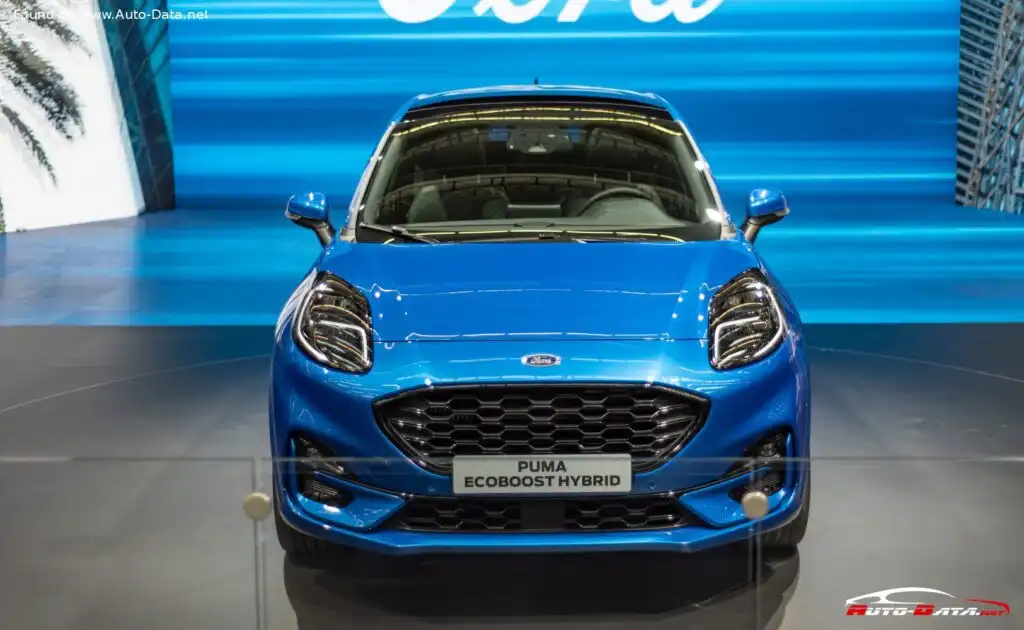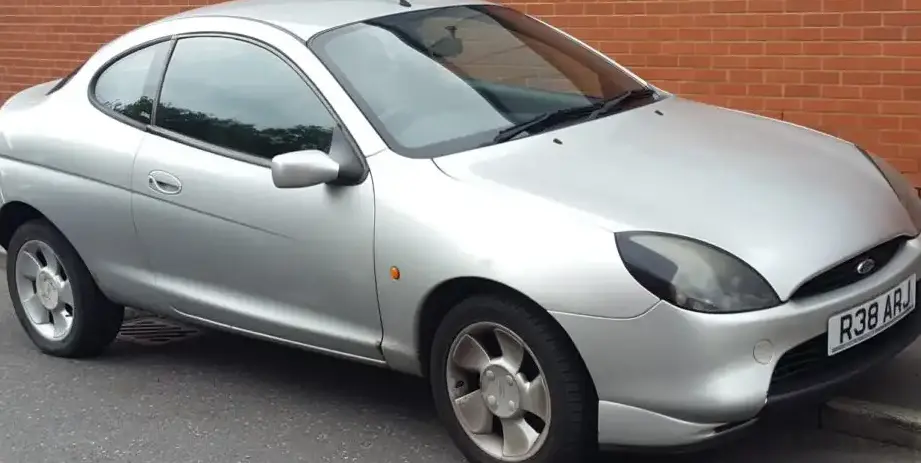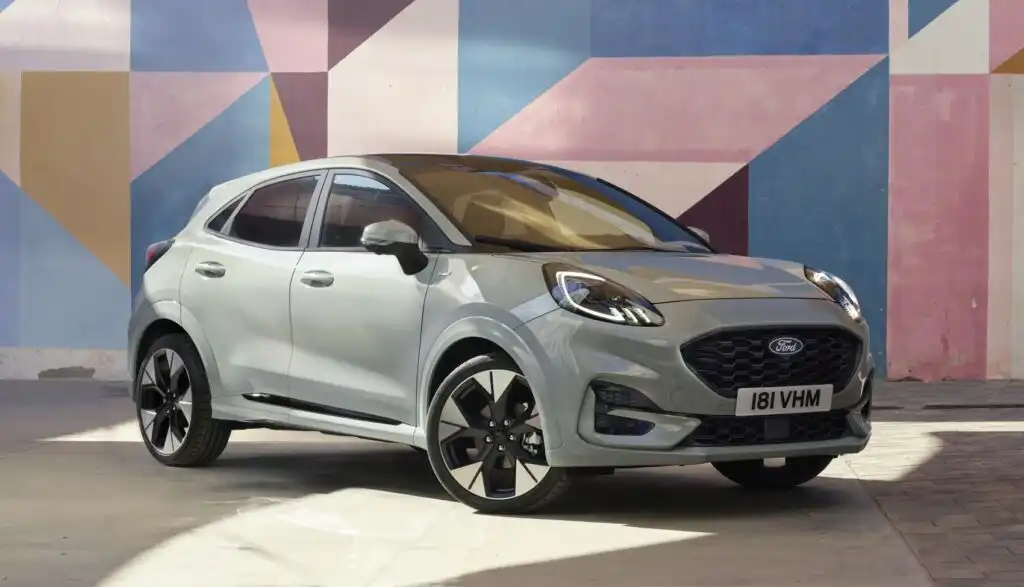
The Ford Puma, revived in 2019, represents Ford’s entry into the highly competitive subcompact SUV/crossover market in Europe. The 2024 facelift brought updated styling and technology, and among the engine options offered was the 1.0 EcoBoost 155 horsepower Mild Hybrid with the Powershift 7-speed dual-clutch automatic transmission. This variant occupied a mid-range position within the Puma lineup, offering a balance between fuel efficiency, performance, and price. Production began in February 2024, and it quickly became a popular choice for buyers seeking a practical and modern small SUV.
Technical Specifications
| Brand | Ford |
| Model | Puma |
| Generation | Puma (facelift 2024) |
| Type (Engine) | 1.0 EcoBoost (155 Hp) Mild Hybrid Powershift |
| Start of production | February, 2024 |
| Powertrain Architecture | MHEV (Mild Hybrid Electric Vehicle) |
| Body type | SUV, Crossover |
| Seats | 5 |
| Doors | 5 |
| Combined fuel consumption (WLTP) | 5.5-6.3 l/100 km (42.8 – 37.3 US mpg, 51.4 – 44.8 UK mpg, 18.2 – 15.9 km/l) |
| CO2 emissions (WLTP) | 125-142 g/km |
| Fuel Type | Petrol (Gasoline) |
| Acceleration 0 – 100 km/h | 8.7 sec |
| Acceleration 0 – 62 mph | 8.7 sec |
| Acceleration 0 – 60 mph | 8.3 sec |
| Maximum speed | 200 km/h (124.27 mph) |
| Emission standard | Euro 6d |
| Weight-to-power ratio | 8.3 kg/Hp, 119.9 Hp/tonne |
| Weight-to-torque ratio | 5.4 kg/Nm, 185.6 Nm/tonne |
| Battery voltage | 48 V |
| Battery technology | Lithium-ion (Li-Ion) |
| Battery location | Under the front seats |
| Electric motor power | 16 Hp |
| Electric motor location | Front, Transverse |
| Power | 155 Hp @ 6000 rpm |
| Power per litre | 155.2 Hp/l |
| Torque | 240 Nm @ 2500 rpm (177.01 lb.-ft. @ 2500 rpm) |
| Engine layout | Front, Transverse |
| Engine displacement | 999 cm3 (60.96 cu. in.) |
| Number of cylinders | 3 |
| Engine configuration | Inline |
| Cylinder Bore | 71.9 mm (2.83 in.) |
| Piston Stroke | 82 mm (3.23 in.) |
| Compression ratio | 10:1 |
| Number of valves per cylinder | 4 |
| Fuel injection system | Direct injection |
| Engine aspiration | Turbocharger, Intercooler |
| Valvetrain | DOHC, Ti-VCT |
| Engine systems | Start & Stop System, Particulate filter |
| Kerb Weight | 1293 kg (2850.58 lbs.) |
| Max. weight | 1835 kg (4045.48 lbs.) |
| Max load | 542 kg (1194.91 lbs.) |
| Trunk (boot) space – minimum | 456 l (16.1 cu. ft.) |
| Trunk (boot) space – maximum | 1216 l (42.94 cu. ft.) |
| Fuel tank capacity | 42 l (11.1 US gal | 9.24 UK gal) |
| Max. roof load | 50 kg (110.23 lbs.) |
| Permitted trailer load with brakes (12%) | 900 kg (1984.16 lbs.) |
| Permitted trailer load without brakes | 665 kg (1466.07 lbs.) |
| Permitted towbar download | 75 kg (165.35 lbs.) |
| Length | 4186 mm (164.8 in.) |
| Width with mirrors folded | 1805 mm (71.06 in.) |
| Width including mirrors | 1930 mm (75.98 in.) |
| Height | 1550 mm (61.02 in.) |
| Wheelbase | 2588 mm (101.89 in.) |
| Front track | 1567 mm (61.69 in.) |
| Rear (Back) track | 1526 mm (60.08 in.) |
| Front overhang | 850 mm (33.46 in.) |
| Rear overhang | 748 mm (29.45 in.) |
| Ride height (ground clearance) | 163 mm (6.42 in.) |
| Minimum turning circle (turning diameter) | 10.4 m (34.12 ft.) |
| Approach angle | 17.5° |
| Departure angle | 26.6° |
| Drivetrain Architecture | ICE and electric motor drive the front wheels in mixed mode. |
| Drive wheel | Front wheel drive |
| Number of gears and type of gearbox | 7 gears, automatic transmission Powershift |
| Front suspension | Independent, type McPherson with coil spring and anti-roll bar |
| Rear suspension | Coil spring, Elastic beam |
| Front brakes | Ventilated discs, 278×25 mm |
| Rear brakes | Drum, 228×40 mm |
| Assisting systems | ABS (Anti-lock braking system) |
| Steering type | Steering rack and pinion |
| Power steering | Electric Steering |
| Tires size | 215/55 R17; 215/50 R18; 225/40 R19 |
| Wheel rims size | 7J x 17; 7J x 18; 7.5J x 19 |
Powertrain & Engine Architecture
The heart of this Puma variant is the Ford 1.0 EcoBoost engine, specifically the turbocharged three-cylinder unit. This engine, known internally as the Dragon series, utilizes a direct fuel injection system and a twin-independent variable camshaft timing (Ti-VCT) system to optimize performance and efficiency. The 155 horsepower output is achieved through a combination of turbocharging and careful engine calibration. The mild-hybrid system incorporates a 48-volt electrical architecture and a belt-integrated starter-generator (BiSG) that provides regenerative braking and electric assist during acceleration. This system allows for engine-off coasting and smoother start-stop operation. The Powershift 7-speed dual-clutch transmission (DCT) is a key component, offering quick and seamless gear changes. This transmission is known for its efficiency and responsiveness, contributing to the overall driving experience.
Driving Characteristics
The 1.0 EcoBoost 155 hp with Powershift delivers a surprisingly lively driving experience for a subcompact SUV. Acceleration to 60 mph takes approximately 8.3 seconds, and the car feels adequately powered for everyday driving and highway merging. The DCT provides smooth and quick shifts, enhancing the sense of responsiveness. While not as sporty as some competitors, the Puma offers a comfortable and composed ride. The mild-hybrid system is largely transparent to the driver, providing a subtle boost during acceleration. Compared to the lower-powered 125 hp version of the 1.0 EcoBoost, this variant offers a noticeable improvement in performance. However, it doesn’t quite match the punch of the 1.5 EcoBoost engine available in higher trim levels. The gear ratios in the Powershift transmission are well-chosen for both city and highway driving, providing a good balance between acceleration and fuel economy.
Equipment & Trim Levels
The 1.0 EcoBoost 155 hp Mild Hybrid Powershift was typically offered in mid-range trim levels, such as Titanium or ST-Line. Standard equipment generally included features like Ford’s SYNC 4 infotainment system with an 8-inch touchscreen, Apple CarPlay and Android Auto compatibility, a digital instrument cluster, and a suite of driver-assistance technologies such as lane-keeping assist and pre-collision assist. Optional extras could include a larger touchscreen, a premium sound system, adaptive cruise control, and a panoramic sunroof. Interior upholstery typically consisted of cloth or partial leather, with a modern and well-designed dashboard layout.
Chassis & Braking
The Puma utilizes a front-wheel-drive platform with an independent McPherson strut suspension at the front and a semi-independent elastic beam suspension at the rear. This setup provides a good balance between ride comfort and handling. The front brakes are ventilated discs, while the rear brakes are drums, a cost-saving measure common in this segment. ABS (Anti-lock Braking System) is standard, along with electronic stability control. The steering is electric power-assisted, providing a light and responsive feel.
Market Reception & Comparison
The Ford Puma, and specifically this 1.0 EcoBoost 155 hp variant, received generally positive reviews from automotive critics. It was praised for its stylish design, practical interior, and enjoyable driving experience. The mild-hybrid system was also well-received for its contribution to fuel efficiency. Compared to rivals like the Volkswagen T-Cross and Nissan Juke, the Puma offered a competitive package in terms of price, features, and performance. Fuel economy figures of 5.5-6.3 l/100 km (42.8-37.3 US mpg) were considered respectable for its class. Reliability reports have been generally positive, although some owners have reported minor issues with the Powershift transmission.
Legacy
The 2024 Ford Puma 1.0 EcoBoost 155 hp Mild Hybrid Powershift represents a significant step forward in the subcompact SUV segment. The combination of a fuel-efficient engine, a responsive transmission, and a well-equipped interior makes it a compelling choice for buyers. As the model matures, its long-term reliability will become clearer, but early indications suggest that it is a well-built and dependable vehicle. On the used car market, this variant is expected to hold its value well due to its popularity and desirable features.