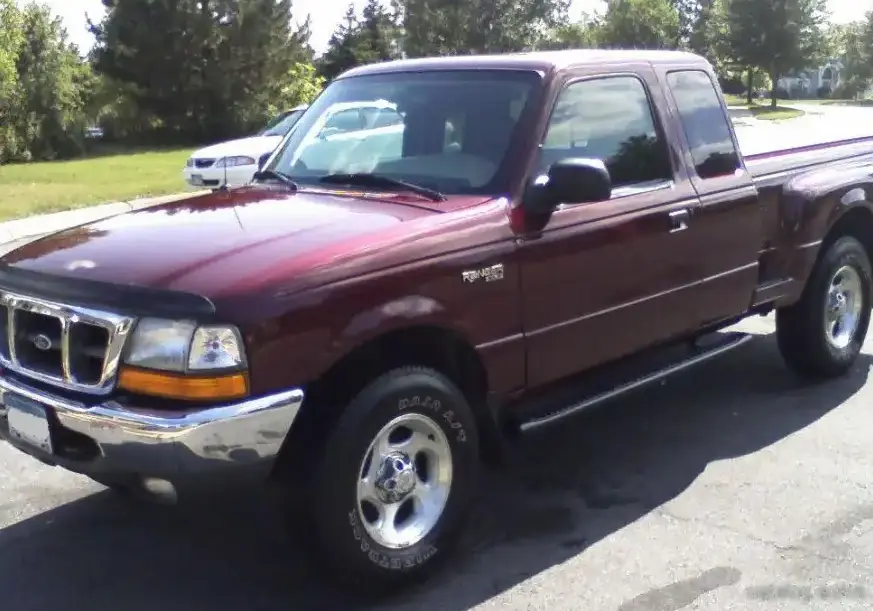
The Ford Ranger I Super Cab 2.5 TDCi 4×4 Automatic, produced between 1998 and 2006, represents a significant iteration of Ford’s globally successful Ranger compact pickup truck. This particular variant was primarily aimed at the European and Australian markets, offering a blend of practicality, off-road capability, and relative affordability. Positioned as a mid-range offering within the first-generation Ranger lineup, it slotted between the base model 2.5L naturally aspirated engine and the more powerful 3.0L TDCi options. The Super Cab configuration, with its extended cab, provided limited rear seating and increased interior storage compared to the standard cab models.
Technical Specifications
| Brand | Ford |
| Model | Ranger |
| Generation | Ranger I Super Cab |
| Type (Engine) | 2.5 TDCi (109 Hp) 4×4 Automatic |
| Start of production | 1998 |
| End of production | 2006 |
| Powertrain Architecture | Internal Combustion engine |
| Body type | Pick-up |
| Seats | 4 |
| Doors | 2 |
| Fuel Type | Diesel |
| Power | 109 Hp @ 3500 rpm |
| Power per litre | 43.6 Hp/l |
| Torque | 266 Nm @ 2000 rpm (196.19 lb.-ft. @ 2000 rpm) |
| Engine layout | Front, Longitudinal |
| Engine Model/Code | WL-T |
| Engine displacement | 2499 cm3 (152.5 cu. in.) |
| Number of cylinders | 4 |
| Engine configuration | Inline |
| Cylinder Bore | 93 mm (3.66 in.) |
| Piston Stroke | 92 mm (3.62 in.) |
| Number of valves per cylinder | 3 |
| Fuel injection system | Diesel Commonrail |
| Engine aspiration | Turbocharger, Intercooler |
| Engine oil capacity | 6.3 l (6.66 US qt | 5.54 UK qt) |
| Coolant | 9.4 l (9.93 US qt | 8.27 UK qt) |
| Max. weight | 2087 kg (4601.05 lbs.) |
| Fuel tank capacity | 70 l (18.49 US gal | 15.4 UK gal) |
| Length | 4998 mm (196.77 in.) |
| Width | 1695 mm (66.73 in.) |
| Height | 1740 mm (68.5 in.) |
| Wheelbase | 3000 mm (118.11 in.) |
| Front track | 1450 mm (57.09 in.) |
| Rear (Back) track | 1440 mm (56.69 in.) |
| Ride height (ground clearance) | 200 mm (7.87 in.) |
| Drive wheel | All wheel drive (4×4) |
| Number of gears and type of gearbox | 5 gears, automatic transmission |
| Front suspension | Independent torsion bar, double wishbone |
| Rear suspension | Dependent suspension of two longitudinal semi-elliptic leaf springs |
| Front brakes | Ventilated discs |
| Rear brakes | Drum |
| Assisting systems | ABS (Anti-lock braking system) |
| Steering type | Steering rack and pinion |
| Tires size | 235/75 R15 |
| Wheel rims size | 15 |
Powertrain & Engine Architecture
The heart of this Ranger variant is the 2.5-liter WL-T TDCi inline-four diesel engine. This engine, a product of Ford’s collaboration with Mazda, utilized a common rail direct injection system, a significant advancement over older mechanical injection systems. The common rail system allowed for more precise fuel delivery, resulting in improved fuel economy, reduced emissions, and a smoother power delivery. A turbocharger with an intercooler was employed to boost power output, bringing it to 109 horsepower at 3500 rpm and 266 Nm (196 lb-ft) of torque at 2000 rpm. The engine featured three valves per cylinder, contributing to improved combustion efficiency. The automatic transmission was a five-speed unit, designed to provide relatively smooth shifts, though it wasn’t known for being particularly sporty or quick to respond.
Driving Characteristics
The 2.5 TDCi with the automatic transmission offered a comfortable, if not exhilarating, driving experience. Acceleration was adequate for everyday use, but the 109 horsepower and the inherent efficiency losses of the automatic gearbox meant it wasn’t a particularly quick vehicle. The torque, however, was readily available from low engine speeds, making it suitable for hauling loads and tackling moderate off-road terrain. The automatic transmission’s gear ratios were geared towards fuel efficiency and usability rather than performance. Compared to the five-speed manual version of the same engine, the automatic felt noticeably slower, especially during overtaking maneuvers. The higher-output 3.0L TDCi models offered significantly more power and a more responsive driving experience, but at a higher price point.
Equipment & Trim Levels
The Super Cab 2.5 TDCi 4×4 Automatic typically came equipped with features such as air conditioning, power steering, and an AM/FM radio. Depending on the market and optional packages selected, additional features could include alloy wheels, a limited-slip differential, and upgraded interior trim. The interior generally featured durable, utilitarian materials, reflecting the truck’s work-oriented nature. The Super Cab configuration offered a small rear bench seat, suitable for occasional passengers or additional storage space. The dashboard layout was functional and straightforward, prioritizing ease of use over aesthetic appeal.
Chassis & Braking
The Ranger I Super Cab utilized a robust ladder-frame chassis, providing a solid foundation for both on-road and off-road driving. The front suspension consisted of independent torsion bars with double wishbones, while the rear suspension employed a traditional leaf spring setup. This combination offered a good balance between ride comfort and load-carrying capacity. Braking duties were handled by ventilated discs at the front and drum brakes at the rear. An Anti-lock Braking System (ABS) was standard, enhancing safety during emergency braking situations. The 4×4 system typically featured a shift-on-the-fly transfer case, allowing the driver to easily switch between two-wheel drive and four-wheel drive modes.
Market Reception & Comparison
The Ford Ranger I Super Cab 2.5 TDCi 4×4 Automatic was generally well-received in its target markets. Critics praised its practicality, durability, and off-road capability. However, the automatic transmission was often criticized for its sluggish performance and lack of responsiveness. Compared to the manual transmission version, the automatic suffered a slight fuel economy penalty. The 3.0L TDCi models were often favored by those seeking more power and performance, while the 2.5L naturally aspirated engine offered a more affordable entry point into the Ranger lineup. The Ranger competed with other compact pickups such as the Toyota Hilux, Nissan Navara, and Mitsubishi L200.
Legacy
The Ford Ranger I Super Cab 2.5 TDCi 4×4 Automatic has proven to be a relatively reliable vehicle, particularly the engine itself. The WL-T engine, while not without its quirks, is generally considered durable and capable of high mileage with proper maintenance. Common issues include wear and tear on the turbocharger and potential problems with the fuel injection system. The automatic transmission, however, can be prone to failure if not serviced regularly. Today, these Rangers are increasingly sought after by enthusiasts and those looking for a capable and affordable workhorse. Parts availability is generally good, and the relatively simple mechanical design makes them relatively easy to maintain and repair. The vehicle represents a pivotal point in Ford’s global pickup strategy, paving the way for the continued success of the Ranger nameplate.