Technical Specifications
| Brand | Ford |
| Model | Ranger |
| Generation | Ranger III Double Cab |
| Type (Engine) | 2.5 (166 Hp) 4×4 |
| Start of production | 2011 |
| End of production | 2015 |
| Powertrain Architecture | Internal Combustion engine |
| Body type | Pick-up |
| Seats | 5 |
| Doors | 4 |
| Fuel consumption (urban) | 14.1 l/100 km (16.7 US mpg, 20 UK mpg, 7.1 km/l) |
| Fuel consumption (extra urban) | 8.9 l/100 km (26.4 US mpg, 31.7 UK mpg, 11.2 km/l) |
| Fuel consumption (combined) | 10.8 l/100 km (21.8 US mpg, 26.2 UK mpg, 9.3 km/l) |
| CO2 emissions | 235 g/km |
| Fuel Type | Petrol (Gasoline) |
| Acceleration 0 – 100 km/h | 11.5 sec |
| Acceleration 0 – 62 mph | 11.5 sec |
| Acceleration 0 – 60 mph | 10.9 sec |
| Maximum speed | 175 km/h (108.74 mph) |
| Emission standard | Euro 4 |
| Weight-to-power ratio | 12.3 kg/Hp, 81.1 Hp/tonne |
| Weight-to-torque ratio | 9.1 kg/Nm, 110.4 Nm/tonne |
| Power | 166 Hp @ 6000 rpm |
| Power per litre | 66.7 Hp/l |
| Torque | 226 Nm @ 4500 rpm (166.69 lb.-ft. @ 4500 rpm) |
| Engine layout | Front, Longitudinal |
| Engine displacement | 2488 cm3 (151.83 cu. in.) |
| Number of cylinders | 4 |
| Engine configuration | Inline |
| Cylinder Bore | 89 mm (3.5 in.) |
| Piston Stroke | 100 mm (3.94 in.) |
| Compression ratio | 10:1 |
| Number of valves per cylinder | 4 |
| Fuel injection system | Multi-port manifold injection |
| Engine aspiration | Naturally aspirated engine |
| Engine oil capacity | 6.7 l (7.08 US qt | 5.9 UK qt) |
| Coolant | 11 l (11.62 US qt | 9.68 UK qt) |
| Kerb Weight | 2048 kg (4515.07 lbs.) |
| Max. weight | 3200 kg (7054.79 lbs.) |
| Max load | 1152 kg (2539.73 lbs.) |
| Trunk (boot) space – minimum | 1210 l (42.73 cu. ft.) |
| Fuel tank capacity | 80 l (21.13 US gal | 17.6 UK gal) |
| Length | 5359 mm (210.98 in.) |
| Width | 1850 mm (72.83 in.) |
| Height | 1815 mm (71.46 in.) |
| Wheelbase | 3220 mm (126.77 in.) |
| Front track | 1560 mm (61.42 in.) |
| Rear (Back) track | 1560 mm (61.42 in.) |
| Ride height (ground clearance) | 229 mm (9.02 in.) |
| Drag coefficient (Cd) | 0.40 |
| Drive wheel | All wheel drive (4×4) |
| Number of gears and type of gearbox | 5 gears, manual transmission |
| Front suspension | Independent coil spring |
| Rear suspension | Dependent suspension of two longitudinal semi-elliptic leaf springs |
| Front brakes | Ventilated discs |
| Rear brakes | Drum |
| Assisting systems | ABS (Anti-lock braking system) |
| Steering type | Steering rack and pinion |
| Power steering | Hydraulic Steering |
| Tires size | 255/70 R16 |
| Wheel rims size | 16 |
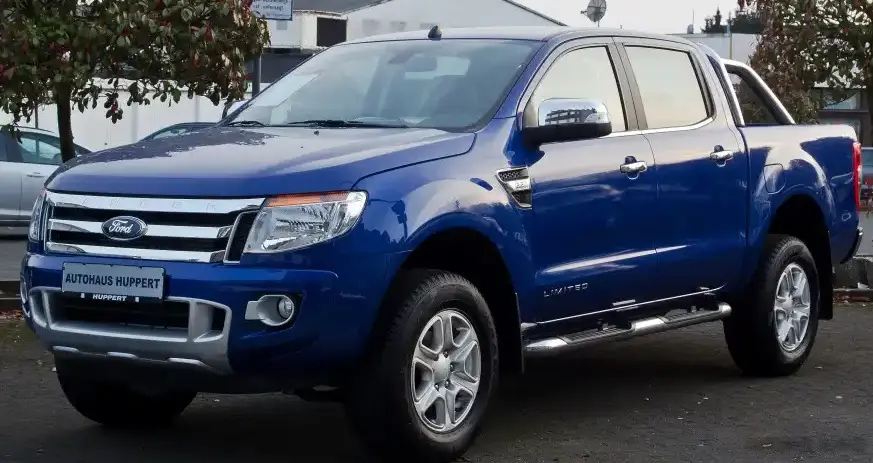
The Ford Ranger III Double Cab 2.5 (166 Hp) 4×4 was a mid-size pickup truck produced by Ford between 2011 and 2015. This variant represented a significant update to the Ranger line, primarily targeted towards the European, Australian, and South African markets, where demand for compact and versatile pickups remained strong. It occupied a key position in the Ranger III lineup, offering a balance between work-truck capability and family-friendly space thanks to its double-cab configuration. This model year served as a transitional period for the Ranger, bridging the gap between older designs and the globally unified Ranger platform that would arrive in subsequent years.
Powertrain & Engine Architecture
The Ranger III Double Cab 2.5 4×4 was powered by the Ford Duratec 250 engine, a 2.5-liter inline-four cylinder gasoline engine. This engine, a variation of the Cologne engine family, featured a cast iron block and an aluminum cylinder head. It utilized a multi-port fuel injection system, delivering fuel directly into the intake ports, and a single overhead camshaft (SOHC) design with four valves per cylinder. The engine produced 166 horsepower at 6000 rpm, with peak torque of 226 Nm (166.69 lb-ft) at 4500 rpm. The engine’s longitudinal mounting allowed for a traditional rear-wheel-drive layout, with a transfer case providing four-wheel drive capability. The standard transmission was a five-speed manual gearbox, chosen for its durability and simplicity. While an automatic transmission was offered on some Ranger III models, it wasn’t commonly paired with this specific 2.5-liter engine in most markets.
Driving Characteristics
The combination of the 2.5-liter engine and the five-speed manual transmission delivered adequate, though not particularly exciting, performance. Acceleration from 0-60 mph took approximately 10.9 seconds, with a top speed around 108.74 mph. The engine felt somewhat stressed when fully loaded or climbing steep inclines. The manual transmission provided precise shifts, but the gear ratios were optimized for fuel economy and durability rather than outright performance. Compared to the higher-output 3.0-liter engines available in the Ranger III lineup, the 2.5-liter felt noticeably less powerful. However, it offered a more economical driving experience, especially in city driving. The 4×4 system provided good traction on loose surfaces, making it suitable for light off-road work and challenging weather conditions.
Equipment & Trim Levels
The Double Cab 2.5 4×4 typically came with a reasonable level of standard equipment. This included air conditioning, power steering, central locking, and an AM/FM radio. Higher trim levels, such as “Limited” or “XLT,” added features like alloy wheels, upgraded interior trim, power windows, and a more advanced audio system. Optional extras included a rear differential lock, a tow bar, and various accessories to enhance the truck’s practicality. Interior upholstery was typically cloth, with vinyl or leather options available on higher-spec models. The dashboard layout was functional and straightforward, prioritizing ease of use over elaborate design.
Chassis & Braking
The Ranger III Double Cab utilized a body-on-frame construction, providing a robust and durable platform. The front suspension consisted of independent coil springs, offering a reasonable level of ride comfort. The rear suspension employed a traditional leaf spring setup, designed to handle heavier loads. Braking was handled by ventilated discs at the front and drum brakes at the rear. An Anti-lock Braking System (ABS) was standard, enhancing safety during emergency braking. The steering was a hydraulic rack and pinion system, providing responsive and predictable handling. Ground clearance was a respectable 9.02 inches, allowing for moderate off-road capability.
Market Reception & Comparison
The Ranger III Double Cab 2.5 4×4 was generally well-received as a practical and versatile pickup truck. Critics praised its spacious cabin, robust construction, and reasonable fuel economy. However, some reviewers noted that the 2.5-liter engine lacked the power of its larger counterparts. Compared to the 3.0-liter versions, the 2.5 offered a more affordable entry point into the Ranger Double Cab range, appealing to buyers who prioritized value and fuel efficiency over performance. The 2.5-liter engine also tended to be more reliable than the more complex 3.0-liter units, potentially reducing repair costs.
Legacy
The Ford Ranger III Double Cab 2.5 4×4 remains a popular choice in the used car market, particularly in regions where pickups are commonly used for both work and leisure. The Duratec 250 engine is known for its durability and relatively simple maintenance requirements. While not the fastest or most luxurious pickup truck available, it offers a solid and dependable platform for a variety of tasks. Parts availability is generally good, and the truck’s straightforward design makes it relatively easy to repair. Today, these Rangers are often sought after by those looking for a capable and affordable workhorse, or a reliable vehicle for outdoor adventures.