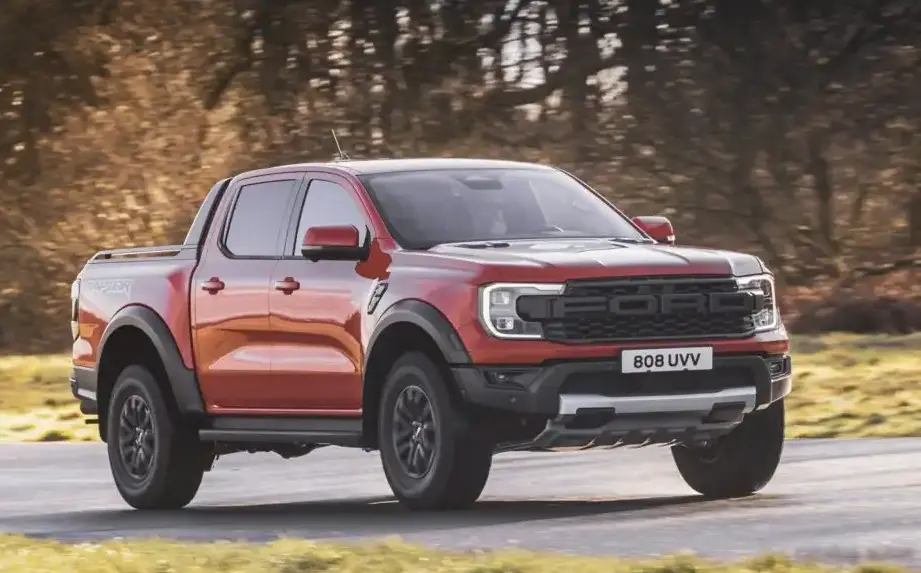
The Ford Ranger IV Double Cab 2.0 EcoBlue (205 Hp) e-4WD Automatic, introduced in March 2023, represents the latest iteration of Ford’s globally successful mid-size pickup truck. This variant is positioned as a versatile option within the Ranger IV lineup, blending diesel efficiency with respectable power and the convenience of an automatic transmission and part-time four-wheel drive. It’s primarily aimed at buyers seeking a capable workhorse with enhanced comfort and technology features, suitable for both on-road driving and light off-road applications. The “e-4WD” designation signifies an electronically controlled four-wheel drive system, offering improved traction and control in varying conditions. This model builds upon the T6 platform, a chassis shared with other global Ford products, but significantly updated for the fourth generation with a focus on increased capability and refinement.
Technical Specifications
| Brand | Ford |
| Model | Ranger |
| Generation | Ranger IV Double Cab |
| Type (Engine) | 2.0 EcoBlue (205 Hp) e-4WD Automatic |
| Start of production | March, 2023 |
| Powertrain Architecture | Internal Combustion engine |
| Body type | Pick-up |
| Seats | 5 |
| Doors | 4 |
| Combined fuel consumption (WLTP) | 8.8-10.3 l/100 km |
| Combined fuel consumption (US mpg) | 26.7 – 22.8 |
| Combined fuel consumption (UK mpg) | 32.1 – 27.4 |
| Combined fuel consumption (km/l) | 11.4 – 9.7 |
| CO2 emissions (WLTP) | 230-271 g/km |
| Fuel Type | Diesel |
| Acceleration 0 – 100 km/h | 10.5 sec |
| Acceleration 0 – 62 mph | 10.5 sec |
| Acceleration 0 – 60 mph | 10 sec |
| Maximum speed | 180 km/h (111.85 mph) |
| Weight-to-power ratio | 11.9 kg/Hp, 84.2 Hp/tonne |
| Weight-to-torque ratio | 4.9 kg/Nm, 205.3 Nm/tonne |
| Power | 205 Hp |
| Power per litre | 102.7 Hp/l |
| Torque | 500 Nm (368.78 lb.-ft.) |
| Engine layout | Front, Longitudinal |
| Engine Model/Code | YN2X |
| Engine displacement | 1996 cm3 (121.8 cu. in.) |
| Number of cylinders | 4 |
| Engine configuration | Inline |
| Number of valves per cylinder | 4 |
| Fuel injection system | Diesel Commonrail |
| Engine aspiration | BiTurbo, Intercooler |
| Engine systems | Start & Stop System, Particulate filter |
| Kerb Weight | 2436 kg (5370.46 lbs.) |
| Max. weight | 3280 kg (7231.16 lbs.) |
| Max load | 844 kg (1860.7 lbs.) |
| Permitted trailer load with brakes (12%) | 3500 kg (7716.18 lbs.) |
| Permitted trailer load without brakes | 750 kg (1653.47 lbs.) |
| Length | 5370 mm (211.42 in.) |
| Width | 2015 mm (79.33 in.) |
| Width including mirrors | 2208 mm (86.93 in.) |
| Height | 1884-1914 mm (74.17 – 75.35 in.) |
| Wheelbase | 3270 mm (128.74 in.) |
| Front track | 1620 mm (63.78 in.) |
| Rear (Back) track | 1620 mm (63.78 in.) |
| Ride height (ground clearance) | 235-261 mm (9.25 – 10.28 in.) |
| Minimum turning circle (turning diameter) | 12.9 m (42.32 ft.) |
| Approach angle | 30-32° |
| Departure angle | 25.6-27° |
| Ramp-over (brakeover) angle | 21-24° |
| Wading depth | 800 mm (31.5 in.) |
| Drivetrain Architecture | The Internal combustion engine (ICE) drives the rear wheels permanently, and the front wheels are driven through an electrically or mechanically operated clutch if necessary. |
| Drive wheel | All wheel drive (4×4) |
| Number of gears and type of gearbox | 10 gears, automatic transmission |
| Front brakes | Ventilated discs |
| Rear brakes | Disc |
| Assisting systems | ABS (Anti-lock braking system) |
| Steering type | Steering rack and pinion |
| Power steering | Electric Steering |
| Tires size | 265/70 R17 |
| Wheel rims size | 17 |
Powertrain & Engine Architecture
At the heart of the Ranger IV Double Cab 2.0 EcoBlue is the YN2X engine, a 2.0-liter inline-four cylinder diesel. This engine utilizes a sophisticated bi-turbocharger setup – a low-inertia turbo for immediate response and a larger turbo for peak power. The common-rail direct fuel injection system, operating at extremely high pressures, ensures efficient combustion and contributes to the engine’s power output and fuel economy. The engine also incorporates an intercooler to further enhance performance by cooling the intake air. The 205 horsepower and 500 Nm (368.78 lb.-ft.) of torque are managed by a 10-speed automatic transmission, a key feature for providing smooth and efficient gear changes. This transmission is designed to optimize engine performance across a wide range of driving conditions, from highway cruising to off-road crawling. The transmission’s wide gear ratio spread also aids in fuel efficiency.
Driving Characteristics
The 2.0 EcoBlue with the 10-speed automatic delivers a balanced driving experience. While not as overtly powerful as some of the higher-output Ranger variants (like those with the larger engines), it provides ample torque for everyday driving and hauling moderate loads. The automatic transmission is generally responsive, offering smooth shifts and intelligent gear selection. The e-4WD system allows the driver to switch between 2WD, 4WD High, and 4WD Low, providing enhanced traction in slippery conditions or challenging terrain. Compared to a manual transmission, the automatic prioritizes convenience and ease of use, but may result in a slight reduction in fuel economy. The 10.5-second 0-60 mph acceleration is respectable for a mid-size pickup, and the engine feels most comfortable in the mid-range, providing strong pulling power for overtaking and climbing hills.
Equipment & Trim Levels
The Ranger IV Double Cab 2.0 EcoBlue typically comes standard with a comprehensive suite of features. These generally include air conditioning, power windows and locks, a touchscreen infotainment system with Apple CarPlay and Android Auto compatibility, and a rearview camera. Safety features such as ABS, electronic stability control, and multiple airbags are also standard. Higher trim levels add features like leather upholstery, heated front seats, a premium sound system, and advanced driver-assistance systems (ADAS) such as adaptive cruise control and lane-keeping assist. Optional extras often include a bed liner, running boards, and various styling packages.
Chassis & Braking
The Ranger IV utilizes a robust ladder-frame chassis, providing a solid foundation for both on-road comfort and off-road durability. The front suspension consists of independent double wishbones, while the rear features leaf springs. This configuration balances ride quality with load-carrying capacity. Braking duties are handled by ventilated discs at the front and solid discs at the rear, providing adequate stopping power for the vehicle’s weight. The electric power steering offers a comfortable and responsive feel, with a variable ratio that adjusts steering effort based on vehicle speed.
Market Reception & Comparison
The Ford Ranger IV has been well-received in the market, praised for its improved refinement, capability, and technology. The 2.0 EcoBlue automatic variant offers a compelling balance of fuel efficiency and performance, making it a popular choice for buyers who prioritize practicality and ease of use. Compared to the higher-output engine options, the 2.0 EcoBlue is generally more fuel-efficient and offers a lower initial purchase price. However, it may not be as well-suited for heavy-duty towing or demanding off-road applications. Critics have noted the transmission’s smooth operation and the engine’s adequate power delivery for most everyday tasks.
Legacy
The 2.0 EcoBlue engine, while relatively new to the Ranger lineup, has proven to be a reliable and durable powerplant in other Ford applications. The 10-speed automatic transmission is also known for its robustness. As the Ranger IV continues to age, the 2.0 EcoBlue automatic variant is expected to hold its value well in the used car market, particularly among buyers seeking a fuel-efficient and capable mid-size pickup. Proper maintenance, including regular oil changes and adherence to Ford’s recommended service intervals, will be crucial for ensuring the long-term reliability of this powertrain.