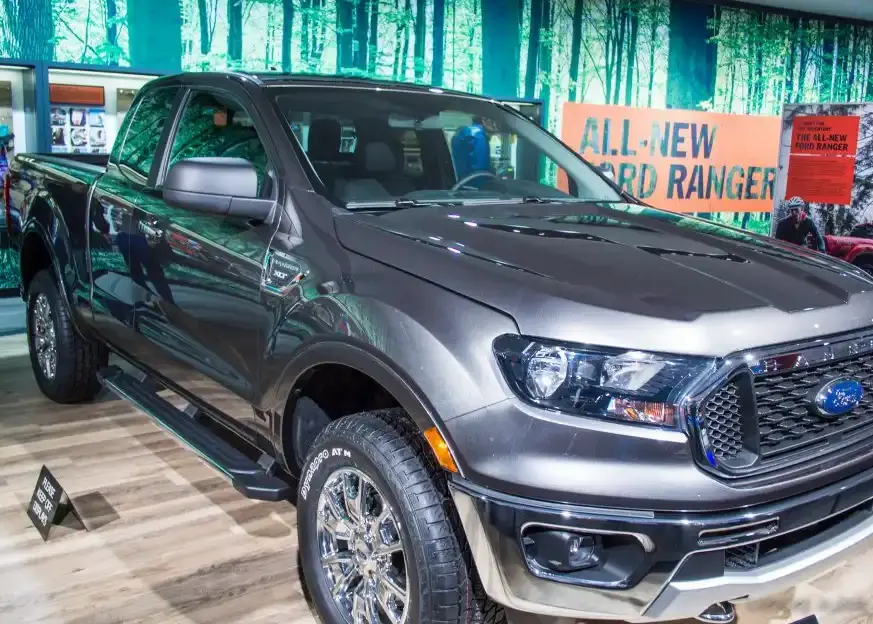
The Ford Ranger IV SuperCab, specifically equipped with the 2.3-liter EcoBoost engine and a ten-speed automatic transmission, was a significant offering in the mid-size pickup truck segment in the Americas from 2019 to 2023. Representing a return of the Ranger nameplate to the North American market after a hiatus, this variant aimed to blend capability with a more fuel-efficient gasoline engine option. It occupied a middle ground in the Ranger lineup, positioned above the base model but below the more powerful 3.0-liter V6 introduced later in the production run. This configuration was designed to appeal to buyers seeking a versatile truck for both work and recreational use, without the higher price tag of the top-tier trims.
Technical Specifications
| Brand | Ford |
| Model | Ranger |
| Generation | Ranger IV SuperCab (Americas) |
| Type (Engine) | 2.3 EcoBoost (270 Hp) Automatic |
| Start of production | January, 2019 |
| End of production | May, 2023 |
| Powertrain Architecture | Internal Combustion engine |
| Body type | Pick-up |
| Seats | 5 |
| Doors | 2 |
| Fuel consumption (urban) | 11.2 l/100 km (21 US mpg, 25.2 UK mpg, 8.9 km/l) |
| Fuel consumption (extra urban) | 9 l/100 km (26.1 US mpg, 31.4 UK mpg, 11.1 km/l) |
| Fuel consumption (combined) | 10.2 l/100 km (23.1 US mpg, 27.7 UK mpg, 9.8 km/l) |
| Fuel Type | Petrol (Gasoline) |
| Power | 270 Hp |
| Power per litre | 119.4 Hp/l |
| Torque | 420 Nm (309.78 lb.-ft.) |
| Engine layout | Front, Longitudinal |
| Engine displacement | 2261 cm3 (137.97 cu. in.) |
| Number of cylinders | 4 |
| Engine configuration | Inline |
| Number of valves per cylinder | 4 |
| Fuel injection system | Direct injection |
| Engine aspiration | Twin-Turbo, Intercooler |
| Valvetrain | DOHC |
| Engine oil capacity | 5.9 l (6.23 US qt | 5.19 UK qt) |
| Coolant | 11 l (11.62 US qt | 9.68 UK qt) |
| Max. weight | 2744 kg (6049.48 lbs.) |
| Fuel tank capacity | 68 l (17.96 US gal | 14.96 UK gal) |
| Permitted trailer load with brakes (12%) | 3402 kg (7500.13 lbs.) |
| Length | 5354 mm (210.79 in.) |
| Width | 1862 mm (73.31 in.) |
| Width with mirrors folded | 1976 mm (77.8 in.) |
| Width including mirrors | 2179 mm (85.79 in.) |
| Height | 1796 mm (70.71 in.) |
| Wheelbase | 3221 mm (126.81 in.) |
| Front overhang | 909 mm (35.79 in.) |
| Rear overhang | 1224 mm (48.19 in.) |
| Ride height (ground clearance) | 213 mm (8.39 in.) |
| Approach angle | 28.7° |
| Departure angle | 25.4° |
| Ramp-over (brakeover) angle | 21.5° |
| Drivetrain Architecture | Rear wheel drive. Internal Combustion engine. |
| Drive wheel | Rear wheel drive |
| Number of gears and type of gearbox | 10 gears, automatic transmission |
| Front suspension | Double wishbone |
| Front brakes | Disc |
| Rear brakes | Disc |
| Assisting systems | ABS (Anti-lock braking system) |
| Steering type | Steering rack and pinion |
| Power steering | Electric Steering |
| Tires size | 255/70 R16; 255/65 R17; 265/60 R18 |
| Wheel rims size | 16; 17; 18 |
INTRODUCTION
The 2019-2023 Ford Ranger IV SuperCab 2.3 EcoBoost Automatic marked Ford’s re-entry into the highly competitive mid-size pickup truck market in North America. Built on the global T6 platform, the Ranger aimed to offer a compelling alternative to established rivals like the Toyota Tacoma and Chevrolet Colorado. The 2.3 EcoBoost engine, part of Ford’s EcoBoost family of turbocharged engines, was chosen for its balance of power, efficiency, and refinement. The SuperCab configuration, with its extended rear passenger area, provided added practicality for families or crews. This particular trim level was positioned as a versatile option, appealing to a broad range of buyers seeking a capable and comfortable daily driver.
Powertrain & Engine Architecture
At the heart of this Ranger variant lies the 2.3-liter EcoBoost inline-four cylinder engine. This engine, designated with various internal codes depending on the specific year and market, utilizes direct fuel injection and a twin-turbocharger setup. The twin-turbo configuration, with one small turbo for quick response and a larger turbo for peak power, helps to mitigate turbo lag and deliver a broad torque curve. The engine features a double overhead camshaft (DOHC) valvetrain with four valves per cylinder, optimizing airflow for increased performance. The 2.3 EcoBoost is paired with a sophisticated ten-speed automatic transmission, developed jointly by Ford and General Motors. This transmission offers a wide range of gear ratios, contributing to both improved acceleration and enhanced fuel economy. The transmission’s programming is tuned to provide smooth shifts and responsive performance in various driving conditions.
Driving Characteristics
The 270 horsepower and 310 lb-ft of torque produced by the 2.3 EcoBoost engine, coupled with the ten-speed automatic, provided the Ranger with respectable performance. While not as overtly powerful as some of its V6-equipped competitors, the 2.3 EcoBoost offered ample power for everyday driving and towing. The ten-speed transmission played a crucial role in keeping the engine in its optimal power band, resulting in brisk acceleration. Compared to the manual transmission option, the automatic provided a more relaxed driving experience, particularly in urban traffic. However, some reviewers noted that the automatic transmission could occasionally hunt for gears, especially during highway cruising. The rear-wheel-drive configuration, standard on this variant, provided a traditional truck feel, while four-wheel drive was available as an option for enhanced traction in challenging conditions.
Equipment & Trim Levels
The Ranger IV SuperCab 2.3 EcoBoost Automatic typically came standard with a respectable array of features. These included air conditioning, a basic infotainment system with a touchscreen display, Bluetooth connectivity, and a rearview camera. Higher trim levels, such as the XLT and Lariat, added features like leather upholstery, heated front seats, a premium sound system, and advanced driver-assistance systems such as blind-spot monitoring and lane-keeping assist. Optional extras included a trailer tow package, off-road suspension upgrades, and a power moonroof. Interior materials were generally durable and functional, reflecting the truck’s work-oriented nature. The SuperCab configuration offered a small rear seat suitable for occasional passengers, while the SuperCrew configuration provided a more spacious rear cabin.
Chassis & Braking
The Ranger IV SuperCab utilized a body-on-frame construction, providing a robust and durable platform for demanding applications. The front suspension featured a double-wishbone design, while the rear suspension employed leaf springs. This setup provided a good balance of ride comfort and load-carrying capacity. Braking duties were handled by disc brakes on all four wheels, providing adequate stopping power. An anti-lock braking system (ABS) was standard, enhancing safety and control during emergency braking maneuvers. The Ranger’s chassis was designed to handle a variety of payloads and towing loads, making it a versatile work truck.
Market Reception & Comparison
The Ford Ranger IV SuperCab 2.3 EcoBoost Automatic was generally well-received by critics and consumers alike. Reviewers praised the truck’s comfortable ride, capable engine, and modern features. However, some criticized its relatively high price compared to competitors and its somewhat cramped rear seat in the SuperCab configuration. In terms of fuel economy, the 2.3 EcoBoost engine offered a competitive advantage over some of the V6-powered rivals. Reliability proved to be generally good, although some owners reported minor issues with the infotainment system and the automatic transmission. Compared to the later-introduced 3.0-liter V6, the 2.3 EcoBoost offered a more affordable entry point into the Ranger lineup, albeit with slightly less power and towing capacity.
Legacy
The Ford Ranger IV SuperCab 2.3 EcoBoost Automatic played a key role in re-establishing the Ranger nameplate in the North American market. The 2.3 EcoBoost engine proved to be a reliable and efficient powerplant, and the ten-speed automatic transmission provided smooth and responsive performance. In the used car market, these Rangers continue to be sought after for their versatility, capability, and relatively modern features. While newer Ranger models have since been introduced, the 2019-2023 variants remain a compelling option for buyers seeking a capable and affordable mid-size pickup truck.