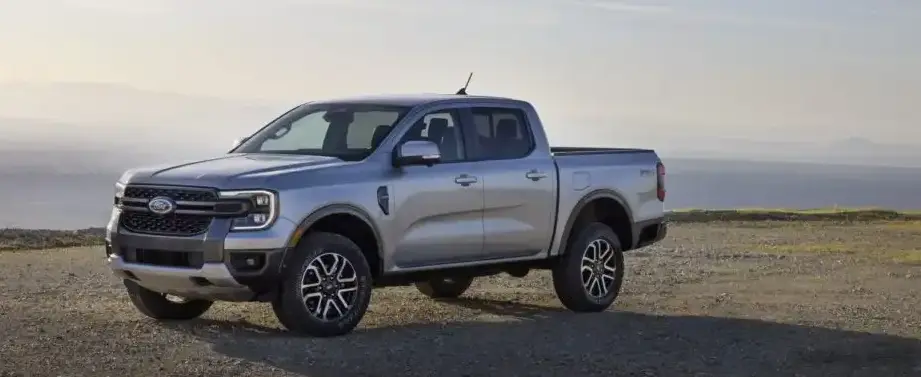
The Ford Ranger V SuperCrew, specifically equipped with the 2.7 EcoBoost V6 engine and a four-wheel-drive automatic transmission, represents a significant offering in the mid-size pickup truck segment within the Americas market. Introduced in May 2023, this variant builds upon the redesigned Ranger platform, aiming to deliver a blend of capability, comfort, and modern technology. It occupies a position as a higher-trim level, offering more power and features than the base engine options while remaining below the potentially more specialized Raptor model. This configuration is targeted towards buyers who require substantial towing and hauling capacity alongside everyday usability and a more refined driving experience.
Technical Specifications
| Brand | Ford |
| Model | Ranger |
| Generation | Ranger V SuperCrew (Americas) |
| Type (Engine) | 2.7 EcoBoost V6 (310 Hp) 4×4 Automatic |
| Start of production | May, 2023 |
| Powertrain Architecture | Internal Combustion engine |
| Body type | Pick-up |
| Seats | 5 |
| Doors | 4 |
| Fuel Type | Petrol (Gasoline) |
| Power | 310 Hp |
| Power per litre | 114.6 Hp/l |
| Torque | 542 Nm / 399.76 lb.-ft. |
| Engine layout | Front, Longitudinal |
| Engine displacement | 2704 cm3 / 165.01 cu. in. |
| Number of cylinders | 6 |
| Engine configuration | V-engine |
| Cylinder Bore | 83.06 mm / 3.27 in. |
| Piston Stroke | 83.06 mm / 3.27 in. |
| Compression ratio | 10:1 |
| Number of valves per cylinder | 4 |
| Fuel injection system | Direct injection and Multi-port manifold injection |
| Engine aspiration | Twin-Turbo, Intercooler |
| Valvetrain | DOHC, Ti-VCT |
| Engine oil capacity | 6.6 l / 6.97 US qt | 5.81 UK qt |
| Coolant | 11.7 l / 12.36 US qt | 10.29 UK qt |
| Trunk (boot) space – maximum | 1232 l / 43.51 cu. ft. |
| Fuel tank capacity | 71 l / 18.76 US gal | 15.62 UK gal |
| Length | 5349 mm / 210.59 in. |
| Width | 1918 mm / 75.51 in. |
| Width with mirrors folded | 2007 mm / 79.02 in. |
| Width including mirrors | 2202 mm / 86.69 in. |
| Height | 1890 mm / 74.41 in. |
| Wheelbase | 3269 mm / 128.7 in. |
| Front track | 1621 mm / 63.82 in. |
| Rear (Back) track | 1621 mm / 63.82 in. |
| Front overhang | 866 mm / 34.09 in. |
| Rear overhang | 1214 mm / 47.8 in. |
| Ride height (ground clearance) | 236 mm / 9.29 in. |
| Minimum turning circle (turning diameter) | 13 m / 42.65 ft. |
| Approach angle | 30.2° |
| Departure angle | 25.8° |
| Ramp-over (brakeover) angle | 23.0° |
| Drivetrain Architecture | All wheel drive (4×4). ICE drives rear wheels, front wheels engaged via clutch. |
| Number of gears and type of gearbox | 10 gears, automatic transmission |
| Front suspension | Double wishbone, Transverse stabilizer |
| Rear suspension | dependent spring suspension, Leaf spring |
| Front brakes | Disc, 310.9×33.78 mm |
| Rear brakes | Disc, 307.85×23.88 mm |
| Assisting systems | ABS (Anti-lock braking system) |
| Steering type | Steering rack and pinion |
| Power steering | Electric Steering |
| Tires size | 255/70 R17; 255/65 R18 |
Powertrain & Engine Architecture
At the heart of the Ranger V SuperCrew is Ford’s 2.7-liter EcoBoost V6 engine. This engine, designated within Ford’s engine family as the third generation, utilizes a compact graphite iron cylinder block and aluminum cylinder heads. The key to its performance lies in its twin-turbocharger setup, providing boosted air to the engine for increased power and torque. The engine employs both direct injection and multi-port fuel injection, optimizing combustion efficiency and reducing emissions. The valvetrain features a double overhead camshaft (DOHC) design with Twin Independent Variable Camshaft Timing (Ti-VCT), allowing for precise control of valve timing to maximize performance across the engine’s operating range. The 10-speed automatic transmission, co-developed with General Motors, is a crucial component, offering a wide gear ratio spread for both acceleration and fuel efficiency. This transmission is designed to handle the engine’s substantial 542 Nm (399.76 lb-ft) of torque.
Driving Characteristics
The 2.7 EcoBoost V6 in the Ranger V SuperCrew delivers a noticeable step up in performance compared to the base 2.3-liter EcoBoost four-cylinder engine. Acceleration is brisk, and the engine provides ample power for highway passing and merging. The 10-speed automatic transmission contributes to smooth and responsive shifts, and the wide gear ratios help keep the engine in its optimal power band. While not as overtly sporty as some competitors, the Ranger V SuperCrew offers a comfortable and capable driving experience. The four-wheel-drive system provides enhanced traction in various conditions, making it suitable for both on-road and off-road use. Compared to a manual transmission equipped Ranger, the automatic prioritizes ease of use and convenience, though it may slightly diminish driver engagement.
Equipment & Trim Levels
The Ranger V SuperCrew 2.7 EcoBoost typically comes standard with a comprehensive suite of features. These generally include a user-friendly infotainment system with touchscreen display, Apple CarPlay and Android Auto compatibility, Ford’s Co-Pilot360 suite of driver-assistance technologies (including automatic emergency braking, lane-keeping assist, and adaptive cruise control), and a comfortable interior with cloth upholstery. Higher trim levels offer upgrades such as leather upholstery, heated and ventilated front seats, a premium sound system, and additional convenience features. Optional extras often include a spray-in bedliner, a tow package, and various appearance packages.
Chassis & Braking
The Ranger V SuperCrew utilizes a robust body-on-frame construction, providing a solid foundation for its capabilities. The front suspension features a double-wishbone design with a transverse stabilizer bar, while the rear suspension employs a traditional leaf spring setup. This configuration balances ride comfort with load-carrying capacity. Braking duties are handled by disc brakes on all four wheels, providing adequate stopping power for the vehicle’s weight. The anti-lock braking system (ABS) is standard, enhancing safety and control during emergency braking situations. The chassis is tuned to provide a comfortable ride while maintaining good handling characteristics, even when carrying a load or towing a trailer.
Market Reception & Comparison
The Ford Ranger V SuperCrew 2.7 EcoBoost has generally been well-received by automotive critics. Reviewers have praised its powerful engine, comfortable ride, and well-equipped interior. Fuel economy is respectable for a vehicle of its size and capability, though it doesn’t match the efficiency of the base four-cylinder engine. Compared to other mid-size pickups, such as the Toyota Tacoma and Chevrolet Colorado, the Ranger V SuperCrew offers a compelling combination of features and value. The 2.7 EcoBoost engine provides a noticeable performance advantage over some competitors’ base engine options. Reliability has been generally good, though some owners have reported minor issues with the infotainment system.
Legacy
The 2.7 EcoBoost V6 engine has proven to be a reliable and durable powertrain in other Ford vehicles, and its application in the Ranger V SuperCrew is expected to continue its positive track record. The combination of the engine and 10-speed automatic transmission provides a smooth and efficient driving experience. In the used car market, the Ranger V SuperCrew 2.7 EcoBoost is likely to hold its value well due to its desirable features and proven capabilities. Its blend of power, comfort, and technology makes it a popular choice among truck buyers seeking a versatile and capable mid-size pickup.