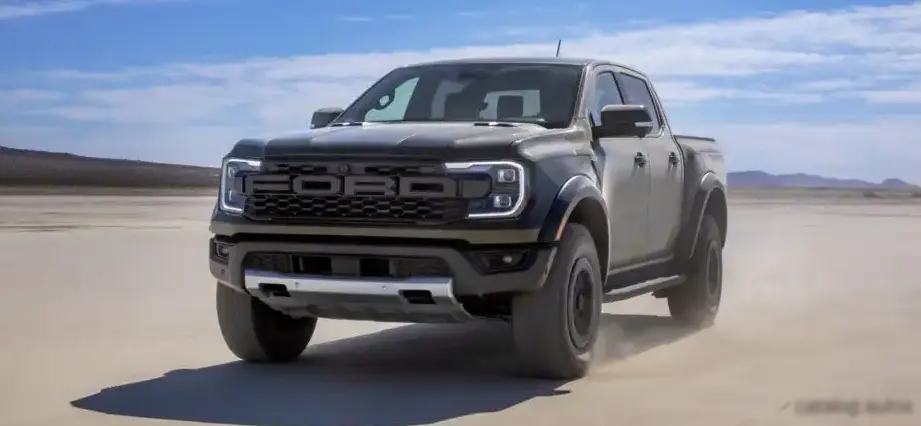
The Ford Ranger Raptor, specifically the V SuperCrew configuration with the 3.0 EcoBoost V6 engine introduced in 2023 for the Americas market, represents a significant evolution in the mid-size pickup truck segment. Building upon the globally successful Ranger platform (P703), the Raptor variant is designed as a high-performance, off-road focused vehicle, distinct from the more traditionally oriented Ranger trims. This model year marked the first time the 3.0L EcoBoost engine, previously found in vehicles like the Ford Explorer ST and Lincoln Aviator, was offered in the Ranger Raptor for North and South America, replacing the previous 2.0L turbocharged four-cylinder engine found in international markets. The V SuperCrew designation indicates a four-door cab and a five-passenger seating capacity.
Technical Specifications
| Brand | Ford |
| Model | Ranger |
| Generation | Ranger V SuperCrew (Americas) |
| Type (Engine) | Raptor 3.0 EcoBoost V6 (405 Hp) 4×4 Automatic |
| Start of production | 2023 |
| Powertrain Architecture | Internal Combustion engine |
| Body type | Pick-up |
| Seats | 5 |
| Doors | 4 |
| Fuel Type | Petrol (Gasoline) |
| Weight-to-power ratio | 6 kg/Hp, 167.7 Hp/tonne |
| Weight-to-torque ratio | 4.1 kg/Nm, 241.4 Nm/tonne |
| Power | 405 Hp |
| Power per litre | 137.3 Hp/l |
| Torque | 583 Nm / 430 lb.-ft. |
| Engine layout | Front, Longitudinal |
| Engine Model/Code | EcoBoost |
| Engine displacement | 2949 cm3 / 179.96 cu. in. |
| Number of cylinders | 6 |
| Engine configuration | V-engine |
| Cylinder Bore | 85.4 mm / 3.36 in. |
| Piston Stroke | 86 mm / 3.39 in. |
| Compression ratio | 10.5:1 |
| Number of valves per cylinder | 4 |
| Fuel injection system | Direct injection and Multi-port manifold injection |
| Engine aspiration | Twin-Turbo, Intercooler |
| Valvetrain | DOHC, TI-VCT |
| Engine oil capacity | 6.62 l / 7 US qt | 5.82 UK qt |
| Kerb Weight | 2415 kg / 5324.16 lbs. |
| Max. weight | 3080 kg / 6790.24 lbs. |
| Max load | 665 kg / 1466.07 lbs. |
| Trunk (boot) space – minimum | 1232 l / 43.51 cu. ft. |
| Fuel tank capacity | 77 l / 20.34 US gal | 16.94 UK gal |
| Permitted trailer load with brakes (12%) | 2499 kg / 5509.35 lbs. |
| Length | 5357 mm / 210.91 in. |
| Width | 2007 mm / 79.02 in. |
| Width with mirrors folded | 2027 mm / 79.8 in. |
| Width including mirrors | 2202 mm / 86.69 in. |
| Height | 1928 mm / 75.91 in. |
| Wheelbase | 3269 mm / 128.7 in. |
| Front track | 1709 mm / 67.28 in. |
| Rear (Back) track | 1709 mm / 67.28 in. |
| Front overhang | 861 mm / 33.9 in. |
| Rear overhang | 1224 mm / 48.19 in. |
| Ride height (ground clearance) | 272 mm / 10.71 in. |
| Minimum turning circle (turning diameter) | 13.2 m / 43.31 ft. |
| Approach angle | 33° |
| Departure angle | 26.4° |
| Ramp-over (brakeover) angle | 24.2° |
| Drivetrain Architecture | The Internal combustion engine (ICE) drives the rear wheels permanently, and the front wheels are driven through an electrically or mechanically operated clutch if necessary. |
| Drive wheel | All wheel drive (4×4) |
| Number of gears and type of gearbox | 10 gears, automatic transmission |
| Front suspension | Double wishbone |
| Rear suspension | Rigid axle suspension, Coil spring |
| Front brakes | Ventilated discs, 310.9×33.78 mm |
| Rear brakes | Ventilated discs, 307.85×23.88 mm |
| Assisting systems | ABS (Anti-lock braking system) |
| Steering type | Steering rack and pinion |
| Power steering | Electric Steering |
| Tires size | 285/70 R17 |
| Wheel rims size | 17 |
Powertrain & Engine Architecture
The heart of the 2023 Ranger Raptor is the third-generation 3.0-liter EcoBoost V6 engine. This engine utilizes a twin-turbocharger setup, with one turbocharger dedicated to low-end response and the other taking over at higher RPMs, minimizing turbo lag. Direct injection combined with multi-port fuel injection optimizes combustion efficiency and power delivery. The engine features a compacted graphite iron (CGI) cylinder block, enhancing strength and reducing weight. The valvetrain employs double overhead camshafts (DOHC) with Twin Independent Variable Camshaft Timing (TI-VCT), allowing for precise control of valve timing to maximize performance and fuel economy. The engine is longitudinally mounted, driving all four wheels through a sophisticated 10-speed automatic transmission. This transmission, co-developed with General Motors, provides a wide gear ratio spread for both acceleration and fuel efficiency. The transmission is electronically controlled and features selectable drive modes tailored to various terrains.
Driving Characteristics
The 3.0L EcoBoost V6 in the Ranger Raptor delivers a markedly different driving experience compared to lower-powered Ranger trims. The 405 horsepower and 583 lb-ft of torque provide robust acceleration, allowing for quick overtaking and confident towing. The 10-speed automatic transmission is well-tuned, offering smooth and responsive shifts. The Raptor’s suspension, featuring Fox 2.5-inch Live Valve dampers, is specifically designed for high-speed off-road driving, providing excellent damping and control over rough terrain. While the increased power and aggressive suspension setup contribute to a more engaging driving experience, the Raptor’s fuel economy is lower than that of the base Ranger models. The wider tires and increased weight also contribute to a slightly less refined on-road ride compared to standard Rangers.
Equipment & Trim Levels
The Ranger Raptor V SuperCrew comes standard with a comprehensive suite of features geared towards both comfort and off-road capability. Interior appointments include unique Raptor-specific seats with enhanced bolstering, a digital instrument cluster, and a large touchscreen infotainment system with Ford’s SYNC 4 software. Standard safety features include automatic emergency braking, lane-keeping assist, and adaptive cruise control. Optional extras include a premium sound system, power-adjustable seats, and a bed liner. The exterior styling is aggressive, with a distinctive grille, flared wheel arches, and unique Raptor badging.
Chassis & Braking
The Ranger Raptor’s chassis is heavily reinforced compared to standard Ranger models to withstand the stresses of off-road driving. The front suspension utilizes a double-wishbone design, while the rear features a rigid axle setup with coil springs. The braking system consists of ventilated discs on all four wheels, providing ample stopping power. The Raptor also features an electronic locking rear differential, enhancing traction in challenging off-road conditions. The tires are specifically designed for off-road use, providing excellent grip on various surfaces.
Market Reception & Comparison
The 2023 Ford Ranger Raptor with the 3.0 EcoBoost V6 was generally well-received by automotive critics. Praise was directed towards its powerful engine, capable suspension, and aggressive styling. Some reviewers noted the higher price point compared to other mid-size pickups and the slightly compromised on-road ride quality. Compared to the standard Ranger trims, the Raptor offers significantly enhanced off-road performance but sacrifices some fuel efficiency and refinement. It competes directly with other high-performance off-road pickups, such as the Toyota Tacoma TRD Pro and the Chevrolet Colorado ZR2.
Legacy
The 3.0 EcoBoost V6-powered Ranger Raptor represents a new benchmark for performance and capability in the mid-size pickup truck segment. While long-term reliability data is still emerging, the EcoBoost engine has proven to be generally reliable in other Ford vehicles. The Raptor’s robust construction and advanced suspension components suggest it will hold up well to demanding use. On the used car market, the 2023 Ranger Raptor is expected to command a premium price due to its unique capabilities and limited availability. Its introduction has raised expectations for future mid-size pickup trucks, pushing competitors to offer more capable and performance-oriented models.