Technical Specifications
| Brand | Ford |
| Model | S-MAX |
| Generation | S-MAX II |
| Type (Engine) | 2.0 TDCi (150 Hp) PowerShift S&S |
| Start of production | 2015 |
| End of production | 2018 |
| Powertrain Architecture | Internal Combustion engine |
| Body type | MPV |
| Seats | 5 |
| Doors | 5 |
| Fuel consumption (urban) | 6.1 l/100 km (38.6 US mpg, 46.3 UK mpg, 16.4 km/l) |
| Fuel consumption (extra urban) | 4.9 l/100 km (48 US mpg, 57.6 UK mpg, 20.4 km/l) |
| Fuel consumption (combined) | 5.4 l/100 km (43.6 US mpg, 52.3 UK mpg, 18.5 km/l) |
| CO2 emissions | 139 g/km |
| Fuel Type | Diesel |
| Acceleration 0 – 100 km/h | 10.8 sec |
| Acceleration 0 – 62 mph | 10.8 sec |
| Acceleration 0 – 60 mph | 10.3 sec |
| Maximum speed | 196 km/h (121.79 mph) |
| Emission standard | Euro 6 |
| Weight-to-power ratio | 11.6 kg/Hp, 86.6 Hp/tonne |
| Weight-to-torque ratio | 5 kg/Nm, 202 Nm/tonne |
| Power | 150 Hp @ 3500 rpm |
| Power per litre | 75.1 Hp/l |
| Torque | 350 Nm @ 2000-2500 rpm (258.15 lb.-ft. @ 2000-2500 rpm) |
| Engine layout | Front, Transverse |
| Engine Model/Code | T7CI, T7CJ, T7CK, T7CL |
| Engine displacement | 1997 cm3 (121.86 cu. in.) |
| Number of cylinders | 4 |
| Engine configuration | Inline |
| Cylinder Bore | 85 mm (3.35 in.) |
| Piston Stroke | 88 mm (3.46 in.) |
| Compression ratio | 17:1 |
| Number of valves per cylinder | 4 |
| Fuel injection system | Diesel Commonrail |
| Engine aspiration | Turbocharger, Intercooler |
| Valvetrain | DOHC |
| Engine oil capacity | 5.6 l (5.92 US qt | 4.93 UK qt) |
| Coolant | 8.2 l (8.66 US qt | 7.21 UK qt) |
| Kerb Weight | 1733 kg (3820.61 lbs.) |
| Max. weight | 2540 kg (5599.74 lbs.) |
| Max load | 807 kg (1779.13 lbs.) |
| Trunk (boot) space – minimum | 700 l (24.72 cu. ft.) |
| Trunk (boot) space – maximum | 2200 l (77.69 cu. ft.) |
| Fuel tank capacity | 70 l (18.49 US gal | 15.4 UK gal) |
| Length | 4796 mm (188.82 in.) |
| Width | 1916 mm (75.43 in.) |
| Width including mirrors | 2137 mm (84.13 in.) |
| Height | 1655 mm (65.16 in.) |
| Wheelbase | 2849 mm (112.17 in.) |
| Front track | 1606 mm (63.23 in.) |
| Rear (Back) track | 1606 mm (63.23 in.) |
| Ride height (ground clearance) | 128-150 mm (5.04 – 5.91 in.) |
| Minimum turning circle | 12 m (39.37 ft.) |
| Drivetrain Architecture | Front wheel drive |
| Number of gears and type of gearbox | 6 gears, automatic transmission PowerShift |
| Front suspension | Independent, type McPherson with coil spring and anti-roll bar |
| Rear suspension | Independent coil spring |
| Front brakes | Ventilated discs |
| Rear brakes | Disc |
| Assisting systems | ABS (Anti-lock braking system) |
| Steering type | Steering rack and pinion |
| Tires size | 235/55 R17; 235/50 R18; 245/45 R19 |
| Wheel rims size | 7.5J x 17; 7.5J x 18; 8J x 19 |
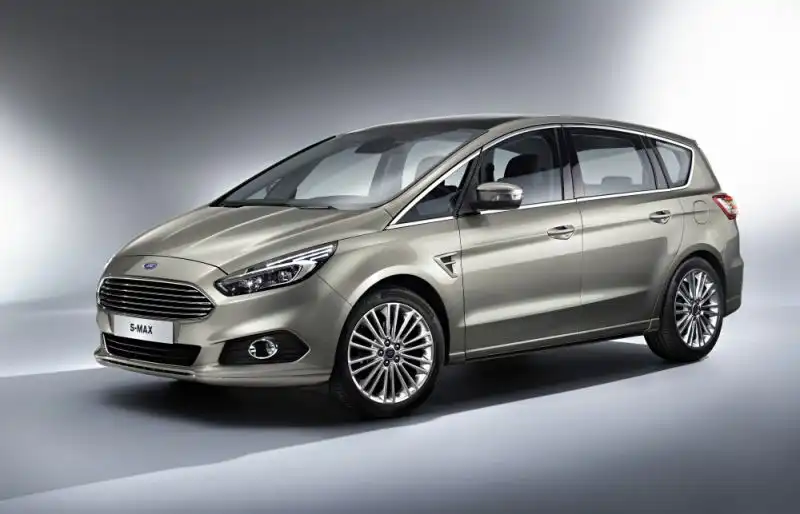
The Ford S-MAX II 2.0 TDCi 150 hp PowerShift S&S, launched in 2015, was a key component of the second-generation S-MAX range. Designed to appeal to families seeking a spacious and versatile vehicle, the S-MAX II built upon the success of the original model, offering improved styling, technology, and driving dynamics. This particular variant, powered by the 2.0-liter TDCi diesel engine paired with Ford’s six-speed PowerShift dual-clutch transmission, was positioned as a practical and economical choice within the lineup. The ‘S&S’ designation indicates the inclusion of Ford’s Auto-Start-Stop system, further enhancing fuel efficiency. It was primarily marketed in Europe, where MPVs remained a popular segment, and in select global markets.
Powertrain & Engine Architecture
At the heart of the S-MAX II 2.0 TDCi is Ford’s 1997cc four-cylinder diesel engine, identified by engine codes such as T7CI, T7CJ, T7CK, and T7CL. This engine utilizes a common-rail direct injection system, delivering fuel at extremely high pressure for optimized combustion. A turbocharger with an intercooler is employed to boost power and torque. The engine features a double overhead camshaft (DOHC) valvetrain with four valves per cylinder, contributing to its efficient operation. The 150 hp output is achieved at 3500 rpm, while peak torque of 350 Nm (258 lb-ft) is available between 2000 and 2500 rpm. This broad torque curve provides good responsiveness in everyday driving situations. The PowerShift six-speed dual-clutch transmission (DCT) is a crucial element of this variant. Unlike a traditional automatic, PowerShift offers quicker, smoother gear changes and improved fuel economy. It operates as two separate manual transmissions within one housing, pre-selecting the next gear for seamless shifts.
Driving Characteristics
The 150 hp 2.0 TDCi PowerShift combination in the S-MAX II delivers a comfortable and capable driving experience. While not as overtly sporty as higher-powered versions, it provides sufficient performance for most driving scenarios. Acceleration from 0-100 km/h (0-62 mph) takes approximately 10.8 seconds. The PowerShift transmission contributes to a smooth and refined feel, particularly during highway cruising. The gear ratios are tuned for a balance of fuel efficiency and responsiveness. Compared to the manual transmission versions of the same engine, the PowerShift offers greater convenience, especially in urban traffic. However, some drivers may prefer the more direct feel of a manual gearbox. Compared to the 210 hp bi-turbo diesel, the 150 hp version feels noticeably less powerful, particularly when fully loaded or tackling steep inclines.
Equipment & Trim Levels
The S-MAX II 2.0 TDCi 150 hp PowerShift S&S typically came equipped with a generous level of standard features. These included air conditioning, power windows, power mirrors, a basic audio system with USB connectivity, and alloy wheels. Higher trim levels, such as Titanium and Vignale, added features like leather upholstery, a more advanced infotainment system with navigation, parking sensors, a rearview camera, and automatic climate control. Optional extras included a panoramic sunroof, adaptive cruise control, and a premium sound system. Interior upholstery was typically cloth on lower trims, with leather options available on higher-spec models. The dashboard layout was modern and functional, with a focus on ergonomics.
Chassis & Braking
The S-MAX II utilizes an independent suspension setup on both the front and rear axles. The front suspension employs McPherson struts with coil springs and an anti-roll bar, while the rear features an independent multi-link suspension with coil springs. This configuration provides a good balance of ride comfort and handling. Braking duties are handled by ventilated discs on the front wheels and solid discs on the rear. Anti-lock Braking System (ABS) is standard. The S-MAX II’s chassis is designed to accommodate the vehicle’s weight and provide stable handling characteristics. Stabilizer bar thickness varied depending on the trim level, with higher trims often featuring thicker bars for reduced body roll.
Market Reception & Comparison
The Ford S-MAX II 2.0 TDCi 150 hp PowerShift S&S was generally well-received by automotive critics. It was praised for its spacious interior, comfortable ride, and fuel efficiency. The PowerShift transmission was noted for its smooth operation, although some concerns were raised regarding its long-term reliability (a common issue with early dual-clutch transmissions). Compared to other trims in the S-MAX II lineup, this variant offered a more affordable entry point while still providing a practical and well-equipped vehicle. Its fuel economy of around 5.4 l/100 km (43.6 US mpg) was competitive within the MPV segment. Compared to rivals like the Volkswagen Touran and Citroën C4 Picasso, the S-MAX II offered a more dynamic driving experience.
Legacy
The Ford S-MAX II 2.0 TDCi 150 hp PowerShift S&S remains a popular choice in the used car market. While the PowerShift transmission has been the subject of some reliability concerns, many owners have reported trouble-free operation. Regular maintenance, including fluid changes, is crucial for ensuring the longevity of the transmission. The 2.0 TDCi engine is generally considered to be robust and reliable, provided it is properly maintained. The S-MAX II’s spacious interior and versatile configuration continue to appeal to families, making it a practical and affordable option for those seeking a well-rounded MPV.