
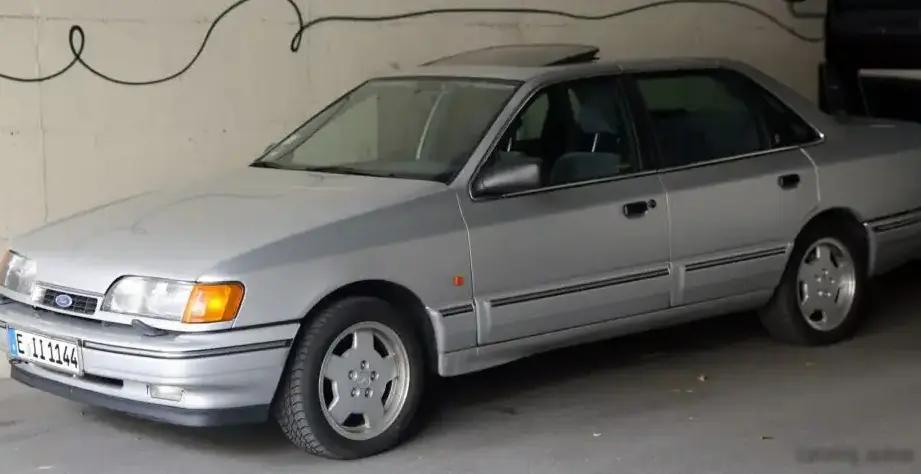
The Ford Scorpio I, produced between 1985 and 1990, represented a significant step forward for Ford’s large family car offerings in Europe. Replacing the Consul and Granada, the Scorpio aimed to blend spaciousness, comfort, and a more modern design. The 2.0i variant, powered by the NER or NRC engine, occupied a middle ground in the Scorpio lineup, offering a balance between affordability and performance. It was positioned as a more accessible option compared to the higher-specification 2.8i and 2.9i models, while still providing a more refined experience than the base 1.6-liter versions. This model was primarily aimed at families and business users seeking a comfortable and reliable saloon.
Technical Specifications
| Brand | Ford |
| Model | Scorpio |
| Generation | Scorpio I (GAE, GGE) |
| Type (Engine) | 2.0i (101 Hp) |
| Start of production | 1985 |
| End of production | 1990 |
| Powertrain Architecture | Internal Combustion engine |
| Body type | Sedan |
| Seats | 5 |
| Doors | 4 |
| Fuel Type | Petrol (Gasoline) |
| Acceleration 0 – 100 km/h | 12.3 sec |
| Acceleration 0 – 62 mph | 12.3 sec |
| Acceleration 0 – 60 mph | 11.7 sec |
| Maximum speed | 183 km/h (113.71 mph) |
| Weight-to-power ratio | 12.5 kg/Hp, 80.2 Hp/tonne |
| Weight-to-torque ratio | 8.5 kg/Nm, 117.5 Nm/tonne |
| Power | 101 Hp @ 5400 rpm |
| Power per litre | 50.7 Hp/l |
| Torque | 148 Nm @ 4000 rpm (109.16 lb.-ft. @ 4000 rpm) |
| Engine layout | Front, Longitudinal |
| Engine Model/Code | NER, NRC |
| Engine displacement | 1993 cm3 (121.62 cu. in.) |
| Number of cylinders | 4 |
| Engine configuration | Inline |
| Cylinder Bore | 90.8 mm (3.57 in.) |
| Piston Stroke | 77 mm (3.03 in.) |
| Number of valves per cylinder | 2 |
| Fuel injection system | Single-point injection |
| Engine aspiration | Naturally aspirated engine |
| Engine oil capacity | 3.8 l (4.02 US qt | 3.34 UK qt) |
| Coolant | 8 l (8.45 US qt | 7.04 UK qt) |
| Kerb Weight | 1260 kg (2777.82 lbs.) |
| Fuel tank capacity | 70 l (18.49 US gal | 15.4 UK gal) |
| Length | 4744 mm (186.77 in.) |
| Width | 1466 mm (57.72 in.) |
| Height | 1450 mm (57.09 in.) |
| Wheelbase | 2761 mm (108.7 in.) |
| Minimum turning circle | 10.4 m (34.12 ft.) |
| Drivetrain Architecture | The Internal combustion engine (ICE) drives the rear wheels of the vehicle. |
| Drive wheel | Rear wheel drive |
| Number of gears and type of gearbox | 5 gears, manual transmission |
| Front brakes | Ventilated discs |
| Rear brakes | Disc |
| Steering type | Steering rack and pinion |
| Power steering | Hydraulic Steering |
Powertrain & Engine Architecture
The heart of the Scorpio 2.0i was the Ford NER or NRC inline-four cylinder engine, displacing 1993cc. This engine utilized a single-point fuel injection system, a relatively common technology in the mid-1980s. While not as sophisticated as multi-point injection, it offered improved fuel efficiency and smoother operation compared to carbureted engines. The engine featured a two-valve per cylinder configuration and a relatively modest compression ratio, prioritizing reliability and longevity over outright performance. The engine was mounted longitudinally in the front of the vehicle, driving the rear wheels. The five-speed manual transmission was the standard offering, providing a reasonable spread of gears for both cruising and acceleration. The transmission was known for its durability, but its shift quality wasn’t particularly sporty.
Driving Characteristics
The 2.0i Scorpio offered a comfortable, if not exhilarating, driving experience. With 101 horsepower, acceleration was adequate for everyday driving, but it wasn’t a particularly quick car. The 0-60 mph time of around 11.7 seconds reflects this. The engine delivered its peak torque of 148 Nm (109.16 lb-ft) at 4000 rpm, meaning that drivers needed to rev the engine to access its full potential. Compared to the more powerful 2.8i and 2.9i models, the 2.0i felt noticeably slower, especially when fully loaded. However, the 2.0i’s lighter weight and less stressed engine contributed to better fuel economy. The rear-wheel-drive configuration provided a balanced feel, although it lacked the handling precision of more modern front-wheel-drive cars.
Equipment & Trim Levels
The Scorpio 2.0i typically came with a reasonable level of standard equipment. This included central locking, electric front windows, and a basic stereo system. Interior upholstery was typically cloth, with a durable and practical design. Higher trim levels offered options such as a sunroof, upgraded stereo, and more luxurious cloth or even leather upholstery. Air conditioning was often an optional extra. The dashboard layout was functional and straightforward, with clearly labeled controls. The Scorpio’s interior was spacious, offering ample headroom and legroom for both front and rear passengers.
Chassis & Braking
The Scorpio I utilized a traditional body-on-frame construction, providing a robust and durable chassis. The front suspension featured independent coil springs and MacPherson struts, while the rear suspension employed a live axle with coil springs. This setup prioritized ride comfort over handling sharpness. The 2.0i models were equipped with ventilated disc brakes at the front and disc brakes at the rear, providing adequate stopping power for the vehicle’s weight and performance. Hydraulic power steering was standard, making the car relatively easy to maneuver, especially at low speeds.
Market Reception & Comparison
The Scorpio 2.0i was generally well-received by automotive critics as a practical and comfortable family car. It was praised for its spacious interior, comfortable ride, and reasonable fuel economy. However, it was often criticized for its relatively uninspiring performance and somewhat dated styling. Compared to the higher-specification Scorpio models, the 2.0i offered a more affordable entry point into the range, but it lacked the performance and prestige of its more powerful siblings. The 2.0i also faced competition from other large family cars, such as the Opel/Vauxhall Senator and the Rover 800.
Legacy
The Ford Scorpio I 2.0i, while not a particularly iconic or sought-after classic, remains a relatively reliable and affordable used car. The NER and NRC engines are known for their durability, provided they have been properly maintained. Common issues include corrosion, particularly on older examples, and wear and tear on suspension components. Today, the Scorpio 2.0i represents a piece of 1980s Ford history, offering a glimpse into a time when large, comfortable saloons were the norm. Its simple mechanical design makes it relatively easy to maintain and repair, appealing to enthusiasts and those seeking a classic car experience without the complexities of modern technology.
