
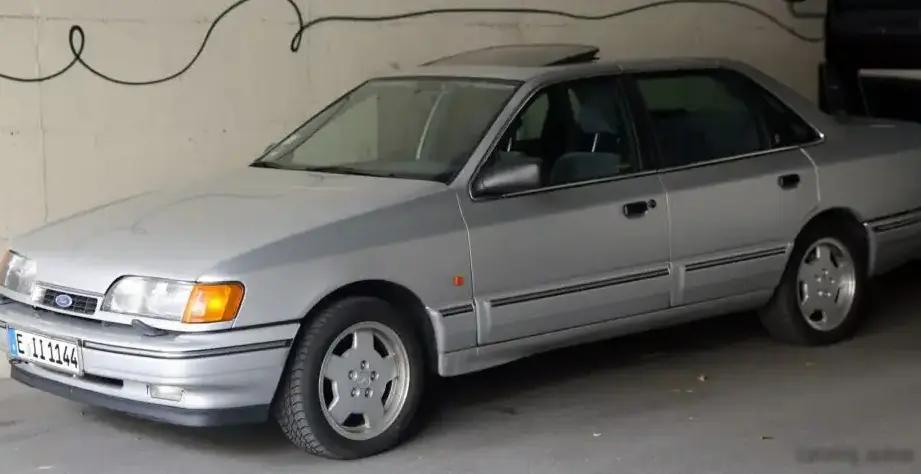
The Ford Scorpio I 2.5 TD, produced between 1993 and 1994, represented a significant offering in Ford’s European executive car lineup. Positioned as a more economical alternative to the petrol-powered versions, the 2.5 TD utilized a turbocharged diesel engine to deliver reasonable performance and improved fuel efficiency. This variant, built on the GAE/GGE platform, aimed to appeal to drivers covering long distances who prioritized practicality and running costs over outright speed. It served as a competitor to vehicles like the Opel Omega, Rover 800, and Peugeot 605 in the European market.
Technical Specifications
| Brand | Ford |
| Model | Scorpio |
| Generation | Scorpio I (GAE,GGE) |
| Type (Engine) | 2.5 TD (116 Hp) |
| Start of production | 1993 |
| End of production | 1994 |
| Powertrain Architecture | Internal Combustion engine |
| Body type | Sedan |
| Seats | 5 |
| Doors | 4 |
| Fuel Type | Diesel |
| Acceleration 0 – 100 km/h | 11.4 sec |
| Acceleration 0 – 62 mph | 11.4 sec |
| Acceleration 0 – 60 mph | 10.8 sec |
| Maximum speed | 185 km/h (114.95 mph) |
| Power | 116 Hp @ 4200 rpm |
| Power per litre | 46.4 Hp/l |
| Torque | 270 Nm @ 2000 rpm (199.14 lb.-ft. @ 2000 rpm) |
| Engine layout | Front, Longitudinal |
| Engine Model/Code | SCB |
| Engine displacement | 2500 cm3 (152.56 cu. in.) |
| Number of cylinders | 4 |
| Engine configuration | Inline |
| Cylinder Bore | 92 mm (3.62 in.) |
| Piston Stroke | 94 mm (3.7 in.) |
| Number of valves per cylinder | 2 |
| Fuel injection system | Precombustion chamber injection |
| Engine aspiration | Turbocharger |
| Valvetrain | OHC |
| Engine oil capacity | 6.6 l (6.97 US qt | 5.81 UK qt) |
| Coolant | 11 l (11.62 US qt | 9.68 UK qt) |
| Fuel tank capacity | 70 l (18.49 US gal | 15.4 UK gal) |
| Length | 4744 mm (186.77 in.) |
| Width | 1766 mm (69.53 in.) |
| Height | 1450 mm (57.09 in.) |
| Wheelbase | 2761 mm (108.7 in.) |
| Minimum turning circle | 10.4 m (34.12 ft.) |
| Drivetrain Architecture | Rear wheel drive |
| Number of gears and type of gearbox | 5 gears, manual transmission |
| Front brakes | Ventilated discs |
| Rear brakes | Disc |
| Steering type | Steering rack and pinion |
| Power steering | Hydraulic Steering |
Powertrain & Engine Architecture
The heart of the Scorpio I 2.5 TD was the SCB engine, a 2.5-liter inline-four cylinder diesel. This engine employed precombustion chamber injection, a system common in European diesels of the era. This system involved injecting fuel into a precombustion chamber connected to the main cylinder, promoting more complete combustion and reducing noise. The addition of a turbocharger significantly boosted power output to 116 horsepower at 4200 rpm and 270 Nm (199 lb-ft) of torque at 2000 rpm. The engine featured an overhead camshaft (OHC) valvetrain with two valves per cylinder. The five-speed manual transmission was the standard offering, providing a balance between fuel economy and drivability. The engine was mounted longitudinally in the front of the vehicle, driving the rear wheels.
Driving Characteristics
The 2.5 TD Scorpio offered a distinctly different driving experience compared to its petrol-powered siblings. While lacking the outright acceleration of the V6 models, the diesel provided ample torque for comfortable cruising and effortless overtaking on highways. The five-speed manual transmission allowed drivers to keep the engine in its optimal power band. The gear ratios were tuned for economy, meaning the engine didn’t rev as freely as the petrol versions. Acceleration to 60 mph took around 10.8 seconds, and top speed was limited to 185 km/h (115 mph). The rear-wheel-drive configuration provided balanced handling, although the added weight of the diesel engine and turbocharger did contribute to some understeer in hard corners.
Equipment & Trim Levels
The 2.5 TD Scorpio typically came with a reasonably well-equipped specification, though it generally sat in the mid-range of the Scorpio lineup. Standard features included central locking, power windows, and a basic stereo system. Interior upholstery was typically cloth, with options for upgraded velour or leather available. Dashboard design was functional and straightforward, prioritizing usability over luxury. Optional extras included air conditioning, a sunroof, and upgraded sound systems. The trim level often dictated the availability of these options, with higher trims offering more standard features.
Chassis & Braking
The Scorpio I utilized a traditional body-on-frame construction, providing a robust and durable chassis. The front suspension consisted of independent double wishbones, while the rear featured a live axle with coil springs. Braking was handled by ventilated discs at the front and solid discs at the rear. Hydraulic power steering was standard, making maneuvering the large sedan relatively easy. Stabilizer bars were fitted to both the front and rear axles to reduce body roll during cornering. The suspension setup was tuned for comfort, prioritizing a smooth ride over sporty handling.
Market Reception & Comparison
The Scorpio I 2.5 TD was generally well-received by automotive journalists as a practical and economical choice for long-distance drivers. Critics praised the engine’s torque and fuel efficiency, but noted that it lacked the refinement and performance of the petrol V6 models. Compared to the 2.0L petrol versions, the 2.5 TD offered significantly better fuel economy, but at the expense of acceleration. The diesel also tended to be more expensive to maintain due to the complexity of the fuel injection system and turbocharger. However, its durability and lower running costs made it a popular choice for fleet operators and private buyers alike.
Legacy
The Ford Scorpio I 2.5 TD, while not a performance icon, holds a respectable place in automotive history as a capable and reliable diesel-powered executive car. The SCB engine proved to be durable, and many examples remain on the road today. In the used car market, these Scorpios are appreciated for their affordability and practicality. However, potential buyers should be aware of the potential for age-related issues, such as turbocharger wear and fuel injection system problems. The Scorpio I 2.5 TD represents a transitional period in automotive engineering, bridging the gap between older, simpler designs and the more technologically advanced vehicles of the 1990s.
