
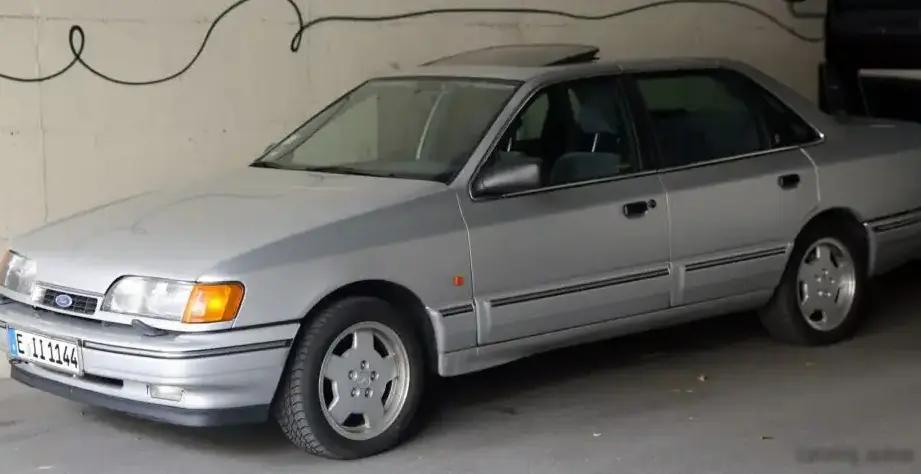
The Ford Scorpio I, specifically the 2.9i 4×4 variant produced between 1986 and 1994, represented a significant step forward for Ford’s executive car offerings in Europe. Positioned as a replacement for both the Consul and Granada models, the Scorpio aimed to compete with vehicles like the Opel Senator and Saab 9000. The 2.9i 4×4 was a higher-specification model within the Scorpio I range, offering all-wheel drive capability and a more powerful engine than the base models. It was built on the GAE/GGE platform, a rear-wheel drive chassis designed for comfort and stability, and was intended to appeal to drivers needing a blend of performance, practicality, and all-weather capability.
Technical Specifications
| Brand | Ford |
| Model | Scorpio |
| Generation | Scorpio I (GAE,GGE) |
| Type (Engine) | 2.9 i 4×4 (150 Hp) |
| Start of production | 1986 |
| End of production | 1994 |
| Powertrain Architecture | Internal Combustion engine |
| Body type | Sedan |
| Seats | 4 |
| Doors | 4 |
| Fuel Type | Petrol (Gasoline) |
| Power | 150 Hp @ 5500 rpm |
| Power per litre | 51.1 Hp/l |
| Torque | 229 Nm @ 3000 rpm / 168.9 lb.-ft. @ 3000 rpm |
| Engine layout | Front, Longitudinal |
| Engine Model/Code | BRC |
| Engine displacement | 2933 cm3 / 178.98 cu. in. |
| Number of cylinders | 6 |
| Engine configuration | V-engine |
| Cylinder Bore | 93 mm / 3.66 in. |
| Piston Stroke | 72 mm / 2.83 in. |
| Number of valves per cylinder | 2 |
| Fuel injection system | Multi-port manifold injection |
| Engine aspiration | Naturally aspirated engine |
| Valvetrain | OHC |
| Engine oil capacity | 4.3 l / 4.54 US qt | 3.78 UK qt |
| Fuel tank capacity | 70 l / 18.49 US gal | 15.4 UK gal |
| Length | 4744 mm / 186.77 in. |
| Width | 1766 mm / 69.53 in. |
| Height | 1450 mm / 57.09 in. |
| Wheelbase | 2761 mm / 108.7 in. |
| Minimum turning circle | 10.4 m / 34.12 ft. |
| Drive wheel | All wheel drive (4×4) |
| Number of gears | 5 gears, manual transmission |
| Front brakes | Ventilated discs |
| Rear brakes | Disc |
| Steering type | Steering rack and pinion |
| Power steering | Hydraulic Steering |
Powertrain & Engine Architecture
The heart of the Scorpio 2.9i 4×4 was the Ford BRC engine, a 2.9-liter, naturally aspirated V6. This engine featured a single overhead camshaft (OHC) design and multi-port fuel injection, contributing to its relatively smooth power delivery. The engine produced 150 horsepower at 5500 rpm and 229 Nm (168.9 lb-ft) of torque at 3000 rpm. The engine’s longitudinal mounting allowed for a rear-wheel-drive configuration, with power then distributed to all four wheels via a viscous coupling all-wheel-drive system. The five-speed manual transmission was standard, providing drivers with full control over the engine’s power band. The BRC engine was known for its durability, but also for its thirst for fuel, a common characteristic of larger displacement engines of the era.
Driving Characteristics
The Scorpio 2.9i 4×4 offered a comfortable and refined driving experience. The all-wheel-drive system provided enhanced traction, particularly in adverse weather conditions, making it a capable grand tourer. While not a sports car, the 150 hp engine provided adequate performance for highway cruising and overtaking. The five-speed manual transmission allowed drivers to keep the engine in its optimal power range. Compared to the lower-powered 2.0-liter versions, the 2.9i offered a noticeable improvement in acceleration and overall responsiveness. However, it wasn’t as nimble as some of its rear-wheel-drive competitors, due to its relatively large size and weight. The gear ratios were spaced to prioritize comfortable cruising rather than outright acceleration.
Equipment & Trim Levels
The 2.9i 4×4 trim level was generally well-equipped for its time. Standard features typically included central locking, electric windows, power steering, and an upgraded interior trim. Upholstery was usually cloth, but leather options were available. The dashboard featured a comprehensive instrument cluster with gauges for engine temperature, fuel level, and speedometer. Optional extras could include a sunroof, upgraded audio system, and air conditioning. The Scorpio aimed for a premium feel, with a focus on comfort and convenience for long-distance journeys.
Chassis & Braking
The Scorpio I utilized a traditional body-on-frame construction, contributing to its robust feel. The suspension consisted of independent front suspension with MacPherson struts and a live axle rear suspension with coil springs. The 2.9i 4×4 models typically featured thicker stabilizer bars compared to the base models, improving handling and reducing body roll. Braking was provided by ventilated discs on the front wheels and solid discs on the rear. Power-assisted steering was standard, making the car relatively easy to maneuver despite its size. The all-wheel-drive system added weight, which slightly impacted braking performance compared to the rear-wheel-drive versions.
Market Reception & Comparison
The Ford Scorpio I 2.9i 4×4 was generally well-received by automotive critics, who praised its comfortable ride, spacious interior, and all-weather capability. However, it was often criticized for its relatively high fuel consumption and somewhat dated styling. Compared to the 2.0-liter versions, the 2.9i offered significantly more performance, but at the cost of increased fuel bills. The 2.9i 4×4 was positioned as a premium offering, competing with vehicles like the Opel Senator and Saab 9000, but it often lacked the brand prestige of its German and Swedish rivals. Reliability was generally good, although the complexity of the fuel injection system and all-wheel-drive components could lead to higher maintenance costs.
Legacy
The Ford Scorpio I, including the 2.9i 4×4 variant, has developed a cult following among classic car enthusiasts. The BRC V6 engine is known for its durability, and parts availability remains reasonably good. While not a particularly rare car, well-maintained examples are becoming increasingly sought after. The Scorpio I represented a bold attempt by Ford to create a genuinely competitive executive car for the European market. Today, the 2.9i 4×4 is appreciated for its unique blend of performance, practicality, and all-weather capability, offering a distinctive alternative to more common classic cars of the era. The all-wheel drive system, while adding complexity, has proven to be relatively reliable over the long term, making these vehicles a viable option for those seeking a classic car that can be used year-round.
