
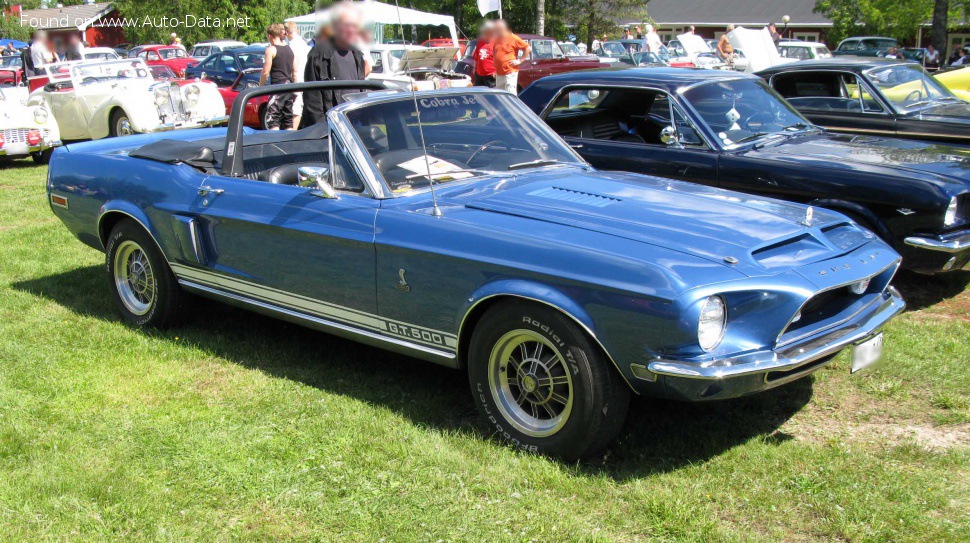
The Ford Shelby I Cabrio Cobra GT 500KR: King of the Road
The Ford Shelby I Cabrio Cobra GT 500KR, produced between 1968 and 1970, stands as an undisputed icon of the American muscle car era. Representing the pinnacle of performance and style in the first-generation Shelby Mustang lineup, the “KR” designation – short for “King of the Road” – was no idle boast. Developed in collaboration with legendary automotive designer and racer Carroll Shelby, this particular variant, the GT500KR, was introduced midway through the 1968 model year, replacing the standard GT500. It quickly cemented its place in automotive history as one of the most powerful and desirable Mustangs ever built, embodying the raw power and rebellious spirit of the late 1960s.
The Shelby Mustang program, initiated by Ford to compete with Chevrolet’s Corvette in road racing, evolved significantly over its production run. By 1968, the focus had shifted from pure racing prowess to a more refined, yet still ferociously powerful, street machine. The GT500KR convertible offered an exhilarating open-air driving experience, combining blistering straight-line performance with the visceral thrill of a top-down cruise. Its imposing presence, aggressive styling, and the thunderous roar of its massive V8 engine made it an unmistakable force on American roads, symbolizing the golden age of high-performance automobiles.
Engine and Performance: The Heart of the Ford Shelby I Cabrio Cobra GT 500KR
At the core of the Ford Shelby I Cabrio Cobra GT 500KR‘s legendary status was its formidable powertrain. This generation saw the introduction of Ford’s potent 428 cubic inch (7.0-liter) Cobra Jet V8 engine, a marvel of engineering designed to dominate drag strips and highways alike. Though officially rated by Ford at 335 horsepower, it was widely known that the true output of this engine was significantly higher, a conservative estimate often placing it closer to or exceeding the 400 horsepower mark. The provided technical data confirms a staggering 406 horsepower at 5600 rpm, a figure that truly reflects its “King of the Road” moniker.
The naturally aspirated V8 engine featured a front, longitudinal layout, ensuring optimal weight distribution for a muscle car of its era. With a compression ratio of 11.6:1 and a carbureted fuel injection system, the 428 Cobra Jet was designed for maximum power delivery, producing an immense 460.24 pound-feet of torque at a relatively low 3200 rpm. This massive torque figure was crucial for the GT500KR’s impressive acceleration, allowing it to launch with ferocity and deliver relentless pulling power across the rev range. Each of its eight cylinders housed two valves, optimized for robust performance and durability.
Power was channeled to the rear wheels via a sturdy 3-speed automatic transmission, a popular choice for drag racing and comfortable cruising, emphasizing the car’s dual nature as both a performance beast and a grand tourer. The drivetrain architecture, with its internal combustion engine driving the rear wheels, was classic American muscle, providing direct feedback and a thrilling driving experience. With a curb weight of 3730.22 pounds, the GT500KR boasted an impressive weight-to-power ratio of 4.2 kg per horsepower (or 240 horsepower per ton), underscoring its exceptional performance capabilities for its time.
Design and Features
The Ford Shelby I Cabrio Cobra GT 500KR was instantly recognizable, distinguished by its aggressive yet elegant styling that set it apart from standard Mustangs. As a two-door cabriolet, it offered seating for four, combining practicality with exhilarating open-top motoring. Its dimensions—186.61 inches in length, 70.91 inches in width, and 51.42 inches in height—gave it a substantial and imposing stance on the road, further accentuated by its wide track (58.11 inches front and rear) and a wheelbase of 107.99 inches.
Visually, the GT500KR featured numerous Shelby-specific design elements. While not explicitly detailed in the raw data, historically these included a unique fiberglass hood with functional scoops for engine cooling, prominent side scoops, sequential rear turn signals, and distinctive badging that proudly displayed the “Cobra” and “GT500KR” emblems. The convertible top added to its allure, allowing occupants to fully immerse themselves in the driving experience, accompanied by the symphony of the big V8 engine.
Mechanically, the GT500KR was equipped to handle its prodigious power. Front brakes were disc-type, offering superior stopping power compared to the drum brakes found on many contemporary vehicles. However, the rear brakes remained drums, a common configuration for the era. The robust chassis and suspension components were engineered to cope with the immense torque and horsepower, providing a balance between straight-line stability and acceptable handling for a car of its size and power. The minimum turning circle of 38.06 feet indicated its substantial turning radius, characteristic of large American vehicles from the period. The 16.91 US gallon fuel tank capacity was generous, but necessary given the thirsty nature of its high-performance V8 engine.
Technical Specifications
| Specification | Value |
|---|---|
| Brand | Ford |
| Model | Shelby |
| Generation | Shelby I Cabrio |
| Type (Engine) | Cobra GT 500KR 7.0 V8 (406 Hp) Automatic |
| Start of Production | 1968 year |
| End of Production | 1970 year |
| Powertrain Architecture | Internal Combustion engine |
| Body Type | Cabriolet |
| Seats | 4 |
| Doors | 2 |
| Performance Specs | |
| Fuel Type | Petrol (Gasoline) |
| Weight-to-Power Ratio | 4.2 kg/Hp, 240 Hp/tonne |
| Weight-to-Torque Ratio | 2.7 kg/Nm, 368.8 Nm/tonne |
| Engine Specs | |
| Power | 406 Hp @ 5600 rpm |
| Power per Liter | 58 Hp/l |
| Torque | 624 Nm @ 3200 rpm (460.24 lb.-ft. @ 3200 rpm) |
| Engine Layout | Front, Longitudinal |
| Engine Displacement | 6997 cm3 (426.98 cu. in.) |
| Number of Cylinders | 8 |
| Engine Configuration | V-engine |
| Cylinder Bore | 104.9 mm (4.13 in.) |
| Piston Stroke | 101.19 mm (3.98 in.) |
| Compression Ratio | 11.6:1 |
| Number of Valves per Cylinder | 2 |
| Fuel Injection System | Carburetor |
| Engine Aspiration | Naturally aspirated engine |
| Space, Volume and Weights | |
| Kerb Weight (Curb Weight) | 1692 kg (3730.22 lbs) |
| Fuel Tank Capacity | 64 l (16.91 US gal) |
| Dimensions | |
| Length | 4740 mm (186.61 in.) |
| Width | 1801 mm (70.91 in.) |
| Height | 1306 mm (51.42 in.) |
| Wheelbase | 2743 mm (107.99 in.) |
| Front Track | 1476 mm (58.11 in.) |
| Rear (Back) Track | 1476 mm (58.11 in.) |
| Minimum Turning Circle | 11.6 m (38.06 ft.) |
| Drivetrain, Brakes and Suspension Specs | |
| Drivetrain Architecture | The Internal combustion engine (ICE) drives the rear wheels of the vehicle. |
| Drive Wheel | Rear wheel drive |
| Number of Gears and Type of Gearbox | 3 gears, automatic transmission |
| Front Brakes | Disc |
| Rear Brakes | Drum |
Legacy and Market Impact
The Ford Shelby I Cabrio Cobra GT 500KR’s production run, though brief, left an indelible mark on automotive history. It arrived at the zenith of the muscle car wars, a period characterized by manufacturers vying for supremacy in horsepower and quarter-mile times. The GT500KR stood tall among its formidable competitors, which included legendary machines like the Chevrolet Corvette, Pontiac GTO, Plymouth Hemi ‘Cuda, and Dodge Charger R/T. What set the Shelby apart was not just its brute force, but also the prestige associated with Carroll Shelby’s name and the unique blend of Ford’s engineering might with Shelby American’s performance tuning.
Its reputation as the “King of the Road” was well-earned, reflecting its status as one of the most powerful and desirable factory-produced cars of its era. The GT500KR was more than just a fast car; it was a cultural phenomenon, appearing in films and popular media, cementing its image as the ultimate American performance machine. The limited production numbers – especially for the convertible variant – further enhanced its exclusivity and appeal, making it a highly sought-after collectible almost immediately after its discontinuation.
Today, the Shelby GT500KR remains one of the most revered and valuable classic American muscle cars. Its historical significance lies in its embodiment of a specific moment in automotive history when raw power, bold design, and the freedom of the open road converged. It showcased the pinnacle of Ford and Shelby’s collaboration, demonstrating what could be achieved when performance was the paramount objective. The enduring legacy of the Ford Shelby I Cabrio Cobra GT 500KR is not just in its impressive technical specifications, but in its ability to evoke the spirit of an era, continuing to captivate enthusiasts and collectors worldwide as a true automotive legend.
