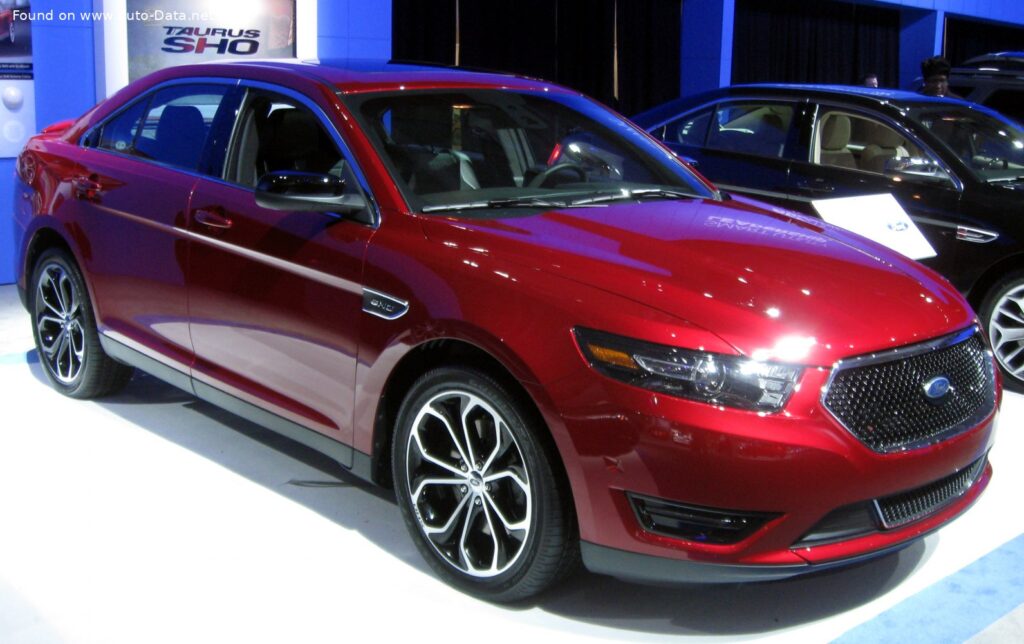
The Ford Taurus VI (facelift 2013) represents a significant iteration of Ford’s long-standing full-size sedan, a vehicle that has played a pivotal role in the American automotive landscape for decades. This particular model, produced from 2013 to 2019, featured a comprehensive refresh of the sixth generation, aiming to modernize its aesthetics, enhance its powertrain offerings, and integrate advanced technologies. Positioned as a flagship sedan in the North American market, the Taurus VI was designed to offer substantial interior space, a commanding road presence, and a comfortable, refined driving experience. It catered to a broad demographic, from families seeking a spacious and safe vehicle to individuals desiring a powerful and well-appointed cruiser. The facelifted model sought to solidify its position against key domestic and international competitors by delivering a compelling blend of performance, efficiency, and contemporary features, all while upholding the Taurus nameplate’s legacy of value and reliability.
Engine and Performance: The Duratec 35 in the Ford Taurus VI (facelift 2013)
At the heart of the Ford Taurus VI (facelift 2013) lies the formidable 3.5-liter Duratec 35 V6 engine, a powertrain renowned for its robust performance and smooth operation. This naturally aspirated, 24-valve V6 unit delivers a substantial 288 horsepower at 6500 revolutions per minute (rpm), providing ample power for both city commuting and highway cruising. The engine’s design incorporates a DOHC (Dual Overhead Camshaft) valvetrain with Ti-VCT (Twin Independent Variable Cam Timing), a sophisticated system that optimizes valve timing for improved power delivery across the rev range and enhanced fuel efficiency. Maximum torque is rated at 253.72 lb.-ft. (344 Nm) at a relatively accessible 4000 rpm, ensuring strong acceleration from a standstill and confident passing maneuvers on the open road. With a compression ratio of 10.8:1 and a multi-port manifold injection system, the Duratec 35 is engineered for efficient combustion and responsive throttle input.
Power is channeled to the front wheels through a smooth and responsive 6-speed SelectShift automatic transmission. This advanced gearbox allows for seamless automatic shifts, but also provides the driver with the option of manual gear selection for a more engaging driving experience, a feature particularly appreciated by enthusiasts. The front-wheel-drive architecture contributes to stable handling and predictable dynamics, especially in adverse weather conditions. The vehicle’s weight-to-power ratio stands at 6.3 kg/Hp (approximately 160 Hp per tonne), while the weight-to-torque ratio is 5.2 kg/Nm (191.1 Nm per tonne), indicating a balanced approach to performance that prioritizes both acceleration and cruising capability for a vehicle of its size. The engine’s displacement of 3496 cubic centimeters (213.34 cubic inches) and six-cylinder V-configuration further underscore its capacity for refined power.
Despite its substantial power output, the Ford Taurus VI (facelift 2013) also demonstrates a commendable effort towards fuel economy for a full-size sedan of its era. The combined fuel consumption is rated at 10.2 liters per 100 kilometers, which translates to an estimated 23.1 US miles per gallon. In urban driving conditions, the Taurus achieves approximately 19.1 US mpg (12.3 l/100 km), while extra-urban driving sees an improved figure of 29 US mpg (8.1 l/100 km). These figures highlight Ford’s commitment to balancing performance with everyday running costs, making the Taurus a practical choice for long-distance travel and daily commutes alike. The 19.02 US gallon (72 liter) fuel tank further extends its range between fill-ups, enhancing its appeal as a long-haul cruiser.
Design and Features of the Ford Taurus VI (facelift 2013)
The Ford Taurus VI (facelift 2013) presented a bold and muscular design aesthetic, characterizing it as a quintessential American full-size sedan. Measuring an imposing 202.91 inches (5154 mm) in length, 76.18 inches (1935 mm) in width, and 60.71 inches (1542 mm) in height, the Taurus commanded a significant road presence. Its long wheelbase of 112.91 inches (2868 mm) contributed not only to its stable ride but also to a remarkably spacious interior, comfortably accommodating five occupants across its four doors. The sedan body style emphasized practicality, offering generous head and legroom for all passengers, a hallmark of its segment.
Visually, the facelift brought sharper lines, a more aggressive grille, and updated lighting elements, giving the Taurus a more contemporary and sophisticated look. The vehicle’s aerodynamic profile, indicated by a drag coefficient (Cd) of 0.3, was carefully sculpted to reduce wind resistance, contributing to both fuel efficiency and a quieter cabin at highway speeds. Standard equipment included 19-inch wheels wrapped in 255/45 R19 tires, which not only filled the wheel wells effectively but also provided a confident grip and enhanced the vehicle’s assertive stance.
Inside, the Taurus VI offered a cavernous trunk space of 20.09 cubic feet (569 liters), making it exceptionally practical for family vacations, grocery runs, or hauling luggage. This ample storage capacity was a key selling point for a vehicle designed to serve as a versatile family hauler. The vehicle’s curb weight of 3968.32 pounds (1800 kg) underscored its solid construction and robust feel. For safety and control, the Taurus was equipped with a comprehensive braking system featuring ventilated discs at the front and solid discs at the rear, complemented by an Anti-lock Braking System (ABS) as a standard assisting system. The steering system utilized a rack and pinion setup, offering precise and predictable control, further enhancing the driving experience. The minimum turning circle of 39.7 feet (12.1 meters) was commendable for a vehicle of its size, aiding maneuverability in urban environments.
Technical Specifications
| Brand | Ford |
| Model | Taurus |
| Generation | Taurus VI (facelift 2013) |
| Type (Engine) | 3.5 V6 24V (288 Hp) Automatic |
| Start of production | 2013 year |
| End of production | 2019 year |
| Powertrain Architecture | Internal Combustion engine |
| Body type | Sedan |
| Seats | 5 |
| Doors | 4 |
| Fuel consumption (economy) – urban | 12.3 l/100 km (19.1 US mpg) |
| Fuel consumption (economy) – extra urban | 8.1 l/100 km (29 US mpg) |
| Fuel consumption (economy) – combined | 10.2 l/100 km (23.1 US mpg) |
| Fuel Type | Gasoline |
| Weight-to-power ratio | 6.3 kg/Hp (160 Hp/tonne) |
| Weight-to-torque ratio | 5.2 kg/Nm (191.1 Nm/tonne) |
| Power | 288 Hp @ 6500 rpm |
| Power per liter | 82.4 Hp/l |
| Torque | 344 Nm (253.72 lb.-ft.) @ 4000 rpm |
| Engine Model/Code | Duratec 35 |
| Engine displacement | 3496 cm3 (213.34 cu. in.) |
| Number of cylinders | 6 |
| Engine configuration | V-engine |
| Cylinder Bore | 92.5 mm (3.64 in.) |
| Piston Stroke | 86.7 mm (3.41 in.) |
| Compression ratio | 10.8:1 |
| Number of valves per cylinder | 4 |
| Fuel injection system | Multi-port manifold injection |
| Engine aspiration | Naturally aspirated engine |
| Valvetrain | DOHC, Ti-VCT |
| Engine oil capacity | 5.7 l (6.02 US qt) |
| Coolant | 10.5 l (11.1 US qt) |
| Curb Weight | 1800 kg (3968.32 lbs.) |
| Trunk (boot) space – minimum | 569 l (20.09 cu. ft.) |
| Fuel tank capacity | 72 l (19.02 US gal) |
| Length | 5154 mm (202.91 in.) |
| Width | 1935 mm (76.18 in.) |
| Width with mirrors folded | 1963 mm (77.28 in.) |
| Width including mirrors | 2177 mm (85.71 in.) |
| Height | 1542 mm (60.71 in.) |
| Wheelbase | 2868 mm (112.91 in.) |
| Front track | 1659 mm (65.31 in.) |
| Rear (Back) track | 1664 mm (65.51 in.) |
| Drag coefficient (Cd) | 0.3 |
| Minimum turning circle (turning diameter) | 12.1 m (39.7 ft.) |
| Drivetrain Architecture | The Internal combustion engine (ICE) drives the front wheels of the vehicle. |
| Drive wheel | Front wheel drive |
| Number of gears and type of gearbox | 6 gears, automatic transmission SelectShift |
| Front brakes | Ventilated discs |
| Rear brakes | Disc |
| Assisting systems | ABS (Anti-lock braking system) |
| Steering type | Steering rack and pinion |
| Tires size | 255/45 R19 |
| Wheel rims size | 19 |