The Ford Taurus, a nameplate synonymous with American full-size sedans for decades, received a significant update for its sixth generation in 2013. Among its various trims, the
Ford Taurus VI (facelift 2013) SHO 3.5 V6 (365 Hp) AWD Automatic
stood out as the pinnacle of performance and luxury, embodying Ford’s commitment to offering a powerful, yet refined, driving experience. Produced from 2013 to 2019, this iteration of the Taurus SHO (Super High Output) was designed to appeal to buyers seeking a spacious sedan with the heart of a sports car. Positioned as a flagship performance model within Ford’s North American lineup, it blended aggressive styling cues with an advanced powertrain, making it a compelling option in the segment for those desiring a blend of executive comfort and exhilarating power. Its all-wheel-drive architecture and sophisticated engine technology underscored its role as a modern, high-performance sedan capable of challenging more expensive European and Japanese rivals, particularly in its primary market, the United States.
Engine and Performance of the Ford Taurus VI (facelift 2013) SHO 3.5 V6 (365 Hp) AWD Automatic
At the core of the Ford Taurus VI (facelift 2013) SHO’s formidable capabilities lies its advanced 3.5-liter EcoBoost V6 engine. This powertrain architecture, an internal combustion engine, generates an impressive 365 horsepower at 5500 rpm, translating to a robust 104.4 horsepower per liter—a significant figure for a full-size sedan. The engine’s strength is further amplified by its twin-turbocharging and intercooling system, which works in conjunction with a direct fuel injection system to optimize combustion efficiency and power delivery across a broad rev range. Torque output is equally impressive, peaking at 475 Nm (350.34 lb.-ft.) available from a remarkably low 1500 rpm all the way up to 5250 rpm. This wide torque band ensures immediate and sustained acceleration, making the SHO responsive in diverse driving conditions, whether navigating city streets or cruising on the highway.
The engine itself is a V-configuration six-cylinder unit, featuring a DOHC (Double Overhead Camshaft) valvetrain with Ford’s Ti-VCT (Twin Independent Variable Cam Timing) technology. This sophisticated valvetrain precisely controls valve overlap, enhancing both power and fuel efficiency. With a compression ratio of 10:1 and four valves per cylinder, the engine is designed for optimal breathing and thermal management, contributing to its high performance and durability. The maximum engine speed is rated at 6200 rpm, allowing for spirited driving dynamics. Power is seamlessly managed by a 6-speed SelectShift automatic transmission, which offers drivers the option of manual gear selection for a more engaging experience. This transmission, combined with an intelligent All-Wheel Drive (AWD) system, ensures that the engine’s substantial power is effectively transferred to the pavement, providing superior traction and stability, especially in adverse weather conditions or during aggressive cornering. The AWD system is a key differentiator, enhancing the SHO’s performance credentials and driver confidence.
Despite its potent performance, the Ford Taurus SHO also demonstrated reasonable fuel economy for its class, particularly considering its weight and power output. The combined fuel consumption is rated at 11.7 liters per 100 km, which translates to approximately 20.1 US mpg. Urban driving yields 13.8 l/100 km (17 US mpg), while extra-urban conditions see a more efficient 9.4 l/100 km (25 US mpg). These figures underscore the balance Ford sought to achieve between exhilarating performance and everyday usability. The vehicle’s curb weight of 1970 kg (4343.11 lbs.) results in a weight-to-power ratio of 5.4 kg/Hp and a weight-to-torque ratio of 4.1 kg/Nm, highlighting its robust construction and the effectiveness of its potent powertrain in moving its mass with authority. The large 72-liter (19.02 US gal) fuel tank also ensures a respectable cruising range.
Design and Key Features
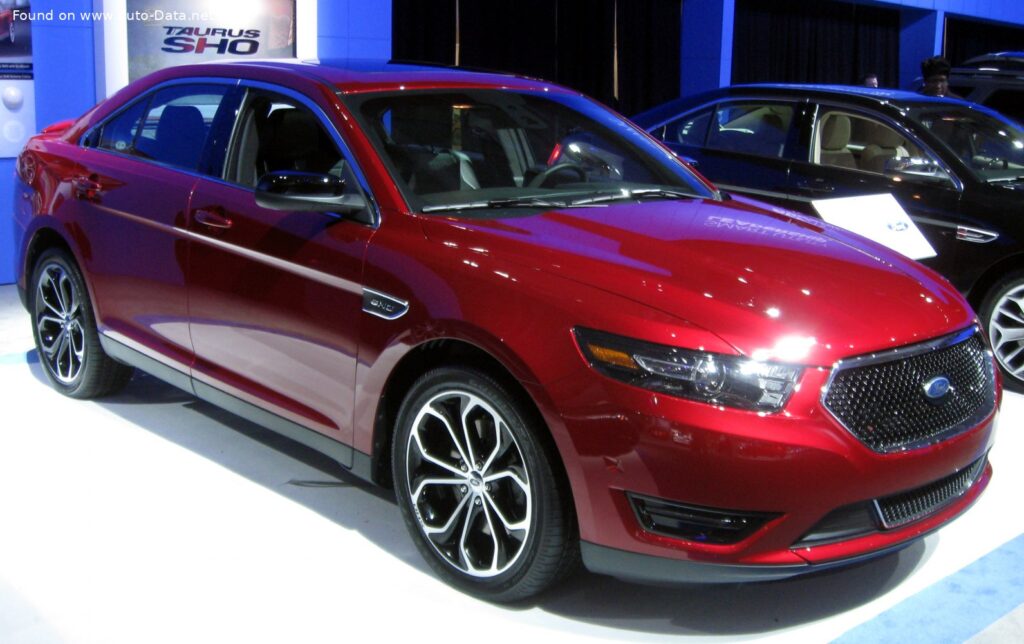
The Ford Taurus VI (facelift 2013) presented a bold and muscular design language, further accentuated in the SHO variant. As a full-size sedan, it commanded a significant road presence, measuring 5154 mm (202.91 inches) in length, 1935 mm (76.18 inches) in width (2177 mm or 85.71 inches including mirrors), and 1542 mm (60.71 inches) in height. Its substantial 2868 mm (112.91 inches) wheelbase contributed to both a stable ride and a spacious interior, comfortably accommodating five occupants across its two rows of seating. The four-door body type provided easy access to the cabin, which, in the SHO trim, featured enhanced materials and specific performance-oriented styling cues, though not explicitly detailed in the technical data provided.
The exterior facelift for 2013 brought a more refined yet aggressive aesthetic, including a redesigned front fascia with a more prominent grille and updated lighting, giving the SHO a distinctive and imposing look. The vehicle’s aerodynamic efficiency was respectable for a sedan of its size, boasting a drag coefficient (Cd) of 0.3. This low figure contributed to both fuel economy and reduced wind noise at higher speeds. The generous trunk space of 569 liters (20.09 cu. ft.) was a significant practical advantage, offering ample room for luggage, groceries, or sports equipment, a typical expectation for a full-size American sedan.
In terms of chassis and braking, the Ford Taurus SHO was equipped to handle its performance capabilities. Both the front and rear axles featured ventilated disc brakes, ensuring strong and consistent stopping power, an essential safety feature for a vehicle of this caliber. An Anti-lock Braking System (ABS) was standard, providing enhanced control during emergency braking maneuvers. The steering system utilized a precise rack and pinion setup, contributing to responsive handling and a direct feel. The vehicle rode on 19-inch wheel rims, shod with 255/45 R19 tires, a combination chosen to optimize grip, handling, and ride comfort. The wide tires and substantial wheel size visually underscored the SHO’s performance intentions and provided a firm foundation for its dynamic capabilities. The minimum turning circle of 12.1 meters (39.7 feet) was also typical for a vehicle of its dimensions, allowing for reasonable maneuverability despite its large footprint.
Technical Specifications
| Brand | Ford |
| Model | Taurus |
| Generation | Taurus VI (facelift 2013) |
| Type (Engine) | SHO 3.5 V6 (365 Hp) AWD Automatic |
| Start of production | 2013 year |
| End of production | 2019 year |
| Powertrain Architecture | Internal Combustion engine |
| Body type | Sedan |
| Seats | 5 |
| Doors | 4 |
| Fuel consumption (economy) – urban | 13.8 l/100 km (17 US mpg, 20.5 UK mpg) |
| Fuel consumption (economy) – extra urban | 9.4 l/100 km (25 US mpg, 30.1 UK mpg) |
| Fuel consumption (economy) – combined | 11.7 l/100 km (20.1 US mpg, 24.1 UK mpg) |
| Fuel Type | Petrol (Gasoline) |
| Weight-to-power ratio | 5.4 kg/Hp, 185.3 Hp/tonne |
| Weight-to-torque ratio | 4.1 kg/Nm, 241.1 Nm/tonne |
| Power | 365 Hp @ 5500 rpm. |
| Power per litre | 104.4 Hp/l |
| Torque | 475 Nm @ 1500-5250 rpm (350.34 lb.-ft.) |
| Maximum engine speed | 6200 rpm. |
| Engine displacement | 3496 cm3 (213.34 cu. in.) |
| Number of cylinders | 6 |
| Engine configuration | V-engine |
| Cylinder Bore | 92.5 mm (3.64 in.) |
| Piston Stroke | 86.7 mm (3.41 in.) |
| Compression ratio | 10:1 |
| Number of valves per cylinder | 4 |
| Fuel injection system | Direct injection |
| Engine aspiration | Twin-Turbo, Intercooler |
| Valvetrain | DOHC, Ti-VCT |
| Engine oil capacity | 5.7 l (6.02 US qt, 5.02 UK qt) |
| Coolant | 10.8 l (11.41 US qt, 9.5 UK qt) |
| Kerb Weight | 1970 kg (4343.11 lbs.) |
| Trunk (boot) space – minimum | 569 l (20.09 cu. ft.) |
| Fuel tank capacity | 72 l (19.02 US gal, 15.84 UK gal) |
| Length | 5154 mm (202.91 in.) |
| Width | 1935 mm (76.18 in.) |
| Width with mirrors folded | 1963 mm (77.28 in.) |
| Width including mirrors | 2177 mm (85.71 in.) |
| Height | 1542 mm (60.71 in.) |
| Wheelbase | 2868 mm (112.91 in.) |
| Front track | 1659 mm (65.31 in.) |
| Rear (Back) track | 1664 mm (65.51 in.) |
| Drag coefficient (Cd) | 0.3 |
| Minimum turning circle (turning diameter) | 12.1 m (39.7 ft.) |
| Drive wheel | All wheel drive (4×4) |
| Number of gears and type of gearbox | 6 gears, automatic transmission SelectShift |
| Front brakes | Ventilated discs |
| Rear brakes | Ventilated discs |
| Assisting systems | ABS (Anti-lock braking system) |
| Steering type | Steering rack and pinion |
| Tires size | 255/45 R19 |
| Wheel rims size | 19 |