The Ford Taurus VII (China) EcoBoost 245 represents a significant iteration of Ford’s long-standing Taurus nameplate, specifically engineered and manufactured for the discerning Chinese automotive market. Launched in November 2015 and produced through August 2019, this generation of the Taurus diverged considerably from its North American counterparts, offering a distinct blend of luxury, space, and modern powertrain technology tailored to Asian consumer preferences for larger, more upscale sedans. Positioned in the competitive executive sedan segment, the Ford Taurus VII (China) EcoBoost 245 was designed to appeal to buyers seeking sophisticated styling, a comfortable and spacious interior, and robust, yet efficient, performance, underscoring Ford’s strategic commitment to global market diversification.
Powertrain and Performance of the Ford Taurus VII (China) EcoBoost 245
At the heart of the Ford Taurus VII (China) EcoBoost 245 lies a highly advanced 2.0-liter EcoBoost inline-four engine. This powerplant, a testament to Ford’s commitment to efficiency and performance through forced induction, features a twin-scroll turbocharger and an intercooler, combined with a direct fuel injection system. These technologies work in concert to deliver a commendable 245 horsepower at 5500 rpm, translating to a substantial power output of 122.6 horsepower per liter. The engine’s robust torque delivery is equally impressive, peaking at 258.15 lb.-ft. across a broad range from 1750 to 4500 rpm. This wide torque band ensures responsive acceleration and flexible power delivery in various driving conditions, from city commuting to highway cruising.
The performance metrics for the Ford Taurus VII (China) EcoBoost 245 reflect its capable powertrain. The sedan can accelerate from 0 to 60 mph in a swift 7.5 seconds, with a 0-100 km/h sprint completed in 7.9 seconds. Its top speed is electronically limited to 135.46 mph (218 km/h), a respectable figure for a vehicle in its class. Power is channeled to the front wheels via a 6-speed manual transmission, a choice that offers a more engaging driving experience for those who prefer greater control over gear selection, even in a luxury-oriented sedan. This drivetrain architecture, combined with the engine’s transverse layout, optimizes interior space while maintaining efficient power transfer.
Fuel economy for the Ford Taurus VII (China) EcoBoost 245 is rated between 29.8 and 28.7 US mpg combined, a highly competitive figure for a vehicle of its size and power, especially considering its target market. This efficiency is a direct benefit of the EcoBoost technology, which effectively balances power output with reduced fuel consumption and emissions. Adhering to the China V emission standard, the vehicle demonstrates Ford’s commitment to environmental responsibility within the regulatory framework of its primary market. The engine’s oil capacity stands at 5.2 liters (5.49 US quarts), with a coolant capacity of 9.4 liters (9.93 US quarts), indicating a well-engineered thermal management system crucial for turbocharged engines.
Design and Features
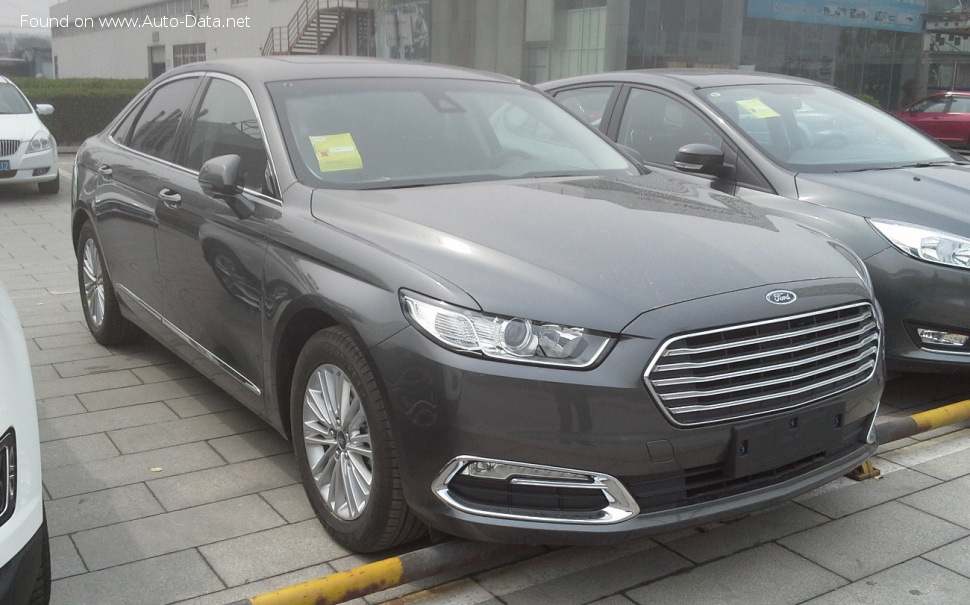
The Ford Taurus VII (China) EcoBoost 245 distinguishes itself with a stately and elegant design, characteristic of executive sedans popular in the Chinese market. As a four-door sedan with seating for five, it emphasizes passenger comfort and a refined aesthetic. The vehicle’s dimensions are generous, measuring 196.69 inches in length, 73.94 inches in width, and 59.17 inches in height. A substantial wheelbase of 116.1 inches contributes significantly to both interior cabin space and ride stability, a paramount consideration for rear-seat passengers often chauffeured in this segment.
Externally, the Taurus VII (China) featured a contemporary Ford design language, incorporating sophisticated lines and a commanding presence on the road. The front fascia typically included a prominent grille and sleek headlamps, projecting an aura of modernity and confidence. Depending on the trim, the vehicle was available with tire sizes ranging from 235/50 R18 to 245/45 R19, mounted on 18-inch or 19-inch wheel rims, which not only enhance the vehicle’s aesthetic appeal but also contribute to its handling dynamics and ride comfort. The ground clearance of 5.24 inches (133 mm) is adequate for urban driving, while a minimum turning circle of 38.39 feet (11.7 meters) ensures maneuverability despite its large footprint.
Inside, the focus was on comfort, connectivity, and premium materials. While specific interior features like infotainment systems and luxury appointments are not detailed in the provided data, the vehicle’s market positioning suggests a host of modern conveniences expected in an executive sedan of its era. Safety was a key consideration, with the Anti-lock Braking System (ABS) listed as a standard assisting system, providing crucial stability and control during emergency braking maneuvers. The spacious trunk offers a minimum volume of 18.86 cubic feet (534 liters), providing ample cargo capacity for luggage or business needs. The fuel tank capacity of 16.91 US gallons (64 liters) ensures a respectable cruising range, further enhancing the vehicle’s suitability for long-distance travel. With a curb weight ranging from 3847.07 to 3955.09 lbs and a maximum load capacity of 826.73 to 934.76 lbs, the Taurus VII (China) EcoBoost 245 was engineered to accommodate its occupants and their cargo with ease and confidence.
Technical Specifications: Ford Taurus VII (China) EcoBoost 245 (245 Hp)
| Brand | Ford |
| Model | Taurus |
| Generation | Taurus VII (China) |
| Type (Engine) | EcoBoost 245 (245 Hp) |
| Start of Production | November, 2015 year |
| End of Production | August, 2019 year |
| Powertrain Architecture | Internal Combustion engine |
| Body Type | Sedan |
| Seats | 5 |
| Doors | 4 |
| Fuel Consumption (Combined) | 29.8 – 28.7 US mpg (7.9-8.2 l/100 km) |
| Fuel Type | Petrol (Gasoline) |
| Acceleration 0 – 60 mph | 7.5 sec |
| Acceleration 0 – 100 km/h | 7.9 sec |
| Maximum Speed | 135.46 mph (218 km/h) |
| Emission Standard | China V |
| Weight-to-Power Ratio | 7.1 kg/Hp, 140.4 Hp/tonne |
| Weight-to-Torque Ratio | 5 kg/Nm, 200.6 Nm/tonne |
| Power | 245 Hp @ 5500 rpm |
| Power per Liter | 122.6 Hp/l |
| Torque | 258.15 lb.-ft. @ 1750-4500 rpm (350 Nm) |
| Maximum Engine Speed | 6500 rpm |
| Engine Layout | Front, Transverse |
| Engine Displacement | 121.99 cu. in. (1999 cm3) |
| Number of Cylinders | 4 |
| Engine Configuration | Inline |
| Compression Ratio | 9.7:1 |
| Number of Valves per Cylinder | 4 |
| Fuel Injection System | Direct injection |
| Engine Aspiration | Twin-scroll turbo, Intercooler |
| Engine Oil Capacity | 5.49 US qt (5.2 l) |
| Coolant | 9.93 US qt (9.4 l) |
| Kerb Weight | 3847.07 – 3955.09 lbs (1745-1794 kg) |
| Max. Weight | 4781.83 lbs (2169 kg) |
| Max Load | 826.73 – 934.76 lbs (375-424 kg) |
| Trunk (Boot) Space – Minimum | 18.86 cu. ft. (534 l) |
| Fuel Tank Capacity | 16.91 US gal (64 l) |
| Length | 196.69 in. (4996 mm) |
| Width | 73.94 in. (1878 mm) |
| Height | 59.17 in. (1503 mm) |
| Wheelbase | 116.1 in. (2949 mm) |
| Front Track | 63.31 in. (1608 mm) |
| Rear (Back) Track | 63.7 in. (1618 mm) |
| Ride Height (Ground Clearance) | 5.24 in. (133 mm) |
| Minimum Turning Circle | 38.39 ft. (11.7 m) |
| Drivetrain Architecture | The Internal combustion engine (ICE) drives the front wheels of the vehicle. |
| Drive Wheel | Front wheel drive |
| Number of Gears and Type of Gearbox | 6 gears, manual transmission |
| Assisting Systems | ABS (Anti-lock braking system) |
| Tires Size | 235/50 R18; 245/45 R19 |
| Wheel Rims Size | 18; 19 |