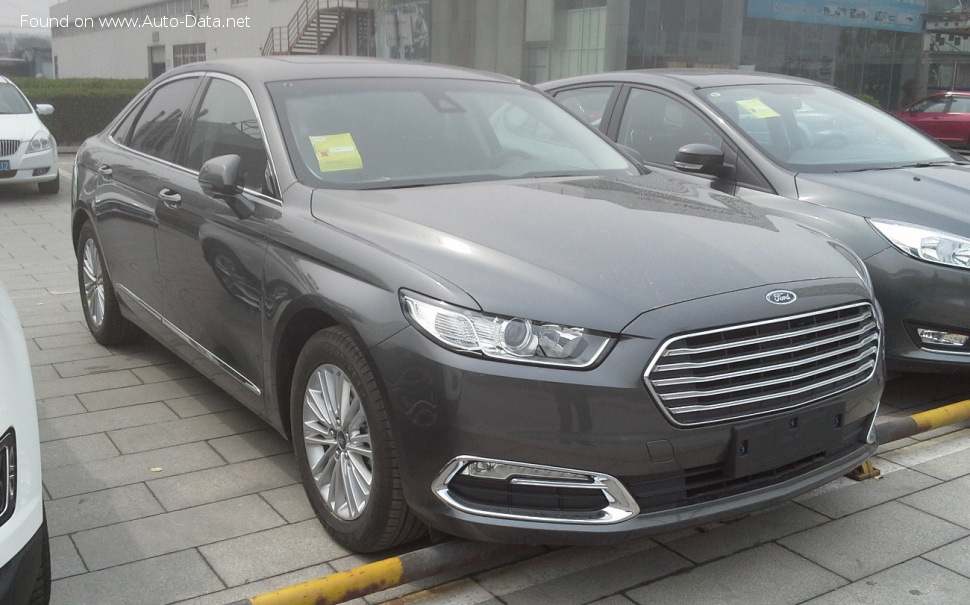
The Ford Taurus, a nameplate long synonymous with American automotive history, took on a distinct identity for the Chinese market with the introduction of the seventh generation, specifically the Ford Taurus VII (China) EcoBoost 325 V6 (329 Hp). Launched in November 2015 and produced through March 2018, this iteration of the Taurus was not merely a rebadged version of its North American counterpart but a purpose-built executive sedan tailored to the discerning preferences of Chinese consumers. Positioned in the highly competitive full-size sedan segment, this model emphasized spaciousness, sophisticated technology, and robust performance, aiming to cater to both business executives and affluent families seeking a premium driving experience. Unlike the more mass-market approach of the US Taurus, the Chinese variant was conceived to offer a more upscale and refined proposition, reflecting the growing demand for luxury and comfort in one of the world’s largest automotive markets. Its development underscored Ford’s strategy to localize products to meet regional demands, creating a vehicle that, while bearing a familiar name, offered a uniquely tailored package designed for its specific audience.
Engine & Performance of the Ford Taurus VII (China)
At the heart of the Ford Taurus VII (China) EcoBoost 325 V6 (329 Hp) lies a formidable powertrain engineered for both exhilarating performance and reasonable efficiency. This variant is equipped with a 2.7-liter (2694 cm3 or 164.4 cu. in.) EcoBoost V6 engine, a testament to Ford’s commitment to advanced engine technology. The engine features a V-engine configuration with six cylinders and four valves per cylinder, optimizing airflow and combustion efficiency. Utilizing a direct injection fuel system, coupled with a sophisticated twin-turbocharger setup and an intercooler, this engine delivers an impressive 329 horsepower at 5500 rpm. This power output, translating to a robust 122.1 Hp per liter, positions the Taurus as a strong contender in its class, offering substantial acceleration and effortless highway cruising.
Torque delivery is equally impressive, with a peak of 350.34 lb.-ft. (475 Nm) available across a broad rev range from 2500 to 4500 rpm. This wide torque band ensures responsive acceleration from low speeds and strong mid-range pull, making for a highly engaging driving experience. The vehicle’s performance metrics are noteworthy for a full-size sedan, with an acceleration time of 0 to 60 mph in a brisk 6.6 seconds, and a top speed electronically limited to 145.4 mph (234 km/h). These figures underscore the performance-oriented nature of the EcoBoost 325 V6 engine, allowing the Taurus to confidently handle various driving scenarios, from urban commutes to high-speed motorway travel.
Despite its potent performance, the EcoBoost 325 V6 also demonstrates a commendable balance with fuel economy. The combined fuel consumption is rated at 25.6 US mpg (9.2 l/100 km), which is quite respectable for a vehicle of its size and power output, especially considering its internal combustion engine powertrain architecture. The engine operates on gasoline and adheres to China V emission standards, reflecting the environmental regulations prevalent during its production period. Power is sent to the front wheels via a 6-speed manual transmission, a rather distinctive choice for a large executive sedan in this era and market, where automatic transmissions are typically standard. This manual gearbox suggests a particular focus on driver engagement or potentially a specific variant aimed at enthusiasts, offering precise control over the engine’s considerable output. With a curb weight of 4133.67 lbs. (1875 kg), the Taurus achieves a weight-to-power ratio of 5.7 kg/Hp (175.5 Hp/tonne) and a weight-to-torque ratio of 3.9 kg/Nm (253.3 Nm/tonne), indicating efficient utilization of its power and torque capabilities.
Design & Features of the Ford Taurus VII (China)
The design of the Ford Taurus VII (China) reflects a deliberate effort to create a commanding and sophisticated presence on the road, perfectly aligning with the preferences of the Chinese executive sedan market. As a traditional 4-door, 5-seat sedan, it embodies classic proportions while incorporating Ford’s contemporary design language. Measuring an expansive 196.69 inches (4996 mm) in length, 73.94 inches (1878 mm) in width, and 59.17 inches (1503 mm) in height, the Taurus projects an imposing stance. Its substantial wheelbase of 116.1 inches (2949 mm) is particularly significant, contributing directly to the vehicle’s impressive interior space, especially for rear passengers—a critical consideration in the Chinese market where chauffeured driving is common among executives.
The exterior styling features clean lines and a bold front fascia, likely dominated by a prominent grille and sophisticated lighting elements that convey a sense of prestige. The generous dimensions not only promise a spacious cabin but also contribute to a smooth and stable ride. With a front track of 63.31 inches (1608 mm) and a rear track of 63.7 inches (1618 mm), the vehicle maintains excellent road presence and stability. The minimum turning circle of 38.39 ft (11.7 m) is respectable for a vehicle of this size, aiding maneuverability in urban environments, while a ground clearance of 5.24 inches (133 mm) is adequate for typical paved roads.
Inside, the Ford Taurus VII (China) was designed with an emphasis on comfort, refinement, and technological integration. While specific interior features are not detailed in the provided data, one can infer from its market positioning that it would have offered high-quality materials, ergonomic seating, and advanced infotainment options for its time. The ample trunk space of 18.86 cu. ft. (534 liters) further enhances its practicality, accommodating luggage for business trips or family outings with ease. Safety was also a key consideration, with the inclusion of an Anti-lock Braking System (ABS) as a standard assisting system. Given its production period and market, it is highly probable that other safety features such as multiple airbags, electronic stability control, and potentially driver-assistance systems were also part of the package, ensuring occupant protection. The vehicle was offered with tire sizes 2