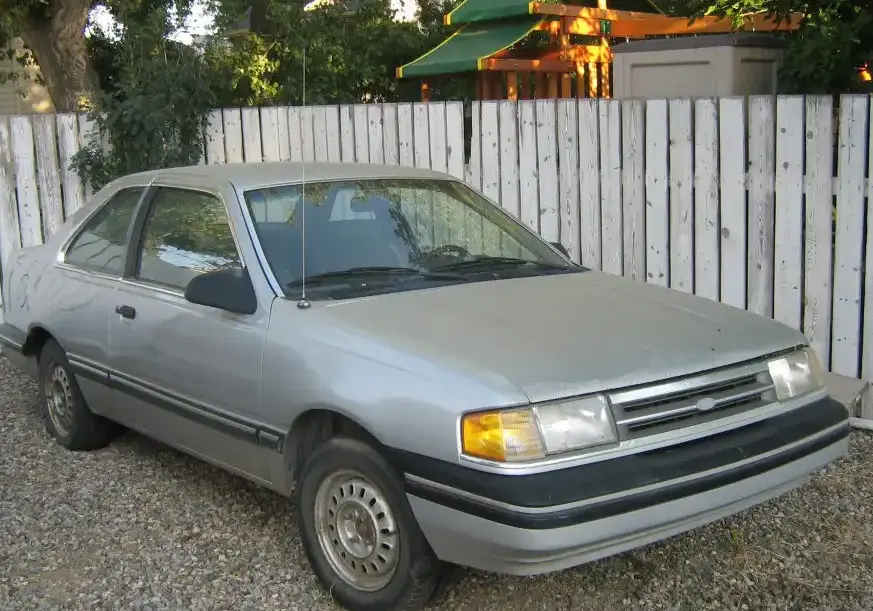
The Ford Tempo 2.3, producing 102 horsepower, was a mainstay of the Ford lineup from 1987 through 1995. Positioned as a compact sedan, it represented Ford’s attempt to offer an affordable and fuel-efficient vehicle in a market increasingly demanding both. The Tempo, and its sister car the Mercury Topaz, were built on the Ford FN platform, and were intended to replace the aging Ford Fairmont and Mercury Zephyr. The 2.3-liter engine variant occupied a middle ground in the Tempo range, offering a balance between performance and economy, slotting above the base 1.9-liter engine and below the optional 3.0-liter V6.
Technical Specifications
| Brand | Ford |
| Model | Tempo |
| Generation | Tempo |
| Type (Engine) | 2.3 (102 Hp) |
| Start of production | 1987 |
| End of production | 1995 |
| Powertrain Architecture | Internal Combustion engine |
| Body type | Sedan |
| Seats | 5 |
| Doors | 4 |
| Fuel consumption (urban) | 11 l/100 km (21.4 US mpg) |
| Fuel consumption (extra urban) | 7 l/100 km (33.6 US mpg) |
| Fuel Type | Petrol (Gasoline) |
| Maximum speed | 160 km/h (99.42 mph) |
| Weight-to-power ratio | 11.6 kg/Hp |
| Weight-to-torque ratio | 6.7 kg/Nm |
| Power | 102 Hp @ 4400 rpm |
| Power per litre | 44.2 Hp/l |
| Torque | 176 Nm @ 2600 rpm (129.81 lb.-ft. @ 2600 rpm) |
| Engine layout | Front, Transverse |
| Engine displacement | 2307 cm3 (140.78 cu. in.) |
| Number of cylinders | 4 |
| Engine configuration | Inline |
| Cylinder Bore | 93.5 mm (3.68 in.) |
| Piston Stroke | 84 mm (3.31 in.) |
| Compression ratio | 9:1 |
| Number of valves per cylinder | 4 |
| Fuel injection system | Multi-port manifold injection |
| Engine aspiration | Naturally aspirated engine |
| Valvetrain | OHC |
| Engine oil capacity | 4.7 l (4.97 US qt | 4.14 UK qt) |
| Coolant | 7.5 l (7.93 US qt | 6.6 UK qt) |
| Kerb Weight | 1180 kg (2601.45 lbs.) |
| Trunk (boot) space – minimum | 365 l (12.89 cu. ft.) |
| Fuel tank capacity | 60 l (15.85 US gal | 13.2 UK gal) |
| Length | 4490 mm (176.77 in.) |
| Width | 1735 mm (68.31 in.) |
| Height | 1340 mm (52.76 in.) |
| Wheelbase | 2540 mm (100 in.) |
| Front track | 1395 mm (54.92 in.) |
| Rear (Back) track | 1460 mm (57.48 in.) |
| Drivetrain Architecture | The Internal combustion engine (ICE) drives the front wheels of the vehicle. |
| Drive wheel | Front wheel drive |
| Number of gears and type of gearbox | 5 gears, manual transmission |
| Front suspension | Coil spring |
| Rear suspension | Coil spring |
| Front brakes | Ventilated discs |
| Rear brakes | Drum |
| Assisting systems | ABS (Anti-lock braking system) |
| Steering type | Steering rack and pinion |
| Power steering | Hydraulic Steering |
| Tires size | 185/70 R14 |
Powertrain & Engine Architecture
The heart of the Tempo 2.3 was the 2.3-liter inline-four cylinder engine, internally designated as the 2.3L. This engine was a relatively simple design, featuring a single overhead camshaft (OHC) operating four valves per cylinder. The engine utilized multi-port fuel injection, a significant upgrade from the carburetor systems found in older Ford models, contributing to improved fuel efficiency and smoother operation. The 2.3L engine was known for its durability and relatively straightforward maintenance. The five-speed manual transmission was the standard offering, providing a direct connection between the engine and the front wheels. The transmission’s gear ratios were tuned for a balance of acceleration and fuel economy, though it wasn’t particularly sporty.
Driving Characteristics
The Tempo 2.3 with the five-speed manual offered adequate, though not exhilarating, performance. Acceleration from 0 to 60 mph took around 10-11 seconds. The engine delivered its peak torque at 2600 rpm, providing reasonable pulling power for everyday driving situations. The five-speed transmission allowed drivers to keep the engine in its optimal power band, but the overall experience was geared towards practicality rather than spirited driving. Compared to the base 1.9-liter engine, the 2.3L provided a noticeable improvement in acceleration and highway passing power. However, it lacked the punch of the optional 3.0-liter V6, which was favored by those seeking more performance.
Equipment & Trim Levels
The Tempo 2.3 was typically offered in base and higher trim levels. Standard equipment generally included a basic AM/FM radio, cloth upholstery, and manual windows and locks. Higher trims added features such as upgraded sound systems, power windows and locks, cruise control, and a more comfortable interior. Optional extras included air conditioning, a sunroof, and upgraded wheel covers. Interior materials were generally durable but basic, reflecting the Tempo’s position as an affordable compact car. The dashboard layout was functional and straightforward, prioritizing ease of use over aesthetic appeal.
Chassis & Braking
The Tempo utilized a relatively conventional chassis design, with independent coil spring suspension at the front and a solid axle with coil springs at the rear. The front suspension provided a comfortable ride, while the rear suspension was tuned for stability. Braking duties were handled by ventilated discs at the front and drum brakes at the rear. Anti-lock braking system (ABS) was available as an option, enhancing safety by preventing wheel lockup during hard braking. The Tempo’s steering was provided by a hydraulic power steering system, making it easy to maneuver in tight spaces. The 185/70 R14 tires offered a good balance of grip and ride comfort.
Market Reception & Comparison
The Ford Tempo 2.3 was generally well-received by critics as a practical and affordable compact car. It was praised for its fuel efficiency, comfortable ride, and durable powertrain. However, it was also criticized for its somewhat bland styling and uninspired driving dynamics. Compared to competitors such as the Honda Civic and Toyota Corolla, the Tempo offered a more spacious interior and a lower price point, but lacked the refinement and sporty handling of the Japanese imports. The 2.3-liter engine offered a good compromise between performance and fuel economy, making it a popular choice among buyers who wanted a bit more power than the base 1.9-liter engine without the added cost of the V6.
Legacy
The Ford Tempo, particularly the 2.3-liter variant, has developed a reputation for long-term reliability. The 2.3-liter engine is known to be robust and capable of high mileage with proper maintenance. Today, well-maintained Tempos are becoming increasingly sought after by collectors and enthusiasts who appreciate their simplicity and affordability. While not a particularly glamorous or high-performance vehicle, the Tempo 2.3 represents a significant chapter in Ford’s history, offering a practical and dependable transportation solution for a generation of drivers. Parts availability remains reasonably good, making it a viable option for those looking for a classic and affordable car to restore or simply enjoy.