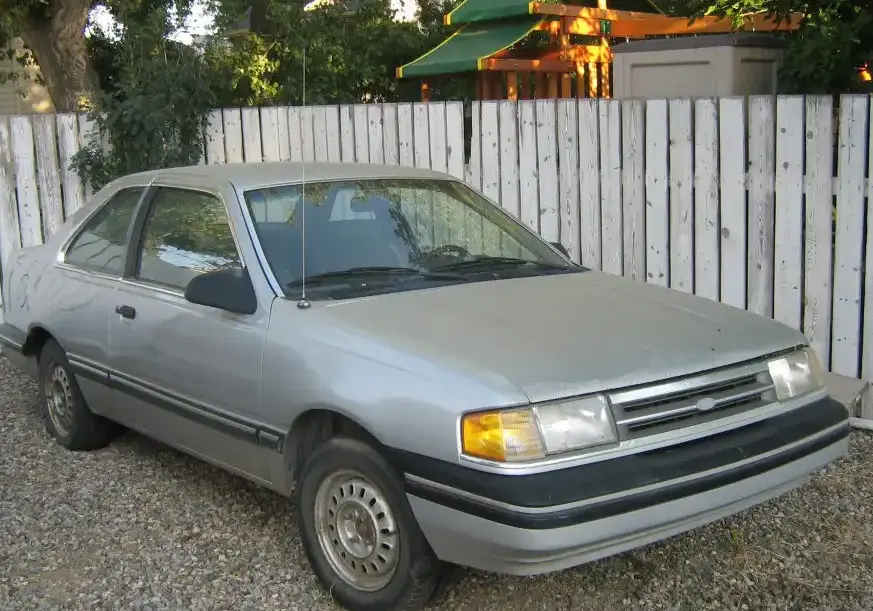
The Ford Tempo 2.3, producing 99 horsepower, was a mainstay of the Ford lineup from 1987 through 1995. Positioned as an entry-level to mid-range compact sedan, it represented Ford’s attempt to offer a fuel-efficient and affordable vehicle in a competitive market segment. The Tempo, and its sister car the Mercury Topaz, were built on the Ford FN10 platform, representing a shift towards more aerodynamic and lighter-weight designs compared to the Fox-bodied cars they partially replaced. This particular 2.3-liter variant served as a popular choice for buyers prioritizing economy and practicality over outright performance.
Technical Specifications
| Brand | Ford |
| Model | Tempo |
| Generation | Tempo |
| Type (Engine) | 2.3 (99 Hp) |
| Start of production | 1987 year |
| End of production | 1995 year |
| Powertrain Architecture | Internal Combustion engine |
| Body type | Sedan |
| Seats | 5 |
| Doors | 4 |
| Fuel consumption (urban) | 12 l/100 km (19.6 US mpg) |
| Fuel consumption (extra urban) | 7 l/100 km (33.6 US mpg) |
| Fuel Type | Petrol (Gasoline) |
| Maximum speed | 165 km/h (102.53 mph) |
| Weight-to-power ratio | 11.9 kg/Hp |
| Weight-to-torque ratio | 7 kg/Nm |
| Power | 99 Hp @ 4400 rpm |
| Power per litre | 42.9 Hp/l |
| Torque | 168 Nm @ 2200 rpm (123.91 lb.-ft. @ 2200 rpm) |
| Engine layout | Front, Transverse |
| Engine displacement | 2307 cm3 (140.78 cu. in.) |
| Number of cylinders | 4 |
| Engine configuration | Inline |
| Cylinder Bore | 93.5 mm (3.68 in.) |
| Piston Stroke | 84 mm (3.31 in.) |
| Compression ratio | 9.1:1 |
| Number of valves per cylinder | 2 |
| Fuel injection system | Multi-port manifold injection |
| Engine aspiration | Naturally aspirated engine |
| Valvetrain | OHC |
| Engine oil capacity | 4.7 l (4.97 US qt | 4.14 UK qt) |
| Coolant | 7.5 l (7.93 US qt | 6.6 UK qt) |
| Kerb Weight | 1175 kg (2590.43 lbs.) |
| Trunk (boot) space – minimum | 365 l (12.89 cu. ft.) |
| Fuel tank capacity | 60 l (15.85 US gal | 13.2 UK gal) |
| Length | 4490 mm (176.77 in.) |
| Width | 1735 mm (68.31 in.) |
| Height | 1340 mm (52.76 in.) |
| Wheelbase | 2540 mm (100 in.) |
| Front track | 1395 mm (54.92 in.) |
| Rear (Back) track | 1460 mm (57.48 in.) |
| Drivetrain Architecture | The Internal combustion engine (ICE) drives the front wheels of the vehicle. |
| Drive wheel | Front wheel drive |
| Number of gears and type of gearbox | 5 gears, manual transmission |
| Front suspension | Coil spring |
| Rear suspension | Coil spring |
| Front brakes | Ventilated discs |
| Rear brakes | Drum |
| Assisting systems | ABS (Anti-lock braking system) |
| Steering type | Steering rack and pinion |
| Power steering | Hydraulic Steering |
| Tires size | 185/70 R14 |
Powertrain & Engine Architecture
The heart of the Tempo 2.3 was the 2.3-liter inline-four cylinder engine, internally designated as the 2.3L HSC. This engine was a relatively simple design, featuring a single overhead camshaft (OHC) operating two valves per cylinder. Fuel delivery was handled by a multi-port fuel injection system, a significant upgrade from the carbureted engines found in earlier Ford models. The 2.3L HSC produced 99 horsepower at 4400 rpm and 168 Nm (123.91 lb-ft) of torque at 2200 rpm. The engine’s design prioritized fuel efficiency and durability over high-performance output. The standard transmission for this variant was a 5-speed manual, although a 3-speed automatic transmission was also offered, impacting performance and fuel economy.
Driving Characteristics
The Tempo 2.3 with the manual transmission offered adequate, though not exhilarating, performance. Acceleration was modest, with a 0-60 mph time estimated around 11-12 seconds. The 5-speed manual allowed drivers to keep the engine in its optimal power band, providing a more engaging driving experience. The automatic transmission, while offering convenience, noticeably reduced acceleration and increased fuel consumption. The Tempo’s suspension, consisting of coil springs all around, provided a comfortable ride, but handling was somewhat soft and lacked the precision of more performance-oriented vehicles. The front-wheel-drive layout contributed to predictable handling in most conditions.
Equipment & Trim Levels
The Tempo 2.3 typically came standard with basic amenities such as cloth upholstery, a simple dashboard layout, and manual windows and locks. Air conditioning was a popular option. Higher trim levels, such as the GLX, added features like upgraded interior trim, power windows and locks, and a better sound system. The Tempo was generally considered a no-frills vehicle, focusing on providing reliable transportation at an affordable price. Optional extras included a sunroof, cruise control, and upgraded audio systems.
Chassis & Braking
The Tempo’s chassis was a unibody construction, designed to minimize weight and maximize rigidity. The front suspension utilized coil springs and MacPherson struts, while the rear suspension employed a coil spring and trailing arm setup. Braking duties were handled by ventilated discs in the front and drum brakes in the rear. An anti-lock braking system (ABS) was available as an option, enhancing safety. The Tempo’s relatively light weight helped to compensate for the modest braking performance.
Market Reception & Comparison
The Ford Tempo 2.3 was generally well-received by consumers looking for an economical and reliable compact sedan. Critics praised its fuel efficiency and spacious interior, but noted its lack of refinement and performance. Compared to other trims in the Tempo lineup, such as the higher-output 2.5-liter engine, the 2.3-liter version offered better fuel economy but less power. It competed directly with other compact sedans like the Chevrolet Cavalier, Toyota Corolla, and Honda Civic. The Tempo often undercut its Japanese competitors in price, making it an attractive option for budget-conscious buyers.
Legacy
The Ford Tempo, while not a particularly groundbreaking vehicle, played an important role in Ford’s transition to more modern designs and manufacturing techniques. The 2.3-liter HSC engine proved to be a durable and reliable powerplant, and many examples remain on the road today. In the used car market, Tempos are known for their affordability and simplicity, making them popular choices for first-time car owners or those seeking a basic and dependable vehicle. While not highly sought after by collectors, well-maintained examples of the Tempo 2.3 represent a piece of automotive history from the late 1980s and early 1990s.