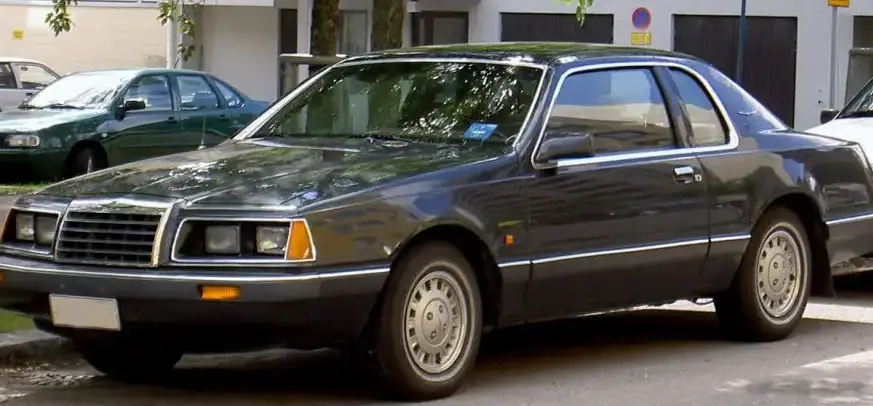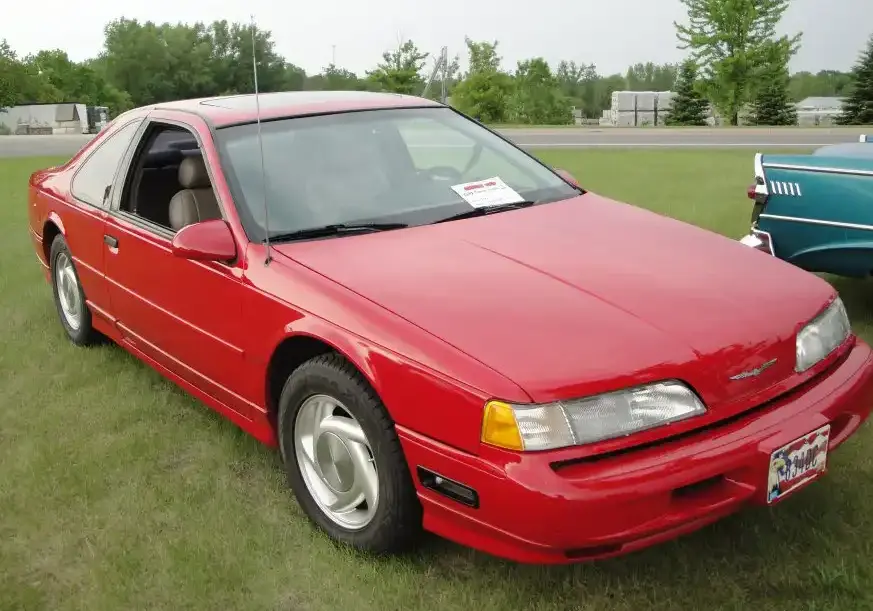
The Ford Thunderbird (Super Birds) 3.8L V6, producing 141 horsepower, represents a significant iteration of the tenth-generation Thunderbird, manufactured between 1988 and 1997. This model occupied a middle-ground position within the Super Birds lineup, offering a balance between affordability and acceptable performance. It was designed to appeal to buyers seeking a comfortable, stylish coupe without the higher price tag of the V8-powered models. The tenth-generation Thunderbird, built on the MN-12 platform, aimed to revive the classic Thunderbird nameplate with a more modern, aerodynamic design and a focus on comfort and convenience features.
Technical Specifications
| Brand | Ford |
| Model | Thunderbird |
| Generation | Thunderbird (Super Birds) |
| Type (Engine) | 3.8 i V6 (141 Hp) |
| Start of production | 1988 year |
| End of production | 1997 year |
| Powertrain Architecture | Internal Combustion engine |
| Body type | Coupe |
| Seats | 5 |
| Doors | 2 |
| Fuel consumption (economy) – combined | 12 l/100 km |
| Fuel consumption (economy) – combined | 19.6 US mpg |
| Fuel consumption (economy) – combined | 23.5 UK mpg |
| Fuel consumption (economy) – combined | 8.3 km/l |
| Fuel Type | Petrol (Gasoline) |
| Maximum speed | 180 km/h |
| Maximum speed | 111.85 mph |
| Weight-to-power ratio | 11.5 kg/Hp |
| Weight-to-power ratio | 87.1 Hp/tonne |
| Weight-to-torque ratio | 5.5 kg/Nm |
| Weight-to-torque ratio | 180.4 Nm/tonne |
| Power | 141 Hp @ 3800 rpm |
| Power per litre | 37.1 Hp/l |
| Torque | 292 Nm @ 2200 rpm |
| Torque | 215.37 lb.-ft. @ 2200 rpm |
| Engine layout | Front, Longitudinal |
| Engine displacement | 3797 cm3 |
| Engine displacement | 231.71 cu. in. |
| Number of cylinders | 6 |
| Engine configuration | V-engine |
| Cylinder Bore | 96.8 mm |
| Cylinder Bore | 3.81 in. |
| Piston Stroke | 86 mm |
| Piston Stroke | 3.39 in. |
| Compression ratio | 9:1 |
| Number of valves per cylinder | 2 |
| Fuel injection system | Multi-port manifold injection |
| Engine aspiration | Naturally aspirated engine |
| Kerb Weight | 1619 kg |
| Kerb Weight | 3569.28 lbs |
| Fuel tank capacity | 72 l |
| Fuel tank capacity | 19.02 US gal |
| Fuel tank capacity | 15.84 UK gal |
| Length | 5088 mm |
| Length | 200.31 in. |
| Width | 1847 mm |
| Width | 72.72 in. |
| Height | 1333 mm |
| Height | 52.48 in. |
| Wheelbase | 2870 mm |
| Wheelbase | 112.99 in. |
| Front track | 1560 mm |
| Front track | 61.42 in. |
| Rear (Back) track | 1530 mm |
| Rear (Back) track | 60.24 in. |
| Drivetrain Architecture | The Internal combustion engine (ICE) drives the rear wheels of the vehicle. |
| Drive wheel | Rear wheel drive |
| Number of gears and type of gearbox | 4 gears, automatic transmission |
| Front suspension | Spring Strut |
| Rear suspension | Coil spring |
| Front brakes | Disc |
| Rear brakes | Drum |
| Assisting systems | ABS (Anti-lock braking system) |
| Power steering | Hydraulic Steering |
| Tires size | 205/70 R15 H |
Powertrain & Engine Architecture
The heart of this Thunderbird variant is the Ford 3.8L (232 cubic inch) Essex V6 engine. This engine, designated with various codes throughout its production run, is a 60-degree V6 featuring a cast iron block and aluminum cylinder heads. The 141 horsepower output was achieved through a multi-port fuel injection system and a relatively conservative 9:1 compression ratio. The engine’s valvetrain utilizes two valves per cylinder, operated by a single overhead camshaft. The 3.8L V6 is known for its smoothness and relative reliability. Paired with this engine is a four-speed automatic transmission, providing a comfortable and convenient driving experience. This transmission was a common choice for the Thunderbird, prioritizing ease of use over outright performance. The transmission’s gear ratios were tuned for relaxed cruising and adequate acceleration, but it wasn’t designed for aggressive driving.
Driving Characteristics
The 141 hp 3.8L V6 automatic Thunderbird delivers a comfortable, but not particularly sporty, driving experience. Acceleration is adequate for everyday driving, with 0-60 mph times estimated around 10-11 seconds. The automatic transmission shifts smoothly, but can feel somewhat sluggish when downshifting. Compared to the 5.0L V8-powered Thunderbirds, this variant offers significantly less power and acceleration. However, it provides better fuel economy and a more relaxed driving experience. The rear-wheel-drive configuration provides a balanced feel, but the suspension is tuned for comfort rather than handling precision. The 205/70R15 tires offer a good compromise between ride comfort and grip.
Equipment & Trim Levels
The 3.8L V6 automatic Thunderbird typically came standard with features such as air conditioning, power windows and locks, a tilt steering wheel, and an AM/FM stereo. Upholstery was typically cloth, although leather was available as an option. Optional extras included a premium sound system, cruise control, and a sunroof. The interior design was generally functional and comfortable, with a focus on ease of use. The dashboard layout was straightforward, with clearly labeled controls. The trim level often dictated the level of interior appointments, with higher trims offering more luxurious materials and features.
Chassis & Braking
The Thunderbird’s chassis features a front independent suspension with coil springs and a rear coil-spring suspension. The front suspension utilizes a MacPherson strut design, while the rear suspension employs a solid axle. Braking duties are handled by disc brakes in the front and drum brakes in the rear. An anti-lock braking system (ABS) was available as an option, enhancing safety. The suspension tuning prioritizes ride comfort, resulting in a relatively soft and compliant ride. The drum brakes in the rear were a cost-saving measure, and offered less stopping power than disc brakes.
Market Reception & Comparison
The 3.8L V6 automatic Thunderbird was generally well-received by critics as a comfortable and affordable personal coupe. It was praised for its smooth ride, comfortable interior, and relatively good fuel economy. However, it was often criticized for its lack of power and somewhat uninspired handling. Compared to the V8-powered models, the 3.8L V6 offered a more economical option, but at the expense of performance. The 3.8L engine also proved to be more reliable than the V8, requiring less frequent and less expensive maintenance. Against competitors like the Chevrolet Monte Carlo and the Chrysler LeBaron, the Thunderbird offered a more stylish and refined package.
Legacy
The 3.8L V6-powered Thunderbird has developed a reputation for reliability and affordability in the used car market. The engine is known for its durability, and the automatic transmission is generally dependable. While not a performance icon, this variant remains a popular choice for those seeking a comfortable and stylish classic coupe. Parts availability is generally good, and maintenance costs are relatively low. Today, these Thunderbirds are often seen as a nostalgic reminder of the 1990s, offering a blend of style, comfort, and affordability.