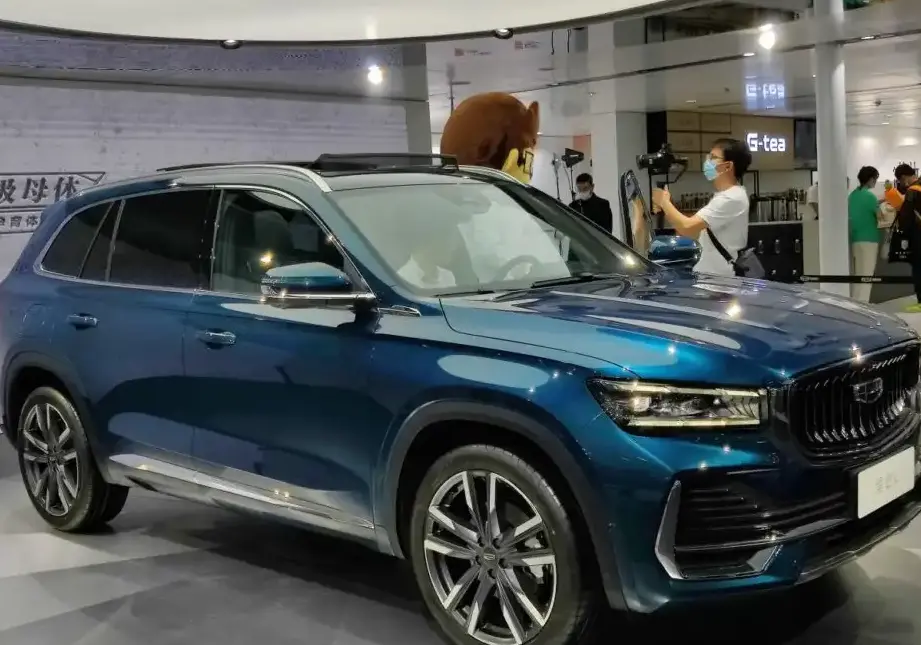
The Geely Xingyue L 2.0T (218 Hp) DCT is a compact SUV produced by the Chinese automaker Geely. Introduced in July 2021, it represents a significant step upmarket for the Geely brand, aiming to compete with established international players in the increasingly competitive Chinese SUV market. The Xingyue L is positioned as a premium offering within Geely’s lineup, emphasizing technology, comfort, and a more refined driving experience. It’s built on Geely’s CMA (Compact Modular Architecture) platform, shared with other models like the Lynk & Co 01, and is designed to appeal to buyers seeking a stylish and well-equipped SUV. This particular 2.0T DCT variant sits at the top of the Xingyue L range, offering the most powerful engine option and a dual-clutch transmission.
Technical Specifications
| Brand | Geely |
| Model | Xingyue L |
| Generation | Xingyue L |
| Type (Engine) | 2.0T (218 Hp) DCT |
| Start of production | July, 2021 |
| Powertrain Architecture | Internal Combustion engine |
| Body type | SUV |
| Seats | 5 |
| Doors | 5 |
| Fuel consumption (economy) – combined | 6.8 l/100 km (34.6 US mpg, 41.5 UK mpg, 14.7 km/l) |
| Fuel Type | Petrol (Gasoline) |
| Acceleration 0 – 100 km/h | 7.9 sec |
| Acceleration 0 – 62 mph | 7.9 sec |
| Acceleration 0 – 60 mph | 7.5 sec |
| Emission standard | China VIb |
| Weight-to-power ratio | 7.7 kg/Hp, 130.1 Hp/tonne |
| Weight-to-torque ratio | 5.2 kg/Nm, 194 Nm/tonne |
| Power | 218 Hp |
| Power per litre | 110.7 Hp/l |
| Torque | 325 Nm (239.71 lb.-ft.) |
| Engine layout | Front, Transverse |
| Engine Model/Code | JLH-4G20TDJ |
| Engine displacement | 1969 cm3 (120.16 cu. in.) |
| Number of cylinders | 4 |
| Engine configuration | Inline |
| Number of valves per cylinder | 4 |
| Fuel injection system | Direct injection |
| Engine aspiration | Turbocharger, Intercooler |
| Engine oil capacity | 5.6 l (5.92 US qt | 4.93 UK qt) |
| Kerb Weight | 1675 kg (3692.74 lbs.) |
| Trunk (boot) space – minimum | 562 l (19.85 cu. ft.) |
| Fuel tank capacity | 55 l (14.53 US gal | 12.1 UK gal) |
| Length | 4770 mm (187.8 in.) |
| Width | 1895 mm (74.61 in.) |
| Height | 1689 mm (66.5 in.) |
| Wheelbase | 2845 mm (112.01 in.) |
| Front track | 1610 mm (63.39 in.) |
| Rear (Back) track | 1610 mm (63.39 in.) |
| Drivetrain Architecture | The Internal combustion engine (ICE) drives the front wheels of the vehicle. |
| Drive wheel | Front wheel drive |
| Number of gears and type of gearbox | 7 gears, automatic transmission DCT |
| Front suspension | Independent, type McPherson with coil spring and anti-roll bar |
| Rear suspension | Independent multi-link spring suspension with stabilizer |
| Front brakes | Ventilated discs |
| Rear brakes | Disc |
| Assisting systems | ABS (Anti-lock braking system) |
| Steering type | Steering rack and pinion |
| Power steering | Electric Steering |
| Tires size | 235/55 R18; 235/50 R19; 245/45 R20 |
| Wheel rims size | 18; 19; 20 |
Powertrain & Engine Architecture
The heart of the Xingyue L 2.0T is Geely’s JLH-4G20TDJ 2.0-liter turbocharged inline-four cylinder engine. This engine utilizes direct fuel injection and a single turbocharger with an intercooler to produce 218 horsepower and 325 Nm (239.71 lb.-ft.) of torque. The engine is transversely mounted in the front of the vehicle. The dual-clutch transmission (DCT) is a 7-speed unit, offering quick and smooth gear changes. This DCT is crucial to the performance characteristics of the 2.0T, allowing for rapid acceleration and efficient power delivery. The engine also incorporates a Start & Stop system to improve fuel economy in city driving conditions.
Driving Characteristics
The Xingyue L 2.0T DCT delivers a noticeably more engaging driving experience compared to lower-spec models. The 218 hp engine provides ample power for both city driving and highway cruising, with a 0-60 mph time of around 7.5 seconds. The DCT contributes to responsive acceleration, and the gear ratios are well-tuned for both performance and fuel efficiency. While not a sports SUV, the 2.0T offers a confident and capable driving experience. The front-wheel-drive configuration provides predictable handling, and the suspension is tuned for a balance between comfort and control.
Equipment & Trim Levels
The 2.0T trim of the Xingyue L typically comes standard with a high level of equipment. This includes features like leather upholstery, a large touchscreen infotainment system with navigation, a panoramic sunroof, automatic climate control, and a suite of advanced driver-assistance systems (ADAS). Optional extras often include premium audio systems, ventilated front seats, and more sophisticated ADAS features. The interior design emphasizes a modern and luxurious aesthetic, with high-quality materials and a well-integrated dashboard layout.
Chassis & Braking
The Xingyue L utilizes an independent suspension setup at all four corners, with McPherson struts at the front and a multi-link system at the rear. This provides a comfortable ride quality while maintaining good handling characteristics. The braking system consists of ventilated discs at the front and solid discs at the rear, equipped with ABS (Anti-lock Braking System) as standard. The steering is electrically assisted, providing a light and precise feel.
Market Reception & Comparison
The Geely Xingyue L 2.0T DCT has been generally well-received in the Chinese market. Critics have praised its stylish design, spacious interior, and advanced technology. The 2.0T engine is considered a significant upgrade over the lower-powered options, offering a more satisfying driving experience. Compared to other SUVs in its class, the Xingyue L 2.0T offers a competitive level of equipment and performance for its price point. Fuel economy is respectable, averaging around 6.8 l/100 km (34.6 US mpg), but is comparable to other turbocharged SUVs in the segment.
Legacy
The Geely Xingyue L 2.0T DCT represents a pivotal model for Geely, demonstrating the brand’s ability to produce a genuinely competitive SUV that can challenge established international brands. While long-term reliability data is still emerging, the Geely brand has been steadily improving its quality and reliability in recent years. The JLH-4G20TDJ engine, in particular, has proven to be a robust and reliable unit. As the Xingyue L continues to gain popularity in the Chinese market, it is likely to become a common sight on the roads, and its powertrain will be evaluated for its long-term durability and maintenance costs.