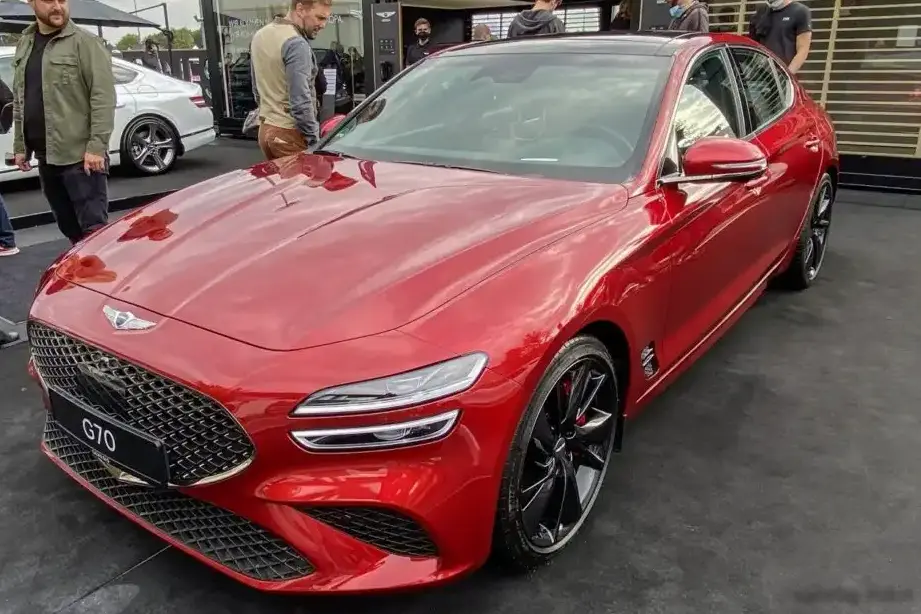
The Genesis G70, particularly the facelifted version introduced in November 2021, represents a significant entry into the luxury sport sedan segment. This variant, equipped with the 2.0 T-GDi engine producing 245 horsepower and paired with an eight-speed automatic transmission and all-wheel drive (AWD), occupies a middle ground within the G70 lineup, offering a balance between performance, efficiency, and features. Positioned above the base 2.5L engine option and below the more potent 3.3L twin-turbo V6, the 2.0T AWD model aimed to attract buyers seeking a refined driving experience without the higher price tag of the flagship trim.
Technical Specifications
| Brand | Genesis |
| Model | G70 |
| Generation | G70 (facelift 2020) |
| Type (Engine) | 2.0 T-GDi (245 Hp) AWD Automatic |
| Start of production | November, 2021 |
| Powertrain Architecture | Internal Combustion engine |
| Body type | Sedan |
| Seats | 5 |
| Doors | 4 |
| Fuel consumption at Low speed (WLTP) | 14.3-14.8 l/100 km (16.4 – 15.9 US mpg, 19.8 – 19.1 UK mpg, 7 – 6.8 km/l) |
| Fuel consumption at Medium speed (WLTP) | 8.9-9.4 l/100 km (26.4 – 25 US mpg, 31.7 – 30.1 UK mpg, 11.2 – 10.6 km/l) |
| Fuel consumption at high speed (WLTP) | 7.6-8 l/100 km (30.9 – 29.4 US mpg, 37.2 – 35.3 UK mpg, 13.2 – 12.5 km/l) |
| Fuel consumption at very high speed (WLTP) | 8.4-8.9 l/100 km (28 – 26.4 US mpg, 33.6 – 31.7 UK mpg, 11.9 – 11.2 km/l) |
| Combined fuel consumption (WLTP) | 9-9.5 l/100 km (26.1 – 24.8 US mpg, 31.4 – 29.7 UK mpg, 11.1 – 10.5 km/l) |
| CO2 emissions (WLTP) | 206-217 g/km |
| Fuel Type | Petrol (Gasoline) |
| Acceleration 0 – 100 km/h | 6.6 sec |
| Acceleration 0 – 62 mph | 6.6 sec |
| Acceleration 0 – 60 mph | 6.3 sec |
| Maximum speed | 240 km/h (149.13 mph) |
| Emission standard | Euro 6d |
| Weight-to-power ratio | 7.1 kg/Hp, 140.8 Hp/tonne |
| Weight-to-torque ratio | 4.9 kg/Nm, 202.9 Nm/tonne |
| Power | 245 Hp @ 6200 rpm |
| Power per litre | 122.6 Hp/l |
| Torque | 353 Nm @ 3500 rpm (260.36 lb.-ft. @ 3500 rpm) |
| Engine layout | Front, Longitudinal |
| Engine Model/Code | Theta II / G4KL |
| Engine displacement | 1998 cm3 (121.93 cu. in.) |
| Number of cylinders | 4 |
| Engine configuration | Inline |
| Cylinder Bore | 86 mm (3.39 in.) |
| Piston Stroke | 86 mm (3.39 in.) |
| Compression ratio | 10:1 |
| Number of valves per cylinder | 4 |
| Fuel injection system | Direct injection |
| Engine aspiration | Turbocharger, Intercooler |
| Engine oil capacity | 5.7 l (6.02 US qt | 5.02 UK qt) |
| Coolant | 7.27 l (7.68 US qt | 6.4 UK qt) |
| Kerb Weight | 1740 kg (3836.04 lbs.) |
| Max. weight | 2200 kg (4850.17 lbs.) |
| Max load | 460 kg (1014.13 lbs.) |
| Trunk (boot) space – minimum | 330 l (11.65 cu. ft.) |
| Fuel tank capacity | 60 l (15.85 US gal | 13.2 UK gal) |
| Permitted trailer load with brakes (12%) | 1500 kg (3306.93 lbs.) |
| Permitted trailer load without brakes | 750 kg (1653.47 lbs.) |
| Length | 4685 mm (184.45 in.) |
| Width | 1850 mm (72.83 in.) |
| Height | 1400 mm (55.12 in.) |
| Wheelbase | 2835 mm (111.61 in.) |
| Front track | 1592 mm (62.68 in.) |
| Rear (Back) track | 1596 mm (62.83 in.) |
| Front overhang | 805 mm (31.69 in.) |
| Rear overhang | 1045 mm (41.14 in.) |
| Ride height (ground clearance) | 130 mm (5.12 in.) |
| Drag coefficient (Cd) | 0.28 |
| Minimum turning circle (turning diameter) | 11 m (36.09 ft.) |
| Drivetrain Architecture | The Internal combustion engine (ICE) drives the rear wheels permanently, and the front wheels are driven through an electrically or mechanically operated clutch if necessary. |
| Drive wheel | All wheel drive (4×4) |
| Number of gears and type of gearbox | 8 gears, automatic transmission |
| Front suspension | Independent type McPherson |
| Rear suspension | Independent multi-link suspension |
| Front brakes | Ventilated discs, 345-350 mm |
| Rear brakes | Ventilated discs, 330-340 mm |
| Assisting systems | ABS (Anti-lock braking system) |
| Steering type | Steering rack and pinion |
| Power steering | Electric Steering |
| Tires size | Front wheel tires: 225/45 R18; 225/40 ZR19Rear wheel tires: 225/45 R18; 255/35 ZR19 |
| Wheel rims size | Front wheel rims: 8.0J x 18; 8.0J x 19Rear wheel rims: 8.0J x 18; 8.5J x 19 |
INTRODUCTION
The Genesis G70, launched as the brand’s first dedicated sport sedan, quickly gained recognition for its dynamic handling and luxurious appointments. The 2020 facelift brought a refreshed exterior design, an upgraded interior, and enhanced technology features. The 2.0 T-GDi AWD Automatic variant, introduced with this update, aimed to broaden the G70’s appeal by offering a compelling combination of performance and practicality. Built on the rear-wheel-drive-based platform (shared with the Kia Stinger), the G70 sought to challenge established players in the compact luxury segment, such as the BMW 3 Series and Mercedes-Benz C-Class.
Powertrain & Engine Architecture
At the heart of the G70 2.0T AWD lies the Hyundai-Kia Theta II engine, specifically the G4KL code. This 1.998-liter inline-four cylinder engine utilizes direct injection and is coupled with a twin-scroll turbocharger and intercooler. This configuration allows for a responsive power delivery and minimizes turbo lag. The engine produces 245 horsepower at 6,200 rpm and 260 lb-ft of torque at 3,500 rpm. The eight-speed automatic transmission, sourced from ZF, is a key component of this powertrain. It offers smooth and quick shifts, contributing to the car’s overall driving experience. The AWD system employs a multi-plate clutch to distribute power between the front and rear axles, enhancing traction and stability in various driving conditions. The engine also features a start/stop system to improve fuel efficiency.
Driving Characteristics
The G70 2.0T AWD delivers a refined and engaging driving experience. While not as overtly sporty as the 3.3T model, the 2.0T provides ample power for everyday driving and confident highway passing. The eight-speed automatic transmission is well-tuned, offering seamless gear changes and responsive kickdowns. The AWD system provides excellent grip, particularly in inclement weather. The steering is precise and well-weighted, offering good feedback to the driver. Compared to the manual transmission versions, the automatic prioritizes comfort and ease of use. While the manual offers a more direct connection to the driving experience, the automatic’s smooth operation and convenience make it a popular choice for many buyers. The gear ratios are optimized for both acceleration and fuel efficiency, providing a good balance between performance and economy.
Equipment & Trim Levels
The 2.0T AWD trim typically included a generous array of standard features. These often included leather upholstery, heated front seats, a 10.25-inch touchscreen infotainment system with Apple CarPlay and Android Auto compatibility, a premium sound system, and a suite of advanced driver-assistance systems (ADAS) such as forward collision avoidance assist, lane keeping assist, and adaptive cruise control. Optional extras could include a panoramic sunroof, ventilated front seats, a heads-up display, and premium leather options. Interior trim levels varied, with options for aluminum or wood accents. The dashboard layout is driver-focused, with intuitive controls and a clean design.
Chassis & Braking
The G70’s chassis is designed to provide a balance between comfort and handling. The front suspension utilizes a McPherson strut design, while the rear features a multi-link setup. This configuration allows for precise wheel control and minimizes body roll. The 2.0T AWD models typically came equipped with ventilated disc brakes on all four wheels, providing ample stopping power. The front brakes measure 345-350mm, while the rear brakes are 330-340mm. ABS (Anti-lock Braking System) is standard, along with other electronic stability control systems. The electric power steering system provides precise and responsive steering feel.
Market Reception & Comparison
The Genesis G70 2.0T AWD was generally well-received by automotive critics. It was praised for its stylish design, comfortable interior, and engaging driving dynamics. However, some reviewers noted that the 2.0T engine, while capable, lacked the outright performance of the 3.3T V6. Fuel economy was considered competitive for the segment, with combined ratings around 26 mpg. Compared to the 3.3T, the 2.0T offered a more affordable entry point into the G70 lineup, making it attractive to a wider range of buyers. Reliability reports have been generally positive, with few major issues reported.
Legacy
The Genesis G70 2.0T AWD has established itself as a solid contender in the luxury sport sedan market. The Theta II engine, while not without its share of minor issues across the Hyundai-Kia lineup, has proven to be generally reliable when properly maintained. On the used car market, these models offer a compelling value proposition, providing a luxurious and well-equipped driving experience at a competitive price point. The G70’s success has helped to solidify Genesis as a legitimate luxury brand, challenging the established German automakers.